
Mechanical Strength and Durability of Rice Husk Ash–Corn Cob Ash Ternary Blended Concrete under Elevated Temperatures
DOI:
https://doi.org/10.33003/fjs-2026-1024-6314Keywords:
Rice Husk Ash, Corn Cob Ash, Ternary Concrete, Elevated Temperature, DurabilityAbstract
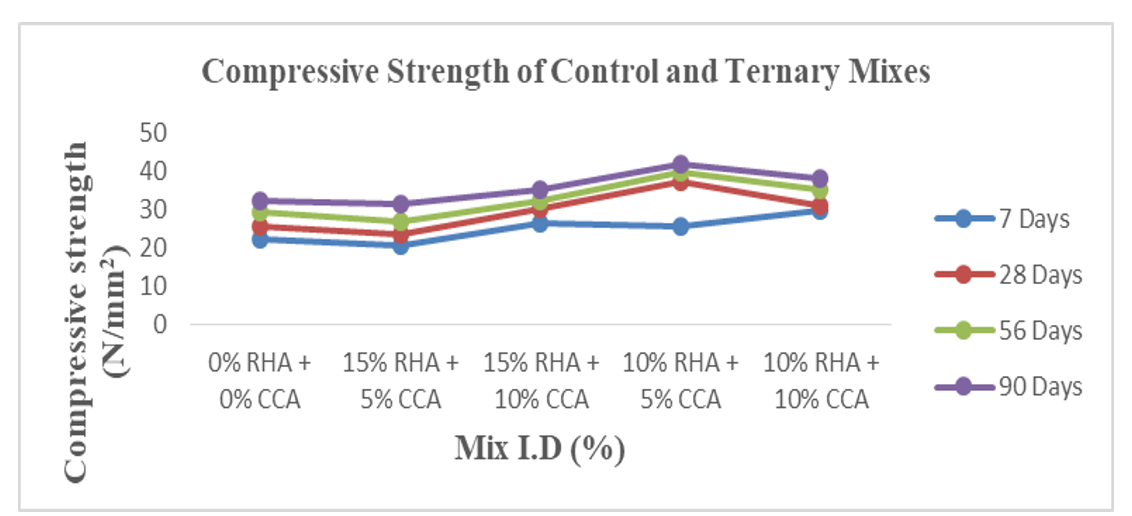
The utilisation of agricultural waste ashes as supplementary cementitious materials offers opportunities to reduce cement consumption and improve resource efficiency in concrete production. This study investigated the mechanical strength and durability characteristics of ternary blended concrete incorporating rice husk ash (RHA) and corn cob ash (CCA) as partial replacements for Portland limestone cement. Nine concrete mixtures comprising one control, four binary blends, and four ternary blends were initially investigated. Compressive, splitting tensile and flexural strengths were evaluated at curing ages of 7, 28, 56 and 90 days. The mixture containing 10% RHA and 5% CCA exhibited the highest reported later-age strength among the investigated ternary mixtures, attaining compressive, splitting tensile and flexural strengths of 41.50, 2.94 and 3.90 N/mm², respectively, at 90 days. This mixture was subsequently subjected to temperatures of 200, 400, 600 and 800 °C, followed by residual compressive strength and durability assessments. Residual compressive strength decreased with increasing temperature, reaching 7.50 N/mm² at 800 °C after 90 days of curing. Water absorption, acid resistance and abrasion performance were also evaluated. The findings indicate that a 15% combined replacement of cement with RHA and CCA can produce favourable mechanical strength under the investigated curing conditions. However, severe thermal exposure substantially reduced residual strength and durability performance. The findings support the selection of sustainable cementitious binders for construction applications where resistance to heating, post-exposure durability, structural safety, and long-term reliability are important considerations.
References
Abdelmelek, N., Alimrani, N. S., Krelias, N., & Lubloy, E. (2026). Effect of elevated temperatures on microstructure of high strength concrete based-metakaolin. Journal of King Saud University – Engineering Sciences, 38, Article 25. https://doi.org/10.1007/s44444-025-00060-4
Anderson, S., & Adesina, A. (2026). Synergistic effects of high-volume cement replacement in binary, ternary, and quaternary binder systems. Journal of Sustainable Cement-Based Materials, 15(7), 2540–2567. https://doi.org/10.1080/21650373.2026.2649533
Ankit, Tiwary, A. K., & Hasrat, H. A. (2026). Influence of zirconia and rice husk ash on residual characteristics of sustainable cement mortar after exposure to elevated temperatures. Discover Materials, 6, Article 14. https://doi.org/10.1007/s43939-025-00481-7
ASTM International. (2026). Standard test methods for chemical resistance of mortars grouts, and monolithic surfacings and polymer concretes (ASTM C267-20(2026)).
ASTM International. (2019). Standard test method for abrasion resistance of horizontal concrete surfaces (ASTM C779/C779M-19).
Balagopal, V., & Sambamurthy, V. (2020). Performance evaluation of coir pith ash blended cement concrete exposed to elevated temperature. Jurnal Teknologi, 82(2). https://doi.org/10.11113/jt.v82.13851
Barbhuiya, S., Das, B. B., Adak, D., Rajput, A., & Katare, V. (2025). Rice husk ash in structural concrete: Influence on strength, durability and sustainability. Discover Concrete and Cement, 1, Article 14. https://doi.org/10.1007/s44416-025-00013-9
Biswas, D., Mondal, A., Shiuly, A., Mondal, A., Sau, D., Acharya, S., Modak, R., Kumar, V., Hembram, S., Gupta, B., Das, S. K., & Roy, S. (2026). A review on agricultural waste ashes as sustainable supplementary cementitious materials for concrete applications. Discover Concrete and Cement, 2, Article 25. https://doi.org/10.1007/s44416-026-00064-6
British Standards Institution. (2019a). Testing hardened concrete—Part 3: Compressive strength of test specimens (BS EN 12390-3:2019).
British Standards Institution. (2019b). Testing hardened concrete—Part 5: Flexural strength of test specimens (BS EN 12390-5:2019).
British Standards Institution. (2023). Testing hardened concrete—Part 6: Tensile splitting strength of test specimens (BS EN 12390-6:2023). BS 1881-122:2011+A1:2020: Testing concrete—Part 122: Method for determination of water absorption
Cherkos, F. D. (2025). Experimental study on the mechanical, durability, and microstructural properties of concrete with partial cement replacement with coffee husk ash and rice husk ash. Advances in Materials Science and Engineering, 2025, Article 9592140. https://doi.org/10.1155/amse/9592140
Gora, A. M., Shettima, A. M., Haruna, S. I., Rafindadi, A. D., & Ibrahim, Y. E. (2026). Synergistic effects of bagasse ash and rice husk ash on the fresh and mechanical properties of ternary blended concrete: An optimization approach using response surface methodology. Eng, 7(7), Article 355. https://doi.org/10.3390/eng7070355
Hu, Y., Duan, F., Zheng, M., Dong, Y., Zhu, Y., Cai, Y., & Zhu, D. (2025). Deterioration and damage mechanisms of concrete under high-temperature and sulfate-rich environments. Journal of Building Engineering, 114, Article 114221.
Jing, Y., Lee, J. C., Moon, W. C., Jin, Y., Ng, J. L., & Yew, M. K. (2025). Ternary and quaternary sustainable cementitious composites containing rice husk ash: A comprehensive review. Discover Applied Sciences, 7, Article 174. https://doi.org/10.1007/s42452-025-06599-w
Li, S. (2025). Impact of rice husk ash properties on concrete strength: Experimental and machine learning study. Advances in Civil Engineering, Article 1812998. https://doi.org/10.1155/adce/1812998
Montazeri, P., Bamshad, O., Aghililotf, M., & Singh, P. (2025). Mechanical and durability-based life cycle assessment of rice husk ash containing concrete. Case Studies in Construction Materials, 23, Article e05241. https://doi.org/10.1016/j.cscm.2025.e05241
Nadgouda, P. A., Kumar, D. R., Sharma, A. K., & Wipulanusat, W. (2025). Optimizing compressive strength prediction of sustainable concrete using ternary-blended agro-waste ash, sugarcane bagasse ash, and rice husk ash with soft computing techniques. Structural Concrete, 26(6), 7608–7636. https://doi.org/10.1002/suco.202401562
Nazari, A. & Toufigh, V. (2024). Effects of elevated temperatures and re-curing on concrete containing rice husk ash. Construction and Building Materials, Article: 137277. Volume 439
Rochmah, N., Antariksa, Wisnumurti, & Semedi, B. (2026). Influence of agricultural waste as a partial substitute for cement in flowing concrete. Nature, Environment and Pollution Technology, 25(3).
Su, D., Han, C., Xie, L., Zhou, C., & Deng, F. (2025). Experimental study on pore structure and dynamic mechanical properties of different types of fiber reinforced concrete after elevated temperature action. Scientific Reports, 15, Article 34005. https://doi.org/10.1038/s41598-025-13409-1
Terlumun, S., Adamu, A. K., Jessey, B., Babadoko, M. A., Aderigbigbe, I., Oladimeji, I., Hassan, A., & Brown, D. I. F. (2025). Investigating the tensile strength of concrete incorporating rice husk ash. International Journal of Environmental Design and Construction Management, 9(4). https://doi.org/10.70382/hijedcm.v09i4.040
Ullah, M. F., Tang, H., Ullah, A., Ahmad, S., Alzlfaawi, A., Ahmad, M., & Toth, Z. (2026). Modeling and optimization of sustainable ternary concrete incorporating rice husk ash and extracted micro silica. Scientific Reports, 16, Article 5063. https://doi.org/10.1038/s41598-026-35983-8
Williams, C. E., Amartey, Y. D., Adamu, L., Amartey, B. S., Ejembi, R. O., & Joseph, K. Z. (2026). Physico-chemical characterization of the constituent materials for sustainable concrete: Incorporating rice husk ash and corn cob ash as partial cement replacements. FUDMA Journal of Sciences, 10(20), 345–352. https://doi.org/10.33003/fjs-2026-1020-5385
Wu, J., Wang, Y., Zhang, S., Wang, P., Gao, C., Yang, Z., Chang, T., & Niu, D. (2026). Performance degradation mechanism of UHPC under combined thermal and sulfate exposure: A study of one-dimensional erosion in harsh environments. Construction and Building Materials, 510, Article 144642. https://doi.org/10.1016/j.conbuildmat.2025.144642
Zhang, S., Wang, Y., Li, Z., & Guo, B. (2025). Mechanism of concrete durability deterioration under the unidirectional coupling effect of temperature field and sulfate attack. Construction and Building Materials, 494, Article 143372. https://doi.org/10.1016/j.conbuildmat.2025.143372
Downloads
Published
Issue
Section
Categories
License
Copyright (c) 2026 Williams Chris Ejembi, Yusuf Dada Amartey, Adamu Lawan, Bilkisu Hassan Amartey, Joseph Kevin Zambwa, Raphael Owoicho Ejembi, Mohammed Aminu Sambo

This work is licensed under a Creative Commons Attribution 4.0 International License.


