
Design, Fabrication and Thermal Performance Evaluation of a Parabolic Solar Cooker in Sokoto City, Nigeria
DOI:
https://doi.org/10.33003/fjs-2026-1024-6317Keywords:
Clean energy, Solar Thermal System, Parabolic Cooker, Sustainability, Sokoto cityAbstract
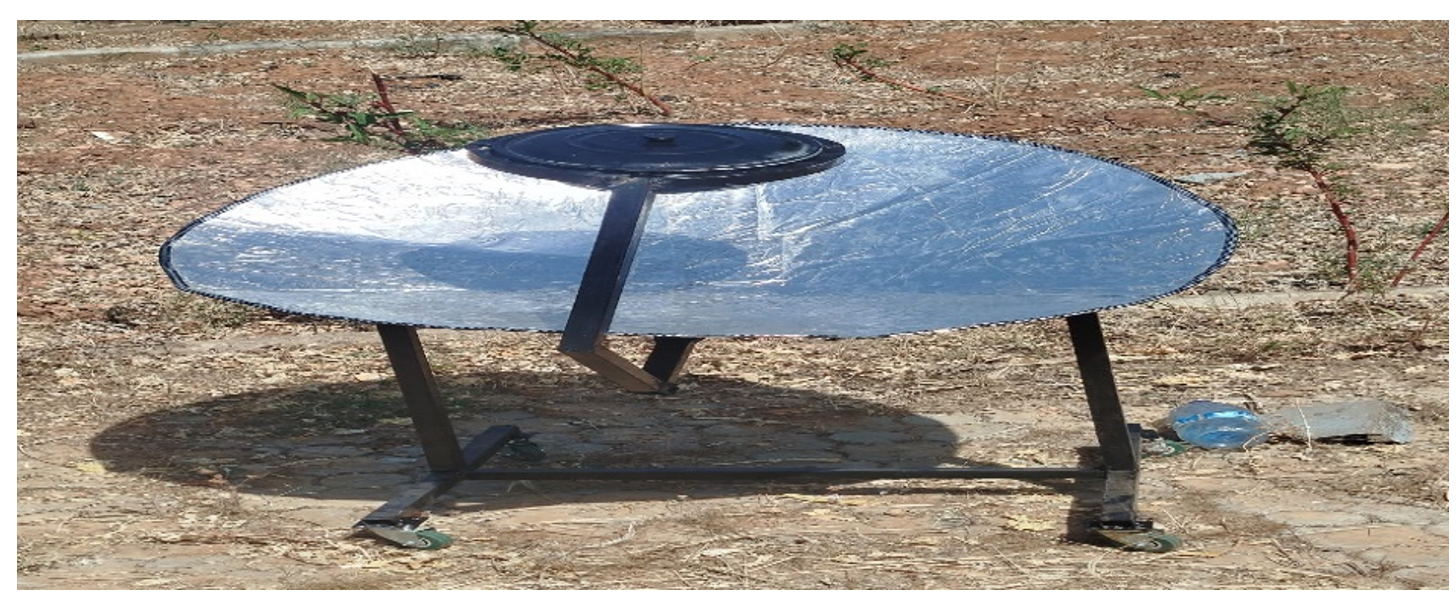
This study investigated the design, fabrication and thermal performance of a parabolic solar cooker constructed using locally available materials for application in Sokoto city, Nigeria. The cooker incorporated a parabolic reflector and receiving vessel mounted on a supporting frame at a fixed southward tilt angle of 13°. The fabricated concentrator had an aperture diameter of 77 cm, an estimated focal length of 0.309 m and a geometric concentration ratio of 4.15. Thermal performance was assessed through a water-heating experiment involving 1.0 L of water as well as statistical correlation tests using Analysis of Variance (ANOVA). The water temperature increased from 29.3 °C to 81.4 °C over 150 minutes, corresponding to a calculated useful energy gain of approximately 2.18 × 10⁵ J and average useful thermal power of 24.2 W. A thermal efficiency of approximately 22.7% was estimated using an assumed average solar irradiance of 229.17 W/m² because irradiance was not measured during the experiment. The correlation tests showed statistical significant evidence for a strong relationship amongst the dual-based thermal performance parameters considered at the considered confidence level. The findings demonstrate that the fabricated cooker was capable of heating water under the investigated outdoor conditions. However, the absence of measured solar irradiance, repeated experimental trials and uncertainty analysis limits the reliability of the estimated thermal efficiency. Further evaluation under measured solar conditions and standardised solar-cooker testing procedures is recommended to establish reproducible performance characteristics.
References
Aririguzo, J. C. (2023). Design and Performance Evaluation of a Parabolic Solar Cooker for Rural Communities in Eastern Nigeria. Nigerian Agricultural Journal, 54(2), 9. Retrieved from http://www.ajol.info/index.php/naj
Bhanzu. (2026). Frustum - Definition, Volume and Surface Area. Retrieved October 2026, from Bhanzu: https://bhanzu.com/math/geometry/frustum
Fedkin, M. (n.d). Utility Solar Electric and Concentration - Concentration Fundamentals. (Pennsylvania State University) Retrieved October 2026, from PennState College of Earth and Mineral Sciences: https://courses.ems.psu.edu/eme812/node/8
Harmim, A., Merzouk, M., Boukar, M., & Amar, M. (2012). Mathematical modeling of a box-type solar cooker employing an asymmetric compound parabolic concentrator. Solar Energy, 86, 10. https://doi.org/10.1016/j.solener.2012.03.020
Idris, O. W., Ibrahim, Z. M., & Albani, A. (2024). Prospects of Solar Energy Exploitation in Nigeria: Assessments, Economic Viability and Hybrid System. International Journal of Energy Economics and Policy (IJEEP), 14(2), 11. https://doi.org/10.32479/ijeep.14977
Jibrin, I., Garba, M. M., Arugungu, G. M., Mohammed, M. L., & Usman, A. (2023). CONSTRUCTION AND PERFORMANCE EVALUATION OF AN INTEGRATED SOLAR COOKING AND DRYING SYSTEM AND DRYING SYSTEM. FUDMA Journal of Sciences, 7(6), 9. https://doi.org/10.33003/fjs-2023-0706-2113
Jumare, I. A. (2019). Design of Standalone Photovoltaics (PV) / Biogas Hybrid Power System with Hydrogen Storage: Case of Northern Nigeria. International Journal of Engineering Research & Technology (IJERT), 08(10), 11. https://doi.org/10.17577/IJERTV8IS100199
Jumare, I. A., Bhandari, R., & Zerga, A. (2024). Standalone and Grid-connected Renewable Power System Design in Africa: A Critical Review. Journal of Renewable Energy and Environment (JREE), 11(04), 17. https://doi.org/10.30501/jree.2024.445482.1854
Kumar, S., Singh, K. R., & Jhamb, S. (2022). Parabolic Solar Cooker: Design, Construction and Testing. International Research Journal of Engineering and Technology (IRJET), 9(6), 3.
Laboratory for Atmospheric and Space Physics. (n.d). TIM-Science. (U. o. Boulder, Producer) Retrieved October 2026, from TSIS-1 Total and Spectral Solar Irradiance Sensor: https://lasp.colorado.edu/tsis/instruments/tim-total-irradiance-monitor/tim-science/
Muhammad, M., Jumare, I. A., & Sambo, A. S. (2025). Expanding Electricity Supply in Nigeria: A Holistic Low Carbon Approach. Journal of Sustainable Energy, 16(1), 13.
Otte, P. P. (2009). Cooking with the sun - An analysis of Solar Cooking in Tanzania, its adoption and impact on development. Trondheim: Norwegian University of Science and Technology.
Sani, M., Danmalam, I. M., Yusuf, Z., Yusuf, T., & Sule, A. (2024). Performance Evaluation of a Building Integrated Solar Cooker with Asymmetric Compound Parabolic Concentrator for Indoor Cooking Application. INTERNATIONAL JOURNAL OF SCIENCE FOR GLOBAL SUSTAINABILITY, 9. https://doi.org/10.57233/ijsgs.v10i3.707
SmartConversion. (2026). Surface Area of a Paraboloid Calculation. Retrieved October 2026, from Smart Conversion -Conversion Booster: www.smartconversion.com
Soe, N. N., Win, A. K., & Thida Amin, N. K. (2019). Design and Construction of Solar Box Cooker System. Iconic Research and Engineering (IRE) Journals, 3(1), 7.
Solar Cookers International. (2004). SOLAR COOKERS - How to make, use and enjoy. California, USA: Solar Cookers International.
Terres, H., Lizardi, A., Lopez, R., Vaca, M., & Chavez, S. (2014). Mathematical Model to Study Solar Cookers Box-Type with Internal Reflectors. 2013 ISES Solar World Congress (Eneergy Procedia). 57, p. 10. Elsevier. https://doi.org/10.1016/j.egypro.2014.10.150
Water Science School. (2026). Specific Heat Capacity and Water. Retrieved October 2026, from USGS Science for a Changing World: https://www.usgs.gov/water-science-school/science/specific-heat-capacity-and-water
WGBHE ducational Foundation. (2007). Student Hand Book: Finding the Focal Point of a Parabola. NOVA.
Zheng, H. (2017). Solar Energy Utilization and its Collection Devices. In H. Zheng, Solar Energy Desalination Technology. Elsevier.
Downloads
Published
Issue
Section
Categories
License
Copyright (c) 2026 Ismail Abubakar Jumare, Muhammed Babatunde

This work is licensed under a Creative Commons Attribution 4.0 International License.


