
Mathematical Analysis and Analytical Characterization of Mass-Ratio-Dependent Gravitational Recoil and Remnant Diagnostics in Binary Black-Hole Mergers
DOI:
https://doi.org/10.33003/fjs-2026-1022-6322Keywords:
Binary Black Holes, Numerical Relativity, Gravitational Recoil, Gravitational-Wave Multipoles, Symmetric Mass Ratio, Waveform DiagnosticsAbstract
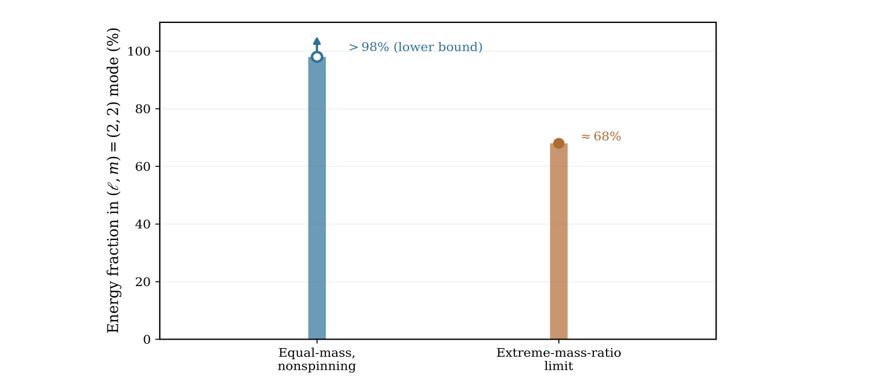
This study presents a unified mathematical assessment of binary black-hole dynamics, gravitational-wave diagnostics, and recoil predictions within the vacuum Einstein framework. The formulation connects the 3+1 initial-value decomposition, conformal and generalized harmonic evolution variables, horizon diagnostics, Newman–Penrose waveform extraction, and detector-weighted waveform comparison. Quantitative evaluation combines previously reported remnant and radiation measurements with deterministic calculations from a nonspinning phenomenological recoil relation. The equal-mass nonspinning benchmark gives a remnant mass fraction of 0.95162 ± 0.00002 and dimensionless spin of 0.68646 ± 0.00004. The adopted recoil fit reaches approximately 175.2 km s⁻¹ near mass ratio q ≈ 0.36 and vanishes at equal masses, consistently with exchange symmetry. Published dominant quadrupolar energy fractions exceed 98% for equal-mass nonspinning coalescence and are approximately 68% in the extreme-mass-ratio regime. Analytical differentiation and limiting expansions characterize the fitted recoil response. The assessment establishes a consistent interpretation of heterogeneous benchmark quantities while distinguishing analytical model evaluation from independent numerical-relativity simulation. No new spacetime evolutions, detector reconstructions, or waveform-convergence measurements are claimed.
References
Abbott, B. P., et al. (2016). Tests of general relativity with GW150914. Physical Review Letters, 116(22), 221101. https://doi.org/10.1103/PhysRevLett.116.221101
10. Grandclément, P., & Novák, J. (2009). Spectral methods for numerical relativity. Living Reviews in Relativity, 12, 1. https://doi.org/10.12942/lrr-2009-1
11. Healy, J., & Loustó, C. O. (2017). Remnant of binary black-hole mergers: New simulations and peak luminosity studies. Physical Review D, 95(2), 024037. https://doi.org/10.1103/PhysRevD.95.024037
12. Healy, J., Loustó, C. O., Lange, J., O’Shaughnessy, R., Zlochower, Y., & Campanelli, M. (2019). Second RIT binary black hole simulations catalog and its application to gravitational waves parameter estimation. Physical Review D, 100(2), 024021. https://doi.org/10.1103/PhysRevD.100.024021
13. Islam, T., Field, S. E., Haster, C.-J., & Smith, R. J. E. (2021). Improved analysis of GW190412 with a precessing numerical relativity surrogate waveform model. Physical Review D, 103(10), 104027. https://doi.org/10.1103/PhysRevD.103.104027
14. Kolitsidou, P., Thompson, J. E., & Hannam, M. (2024). Impact of anti-symmetric contributions to signal multipoles in the measurement of black-hole spins. arXiv preprint. https://doi.org/10.48550/arXiv.2402.00813
15. Loustó, C. O., & Healy, J. (2020). Exploring the small mass ratio binary black hole merger via Zeno’s dichotomy approach. Physical Review Letters, 125(19), 191102. https://doi.org/10.1103/PhysRevLett.125.191102
16. Mills, J. C., & Fairhurst, S. (2021). Measuring gravitational-wave higher-order multipoles. Physical Review D, 103(2), 024042. https://doi.org/10.1103/PhysRevD.103.024042
17. Pratten, G., Husa, S., García-Quirós, C., Colleoni, M., Ramos-Buades, A., Estellés, H., & Jaume, R. (2020). Setting the cornerstone for a family of models for gravitational waves from compact binaries: The dominant harmonic for nonprecessing quasicircular black holes. Physical Review D, 102(6), 064001. https://doi.org/10.1103/PhysRevD.102.064001
18. Radia, M., Sperhake, U., Berti, E., & Croft, R. (2021). Anomalies in the gravitational recoil of eccentric black-hole mergers with unequal mass ratios. Physical Review D, 103(10), 104006. https://doi.org/10.1103/PhysRevD.103.104006
19. Reisswig, C., Bishop, N. T., Pollney, D., & Szilágyi, B. (2010). Characteristic extraction in numerical relativity: Binary black hole merger waveforms at null infinity. Classical and Quantum Gravity, 27(7), 075014. https://doi.org/10.1088/0264-9381/27/7/075014
Abbott, R., et al. (2023). Population of merging compact binaries inferred using gravitational waves through GWTC-3. Physical Review X, 13(1), 011048. https://doi.org/10.1103/PhysRevX.13.011048
20. Ruiz, M., Alcubierre, M., Núñez, D., & Takahashi, R. (2007). Multiple expansions for energy and momenta carried by gravitational waves. General Relativity and Gravitation, 40(8), 1705–1729. https://doi.org/10.1007/s10714-007-0570-8
21. Sathyaprakash, B. S., & Schutz, B. F. (2009). Physics, astrophysics and cosmology with gravitational waves. Living Reviews in Relativity, 12, 2. https://doi.org/10.12942/lrr-2009-2
22. Scheel, M. A., Boyle, M., Chu, T., Kidder, L. E., Matthews, K. D., & Pfeiffer, H. P. (2009). High-accuracy waveforms for binary black hole inspiral, merger, and ringdown. Physical Review D, 79, 024003. https://doi.org/10.1103/PhysRevD.79.024003
23. Sperhake, U., Berti, E., & Cardoso, V. (2013). Numerical simulations of black-hole binaries and gravitational wave emission. Comptes Rendus Physique, 14(4), 306–317. https://doi.org/10.1016/j.crhy.2013.01.004
24. Yoneda, G., & Shinkai, H. (2002). Advantages of a modified ADM formulation: Constraint propagation analysis of the Baumgarte-Shapiro-Shibata-Nakamura system. Physical Review D, 66(12), 124003. https://doi.org/10.1103/PhysRevD.66.124003
25. Adamu, S., Aduroja, O. O., Bukar, H., & Onanaye, A. S. (2025). Numerical solution of 2D partial Volterra integro differential equations using polynomial collocation with matrix formulation. FUDMA Journal of Sciences, 9(9), 366–371. https://doi.org/10.33003/fjs-2025-0909-3851
26. Dauda, U. M., & Ja’afaru, L. (2025). Spectral analysis and stability of wave equations with dispersive nonlinearity. FUDMA Journal of Sciences, 9(3), 294–301. https://doi.org/10.33003/fjs-2025-0903-3239
27. Okunola, K., Adebisi, F., & Ojurongbe, T. (2025). A Laguerre-perturbed Galerkin method for numerical solution of higher-order nonlinear integro-differential equations. FUDMA Journal of Sciences, 9(11), 238–242. https://doi.org/10.33003/fjs-2025-0911-3991
Bernuzzi, S., & Hilditch, D. (2010). Constraint violation in free evolution schemes: Comparing the BSSNOK formulation with a conformal decomposition of the Z4 formulation. Physical Review D, 81(8), 084003. https://doi.org/10.1103/PhysRevD.81.084003
Bohé, A., et al. (2017). Improved effective-one-body model of spinning, nonprecessing binary black holes for the era of gravitational-wave astrophysics with advanced detectors. Physical Review D, 95(4), 044028. https://doi.org/10.1103/PhysRevD.95.044028
Buchman, L. T., Pfeiffer, H. P., Scheel, M. A., & Szilágyi, B. (2012). Simulations of unequal-mass black hole binaries with spectral methods. Physical Review D, 86(8), 084033. https://doi.org/10.1103/PhysRevD.86.084033
Campanelli, M., Lousto, C. O., Marronetti, P., & Zlochower, Y. (2006). Accurate evolutions of orbiting black-hole binaries without excision. Physical Review Letters, 96(11), 111101. https://doi.org/10.1103/PhysRevLett.96.111101
González, J. A., Sperhake, U., Brügmann, B., Hannam, M., & Husa, S. (2007a). Maximum kick from nonspinning black-hole binary inspiral. Physical Review Letters, 98, 091101. https://doi.org/10.1103/PhysRevLett.98.091101
González, J. A., Hannam, M., Sperhake, U., Brügmann, B., & Husa, S. (2007b). Supermassive recoil velocities for binary black-hole mergers with antialigned spins. Physical Review Letters, 98, 231101. https://doi.org/10.1103/PhysRevLett.98.231101
González, J. A., Sperhake, U., & Brügmann, B. (2009). Black-hole binary simulations: The mass ratio. Physical Review D, 79, 124006. https://doi.org/10.1103/PhysRevD.79.124006
Downloads
Published
Issue
Section
Categories
License
Copyright (c) 2026 Onubedo Audu Abdulmalik, Nasiru Mohammed, Mohammed Garba

This work is licensed under a Creative Commons Attribution 4.0 International License.


