
Assessment of Limnological Variables Following the Shrinkage of Natu Lake, Bakura, Zamfara State, Nigeria
DOI:
https://doi.org/10.33003/Keywords:
Natu Lake, Water Quality, Soil Physicochemical Properties, Climate Change, Anthropogenic Activities, Bakura, Zamfara State, Sokoto-Rima BasinAbstract
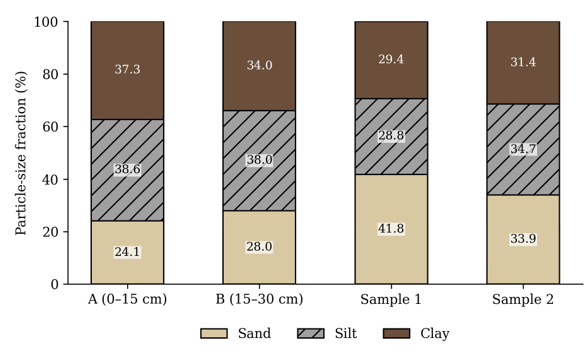
Natu Lake, a shallow freshwater body in Bakura Local Government Area, Zamfara State, Nigeria, supports fishing, irrigation and farming in the surrounding communities of Bakura, Yarkofoji, Balgare and Gamji, yet no physicochemical baseline exists. This study established a preliminary physicochemical baseline for the lake water and adjoining soils. One composite water sample was analysed for pH, electrical conductivity (EC), temperature, nitrate, total dissolved solids (TDS), dissolved oxygen (DO), turbidity and total phosphorus (TP), and four soil samples were analysed for pH, EC, organic carbon, total nitrogen, available phosphorus, exchangeable bases, cation exchange capacity (CEC) and particle-size distribution. Water pH (6.77), TDS (230 mg/L) and nitrate (5.6 mg/L) were within WHO (2022) and Nigerian Standard for Drinking Water Quality (NSDWQ, 2015) limits. However, turbidity (285.3 NTU) exceeded the 5 NTU guideline more than fifty-fold, DO (4.1 mg/L) was below the 5 mg/L level adequate for fish, and TP (0.03 mg/L) placed the lake in the upper mesotrophic range. The soils were slightly acidic (pH 6.53 ± 0.19), clay loam in texture, low in total nitrogen (0.78 ± 0.06 g/kg) and CEC (4.13 ± 0.11 cmol(+)/kg), and very low in available phosphorus (0.24 ± 0.01 mg/kg). Sand content was moderately, but not significantly, negatively correlated with CEC (r = −0.70, n = 4). The high turbidity and low DO are consistent with catchment erosion linked to vegetation loss and desertification, and with irrigation, farming and fishing pressures. Seasonal multi-station monitoring, protection of catchment vegetation and soil-test-guided fertilizer use are recommended
References
Abasiryu, A., Fabian, Z. L., & Abubakar, K. A. (2025). Ensuring Clean Water for All: The Vital Importance of Assessing Lake Alau Water Quality Index. Sahel Journal of Life Sciences Fudma, 3(1), 173-181.
Akudo, E. O., & Otaru, P. O. (2023). The influence of climate change on freshwater availability in the Sokoto Rima River Basin, Northwestern Nigeria. Environmental Monitoring and Assessment, 195(1), 82.
American Public Health Association, American Water Works Association, & Water Environment Federation. (2017). Standard methods for the examination of water and wastewater (23rd ed.). American Public Health Association.
Ayers, R. S., & Westcot, D. W. (1985). Water quality for agriculture (Vol. 29, p. 174). Rome: Food and agriculture organization of the United Nations.
Azare, I. M., Abdullahi, M. S., Adebayo, A. A., Dantata, I. J., & Duala, T. (2020). Deforestation, desert encroachment, climate change and agricultural production in the Sudano-Sahelian region of Nigeria. Journal of Applied Sciences and Environmental Management, 24(1), 141–147. https://doi.org/10.4314/jasem.v24i1.18
Bashir, R., Ademola, T. B., & Ahmed, A. (2025). Assessment of Water Physicochemistry in Relation to Fish Diet and Biodiversity across Three Savanna Reservoirs in Katsina State, Nigeria. UMYU Journal of Microbiology Research (UJMR), 10(3), 81-96.
Ebrahimi, E., & Ojani, M. R. (2024). Phosphorus dynamics in soil–water–sediment environment. In Phosphorus in soils and plants. IntechOpen.
Ekpoh, I. J., & Nsa, E. (2011). The effects of recent climatic variations on water yield in the Sokoto region of northern Nigeria. International Journal of Business and Social Science, 2(7), 251–256.
Esu, I. E., Odunze, A. C., & Moberg, J. P. (1991). Morphological, physico-chemical and mineralogical properties of soils in the Talata Mafara area of Sokoto State, Nigeria.
Ezemonye, M. N., & Emeribe, C. N. (2015). Spatial and temporal patterns of climatic changes in the Sokoto-Rima River Basin, Sudano-Sahel region, Nigeria. European Scientific Journal, 11(26), 392–403.
Lawal, N., & Shehu, A. A. (2024). Evaluating the socioeconomic and health impacts of the 2020 flood in Goronyo Local Government, Sokoto State, Nigeria. Science World Journal, 19(3), 651-658.
Mahmood, S., Kiliç, Z., Saeed, M. M., Rehman, H. A., Aslan, Z., Elsarag, E. I., ... & Haider, S. (2022). Environmental and hydrological consequences of agriculture activities: general review & case study.
Minhas, P. S., & Qadir, M. (2024). Water quality guidelines for irrigation. In Irrigation sustainability with saline and alkali waters: Extent, impacts and management guidelines (pp. 277–294). Springer Nature Singapore.
Nasir, I., Kankara, U. M., Yahaya, M. A., Sadauki, M. A., & Auta, T. (2024). Physicochemical Parameters of Sabke Reservoir, Katsina State, Nigeria. Sahel Journal of Life Sciences FUDMA, 2(4), 27-33.
Ngene, B. U., Nwafor, C. O., Bamigboye, G. O., Ogbiye, A. S., Ogundare, J. O., & Akpan, V. E. (2021). Assessment of water resources development and exploitation in Nigeria: A review of integrated water resources management approach. Heliyon, 7(1), Article e05955. https://doi.org/10.1016/j.heliyon.2021.e05955
Nigerian Investment Promotion Commission. (2019). Zamfara State. https://www.nipc.gov.ng/nigeria-states/zamfara-state/
Nwilo, P. C., Olayinka, D. N., Okolie, C. J., Emmanuel, E. I., Orji, M. J., & Daramola, O. E. (2020). Impacts of land cover changes on desertification in northern Nigeria and implications for the Lake Chad Basin. Journal of Arid Environments, 181, Article 104190. https://doi.org/10.1016/j.jaridenv.2020.104190
Ojanuga, A. G. (1979). Clay mineralogy of soils in the Nigerian tropical savanna regions. Soil Science Society of America Journal, 43(6), 1237–1242. https://doi.org/10.2136/sssaj1979.03615995004300060038x
Raji, M. I. O., Ibrahim, Y. K. E., Tytler, B. A., & Ehinmidu, J. O. (2015). Physicochemical characteristics of water samples collected from River Sokoto, northwestern Nigeria. Atmospheric and Climate Sciences, 5(3), 194–199. https://doi.org/10.4236/acs.2015.53013
Rizani, S., Laze, P., & Ibraliu, A. (2016). Assessment of irrigation water quality of Kosovo Plain. Agro-Knowledge Journal, 17(3), 243–253.
Salami, A. A. (2025). Rainfall variability and trend analyses in Nigeria using remotely sensed data and CMIP5 models. Earth Systems and Environment, 9, 2837–2865. https://doi.org/10.1007/s41748-024-00556-0
Samrawi, S. A., Magami, I. M., & Yelwa, S. M. (2024). The use of benthic macroinvertebrates and insects for evaluation of Kandola Shella (UDUS Stream) status. Sahel Journal of Life Sciences FUDMA, 2(3), 139–146. https://doi.org/10.33003/sajols-2024-0203-18
Setyadin, Y., Leksono, A. S., Tarno, H., & Anggayasti, W. L. (2026). Integrated assessment of irrigation channel ecosystem quality in a tropical agroecosystem: Linking riparian vegetation, physicochemical gradients, and benthic macroinvertebrate responses. Journal of Freshwater Ecology, 41(1), Article 2708822.
Shehu, A. H., Ismail, F. M., Umar, U. H., Muhammad, A. M., Muhammad, A. M., Idris, J. A., & Mairami, F. M. (2025). Spatio-temporal variation of physico-chemical parameters in Wasai Reservoir, Kano State. BIMA Journal Of Science And Technology Gombe, 9(1A), 266-275.
Soil Survey Staff. (2014). Keys to soil taxonomy (12th ed.). United States Department of Agriculture, Natural Resources Conservation Service.
Standards Organisation of Nigeria. (2015). Nigerian standard for drinking water quality (NIS 554:2015). Standards Organisation of Nigeria.
Subedi, R., Jojiju, B., McBroom, M., Gaspar, L., Dercon, G., & Navas, A. (2025). Impact of land cover change on eutrophication processes in Phewa Lake, Nepal. Hydrology, 12(10), Article 246. https://doi.org/10.3390/hydrology12100246
Vollenweider, R. A., & Kerekes, J. (1982). Eutrophication of waters. Monitoring, assessment and control. Organization for Economic Co-Operation and Development (OECD), Paris, 156.
World Health Organization. (2022). Guidelines for drinking-water quality: Fourth edition incorporating the first and second addenda. World Health Organization.
Zamfara State Civil Service Commission. (n.d.). Local Government Areas. Retrieved September 2026, from https://csc.zamfara.gov.ng/local-government-areas/
Downloads
Published
Issue
Section
Categories
License
Copyright (c) 2026 Aliyu Abubakar Shehu, Saadu Abubakar Mafara, Aliyu Abubakar Shehu, Habibu Musa Gebbe

This work is licensed under a Creative Commons Attribution 4.0 International License.


