
Prevalence of Plasmodium Falciparum Infection and Assessment of Histidine-Rich Protein (Pfhrp2 and Pfhrp3) Following Antimalarial Treatment Among Lactating Mothers and Infants in Dutsin-Ma Local Government Area, Katsina State
DOI:
https://doi.org/10.33003/fjs-2026-1021-6335Keywords:
Plasmodium falciparum, Malaria, HRP2, HRP3, RDT, Persistence positivity, PfCRT, Infants, Dutsin-MaAbstract
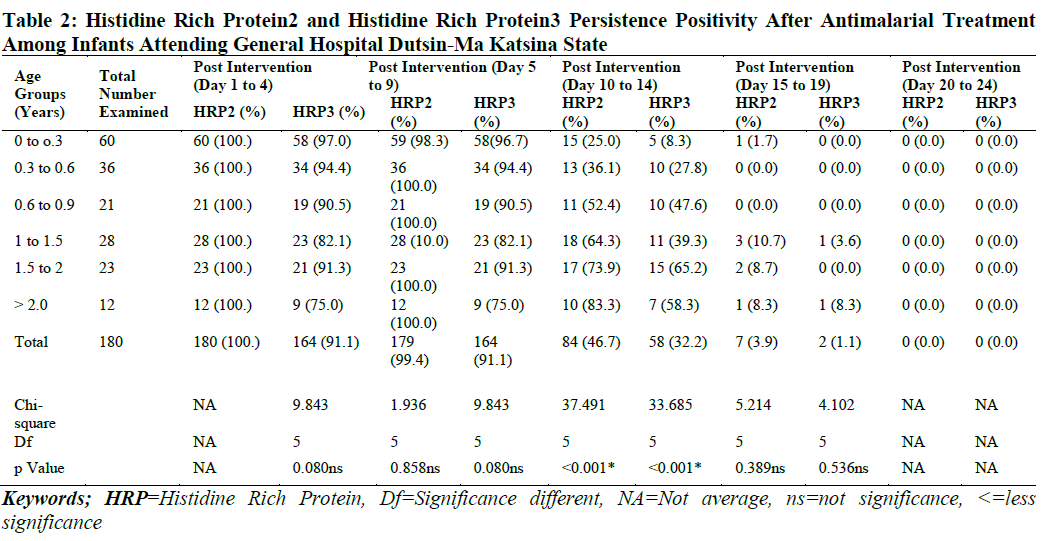
Malaria Rapid Diagnostic Test antigen persistence complicates treatment monitoring in endemic areas. This longitudinal therapeutic efficacy study assessed HRP2/HRP3 persistent positivity after ACT and Fansidar treatment and identified associated biofactors among 360 participants 180 infants 0-2 years and 180 lactating mothers 19->40 years with microscopy-confirmed Plasmodium falciparum at General Hospital Dutsin-ma. Participants received Artemether-lumefantrine ACT, N=119 (66.1%) or Sulfadoxine-pyrimethamine Fansidar n=61 (33.9%). Follow-up was on Day 1-4, 5-9, 10-14, 15-19 and 20-24. HRP2/HRP3 clearance was assessed by RDT. Biofactors PfCRT K76T, anemia, HIV were analyzed using Chi-square and pearson correlation at p<0.05. At baseline Day 1-4, 100% were HRP2 positive and 91.1% HRP3 positive. Persistence declined progressively; Day 5-9, 99.4% HRP2; Day 10-14, 46.7% infants and 47.2% mothers; Day 15-19, 3.9%; Day 20-24, 0% clearance in both groups. Age significantly influenced clearance p<0.001: infants 0-0.3 years 25.0% vs >2.0 years 83.3% on Day 10-14; mothers 19-21 years 25.8% vs >40 years 85.7%. ACT group had 63.0% persistence vs 18.0% Fansidar on Day 10-14 p<0.001. PfCRT showed strongest correlation with persistence r=0.65, followed by anemia r=0.50 and HIV r=0.45. Despite eventual clearance by Day 20-24, delayed clearance in ACT group is concerning and suggests reduced efficacy or tolerance. Persistence is multifactorial driven by parasite resistance marker and host factors
References
Ariey F, Witkowsk B, Amaratunga C (2014). A molecular marker of artemisinin resistant plasmodium falciparum malaria. Nature. Malaria Journal, 505(7481): 50-55.
Abeku, T. A., Hay, S.I., Ochola, S., Langi, P., Breard, B., De Vlas, S. J., & Cox, J. (2008). Malaria seasonal epidemics: lessons from 41 years in East Africa. Malaria journal, 7:196.
Abaje, I. B.1., Sawa, B. A. and Ati, O. F.1 (2014). Climate Variability and Change, Impacts and Adaptation Strategies in Dutsin-Ma Local Government Area of Katsina State, Nigeria Journal of Geography and Geology. Volume. 6, Pp 103.
Adebobola, O.K (2021). Prevalence of mutant dihydrofolate reductase gene (DHRF) and its implication on pyrimethamine resistance in rural Kwara State, Nigeria (Master’s thesis Kwara State University, Nigeria).
Asua, V., Conrad, M.D., Aydemir, O., Duvalsaint, M., Legac, J., Duarte, E., & Rosenthal, P.J. (2021). Changing prevalence of potential mediators of aminoquinoline, antifolate and artemisinin resistance across Uganda. Journal of infectious Diseases. 223(6), 985-994.
Atroosh, W. M., Al-Mekhlafi, H. M., Mahdy, M. A., Surin, J. (2012). The detection of pfcrt and pfmdr1 point mutations as molecular markers of chloroquine drug resistance, Pahang, Malaysia,11; 251.
Baker, J., McCarthy, J., Gatton, M., Kyle, D.E., Belizario, V., Luchavez, J. & Cheng, Q. (2005). Genetic diversity of Plasmodium falciparum histidine rich protein 2 and its effect on the performance of PfHRP2-based rapid diagnostic tests. Journal of molecular and Biochemical Parasitology. 144(1), 127-138.
Balikagala, B., Fukuda, N., Ikeda, M., Katuro, O. T., Tachibana, S, I., Yamauchi, M. & Mita, T. (2021). Evidence of artemisinin-resistant malaria in Africa. New England Journal Medicine. 385(13), 1163-1171.
Boldbaatar, D., Cooper, R.A., Hart,C. (2020). Performance of Histidine-rich protein 2 and Lactate dehydrogenase rapid diagnostic tests in Enugu, Southeast Nigeria. Nigerian Journal of Parasitology. 41(2), 201-207.
Bhutta, Z. A., Darmstadt, G. L., Hasan, B. S. & Haws, R. A. (2005). Community-based interventions for improving perinatal and neonatal health outcomes in developing countries: a review of the evidence, 115; 519 – 617.
Calçada, C., Silva, M., Baptista, V., Thathy, V., Silva-Pedrosa, R., Granja, D. (2020). Expansion of a specific Plasmodium falciparum PfMDR1 haplotype in Southeast Asia with increased substrate transport, Journal of Parasitology 11; 02093 – 20.
Carmeli, Y., Eliopoulos, G., Mozaffari, E., Samore, M. (2002). Health and Economic Outcomes of Vancomycin-Resistant Enterococci. Archives of Internal Medicine, journal of medicine 162 (19); 2223 – 28.
Davis, T. M., Mueller, I. & Rogerson, S. J. (2010). Prevention and treatment of malaria in pregnancy. Journal of Microbiology, 5; 1599 – 1613.
Dalrymple, U., Arambepola, R., Gething, P. W., & Cameron, E. (2018). How long do rapid diagnostic tests remain positive after anti-malarial treatment. Malaria Journal, 17,437.
Duah, N. O., Miles, D. J., Whittle, H.C. & Conway, D. J. (2010). Acquisition of antibody isotypes against Plasmodium falciparum blood stage antigens in a birth cohort. Journal of Parasite Immunology, 32; 125 – 134.
Elyazar, I. R., Hay, S. I., Baird, J. K. (2011). Malaria distribution, prevalence, drug resistance and control in Indonesia. Journal of Advance Parasitology, 74; 41–175.
Fagbamigbe, A. F., Dzekunov, S, M., Abullah, S. (2019). Comparative analysis of malaria rapid diagnostic tests versus microscopy for detection of Plasmodium falciparum. African Journal of Reproductive Health, 23(1), 82-90.
Federal Ministry of Health (2020). National Guidelines for Diagnosis and Treatment of Malarea. Federal Ministry of Health, Abuja, Nigeria.
Fidock DA, Nomura T, Talley AK (2000). Mutations in the P.falciparum digestive vacuole transmembrane protein pfcrt and evidence for their role in chloroquine resistance. Mol cell. Journal of malaria 6(4):861-871.
Getahun, H., Smith, I., Trivedi, K., Paulin, S., Balkhy, H. H. (2020). Tackling antimicrobial resistance in the COVID-19 pandemic Bull. World Health Organ, 98; 442.
Grais, R., Laminous, I., Woi-Messe, L., Makarimi, R., Bouriema, S., Langendorf, C., & Sibley, C., (2018). Molecular markers of resistance to amodiaquine plus sulfadoxine pyrimethamine in an area with seasonal malaria chemoprevention in central niger. Malaria journal of parasite, 17(1). https://doi.org/10.1186/s12936-018-2242-4.
Hatz, C., Abdulla, S., Mull, R. (2008). Pharmacokinetics and pharmacokinetics of lumefantrine. Malaria Journal, 7, 195.
Houze, S., Boly, M, D., Le, Bras, J., Deloron, P., & Faucher, J. F. (2011). Combined deletions of pfhrp2 and pfhrp3 genes and impact on RDT. Malaria Journal, 10, 192
Ichengoma DS, Francis F, Mmbando BF (2011). Accuracy of malaria rapid diagnostic tests in community studies. Malaria Journal. 10:223.
Karbwang, J., Andrews K,T., Mungai, P. (2019). Persistence of HRP2 after treatment in Southeast Asia. Southeast Asian Journal of Tropical Medicine and Public Health, 50(3), 445-452.
Kayode, O., Deloron, P., Faucher, J. F. (2020). Malaria prevalence among infants in Osun State. Journal of Medical and Tropical Sciences, 12(1), 34-40.
Kourtis, A, P., Read, J. S., & Jamieson, D. J. (2014). Pregnancy and infection. Journal of Clinical Microbiology Reviews, 27(3), 593-616.
Kennedy, K., Collignon, P. (2010). Colonisation with Escherichia coli resistant to “critically important” antibiotics: A high risk for international travellers. European Journal of Clinical Microbiology & Infectious diseases, journal of Microbiology 29 (12); 1501 – 1506.
Korenromp EL, Williams BG, Gouws E, Dye C, Snow RW. (2005). Measurement of trends in childhood malaria mortality in Africa: an assessment of progress toward targets of the Abuja Declaration. : 1477-1480. (Shankar) 2010
Larru, B., Molyneux, E, Ter Kuile F. O., Taylor, T., Molyneux, M. & Terlouw, D. J. (2009). Malaria in infants below six months of age: retrospective surveillance of hospital admission records in Blantyre, Malawi. Malaria Journal of parasite, 8; 310.
Laurent, A., Dent, A., Goldring, J. P. (2021). Performance of HRP2-based RDT in Tanzania. Journal of Infectious Diseases, 21, 321.
Lee, N., Baker, J., Andrews, K. T., (2012). Effect of sequence variation in Plasmodium falciparum histidine-protein 2 and 3 on RDT performance. Malaria Journal, 11, 277.
Ly, A.B., Gasser, R. A., Bousema, T., (2010). Use of HRP2-based rapid diagnostic test for follow-up of malaria treatment in Mali. Bulletin de la Societe de Pathologie Exotique, 103(4), 234-238.
Lesko, C. R., Arguin, P. M. & Newman, R. D. (2007). Congenital malaria in the United States: a review of cases from 1966 to 2005. Archives of Pediatrics and Adolescent Medicine, 161; 1062 – 1067.
Lobel, H. O., Campbell, C. C. (2001). Malaria Prophylaxis and distribution of drug resistance. Clinics in Tropical Medicine and Communicable Diseases, journal of medicine. 1; 225 – 242.
Murray CK, Gasser RA, Magill AJ, Miller RS (2008). Updated on Rapid Diagnostic Tasting for malaria. Clinical microbiology Review. 21 (1):
Malhotra, I., Dent, A., Mungai, P., (2018). Can prenatal malaria exposure produce an immune tolerant phenotype Journal of Infectious Diseases? 218(1), 102-109.
Maguire, J., Susanti, A., Sismadi, P., Fryauff, D., Baird, J. (2001). eT76 mutation in the pfcrt gene of Plasmodium falciparum and clinical chloroquine resistance phenotypes in Papua, Indonesia. Ann Trop Med Parasitol, journal of medical parasitology. 95; 559 – 72.97-110.
Menendez, C. & Mayor, A. (2007). Congenital malaria: the least known consequence of malaria in pregnancy. Seminars in Fetal and Neonatal Medicine, journal of medicine. 12; 207 – 213.
Moges, B., Griffin, J. T., Dent, A.E. (2001). Comparison of Care Start HRP2 rapid diagnostic test and microscopy for malaria diagnosis in Northwest Ethiopia. Ethiopian Journal of Health Sciences, 21(2), 95-102.
Moormann, A. M. (2009). How might infant and paediatric immune responses influence malaria vaccine efficacy journal of paediatric, 31; 547 – 559.
Mouatcho, J. C., & Goldring, J.P.D. (2013). Malaria rapid diagnostic tests: challenges and prospects. Journal of Medical Microbiology. 62(10), 1491-1505.
Murray, C. K., Gasser, R. A., Magill, A. J., & Miller, R. S. (2008). Update on rapid diagnostic testing for malaria. Journal of Clinical Microbiology Rewiews. 21(1), 97-110.
Mukhtar, M.Y., Lesi, F.E., Iroha, E.U., Egri-Okwaji, M.T. & Mafe, A.G. (2006). Congenital malaria among inborn babies at a tertiary centre in Lagos, Nigeria. Journal of Tropical Pediatrics, 52; 19 – 23.
Mwaniki, M. K., Talbert, A.W., Mturi, F.N., Berkley, J.A., Kager, P., Marsh, K. & Newton, C.R. (2010). Congenital and neonatal malaria in a rural Kenyan district hospital: an eight-year analysis, 9, 313.
Nimir, A. R., Isa, N. H., Eugene, C. B., Ghauth, I. M., Salleh, F. M., & Rahman, R. A. (2006). Severity of Malaria cases reported in urban and rural hospitals in Malaysia. Southeast Asian Journal of Tropical Medicine and Public Health, 37, 831 – 837.
Oidovsambuu, O, Mouatcho, J. C., Dent, A. (2020). Performance of SD Bioline malaria rapid diagnostic test in Mongolia. Malaria Journal, 19. 389.
Okell LC, Drakeley CJ, Ghani AC, Bousem T, Sutherland CJ (2012). Reduction of transmission from malaria patients by ACT: a pooled analysis. Malaria Journal. 11:73
Riley, E, M. Singh, S., Senga, R, K. (2019). Safety of anti-malarial during breastfeeding. Lancel infectious Diseases, 19(8), e250-e259.
Riley, E. M., Wagner, G. E., Ofori, M., Wheeler, J. G., Akanmori, B. D., Tetteh, K., McGuinness, D., Bennet, S. N., kumah, F. K., Anders, R. F., Koram, K. A. (2000). Lack of association between maternal antibody and protection of African infants from malaria infection. Infect Immune, Journal of Tropical Pediatrics. 68; 5856 – 5863.
Ramutton, T., Miller, R. S., (2019). Stability of HRP2 antigen. Journal of Clinical Microbiology, 57(5), e00125-19.
Reynaldi, A., Dent, A. E., Okell, L. C. (2019). Kinetics of maternally-derived anti-malaria antibodies. PLOS ONE, 14(6), e0217578.
Roepe, P. D. (2009). Molecular and physiologic basis of quinoline drug resistance in Plasmodium falciparum malaria. Future Microbiol journal of microbiology, 4; 441–55.
Shankar AH. (2010). Nutritional modulation of malaria morbidity and mortality. Journal of Infectious Diseases. 202(Suppl 2):S263-S273.
Sharp, B., Kleinschmidt, I., Streat, E., Maharaj, R., Barnes, K., Durrheim, D.N., Ridl, F.C., Morris, N., Seocharan, I., Kunene, S., La Grange, J.J.P., Mthembu, J.D., Maartens, F., Martin, C.L. & Barreto, A. (2007). Seven years of regional malaria control collaboration-Mozambique, South Africa and Swaziland. American Journal of Tropical Medicine and Hygiene, 76; 42 – 47.
Sholapurkar, S. L., Senga, R. K., Sartorius, B. (2018). Postpartum immunosuppression and malaria. Journal of Obstetrics and Gynaecology, 38(2), 234-240.
Singh, S., Reynaldi, A., Stokes, B. H. (2020). Persistent positivity of HRP2 RDT after treatment in Central India. Journal of Vector Borne Diseases, 57(2), 145-150.
Snow, R. W., Sartorius, B., Kyobutungi, C. (2017). The global distribution of clinical episodes of Plasmodium malaria. Nature, 526, 732-735. Lancet reference corrected.
Snow, R.W., Nahlen, B., Palmer, A., Donnelly, C.A., Gupta, S. & Marsh, K. (1998). Risk of severe malaria among African infants: direct evidence of clinical protection during early infancy. Journal of Infectious Diseases, 177; 819 – 822.
Sutherland, C. J., Drakeley, C. J. & Schellenberg, D. (2007). How is childhood development of immunity to Plasmodium falciparum enhanced by certain antimalarial interventions, 6; 161.
Tiono, A, B., Counihan, H. Gasser, R, A. (2014). Dynamics of malaria transmission and persistence of HRP2. Malaria Journal, 13, 456.
Tjitra, E., Suprianto, S., McBroom, J. (2001). Persistent PfHRP2 positivity after treatment in Indonesia. Transactions of the Royal Society of Tropical Medicine and Hygiene, 95(4), 458-464.
Thaithong, S. (2000). Clones of different sensitivities in drugresistant isolates of Plasmodium falciparum. Bulletin of the World Health Organization, 61; 709 – 712.
Uwimana, A., Legrand, E., Stokes, B, H, (2020). Emergence and clonal expansion of artemisinin-resistant Plasmodium falciparum kelchi13 R561H mutant in Rwanda. Nature Medicine, 26(10). 1602-1609.
White, N. J (2018). Artemisinin and artemisinin-based combination therapy. Journal of Clinical Investigation, 128(1), 214-222.
Witkowski B. (2017). Mechanisms of artemisinin resistence. Lancet Infectious Diseases, 17(5), e156-e165.
Worral, E., Basu, S. & Hanson, K. (2005). Is malaria a disease of poverty? A review of literature. Tropical Medicine and International Health, 10; 1047 – 1059.
Wang, X., Zhang, X., Chen, H., Lu, Q., Ruan, W., & Chen, Z. (2022). Molecular determinant of sulfadoxine-pyrimethamine resistance in PF isolates from Central Africa between 2016 & 2021: Wide geographic spread of highly mutated Pfdhfr and Pfdhps alleles. Microbiology Spectrum, journal of microbiology 10(5), e02005-22.
World Health Organization (WHO, 2009). Methods for surveillance of antimalaria drug efficacy. World Health Organization,Geneva.
World Health Organization (WHO, 2009). Methods and Techniques for assessing the efficacy of antimalarial drugs. Geneva: WHO; 2009. Updated 2022.
World Health Organization (WHO, 2015). Guidelines for the treatment of malaria. 3rd Edition. World Health Organization,Geneva.
World Health Organization. (WHO, 2022a). World Malaria Report 2022. Geneva WHO Press.
World Health Organization. (2016). World Malaria Report. http://www.who.int/malaria/publications/world-malaria-report-2016/report/en/
World Health Organization (WHO, 2022). Guidelines for malaria (Updated September 2022). World Health Organization,Geneva.
World Health Organization (WHO, 2023). World Health Report 2023. World Health Organization, Press. Geneva
Downloads
Published
Issue
Section
Categories
License
Copyright (c) 2026 Alhassan Babangida Sani, Umar Muhammad Aliyu, Kabir Dalha Abubakar, Murtala Umar

This work is licensed under a Creative Commons Attribution 4.0 International License.


