
Comparative Mathematical Modelling and Numerical Analysis of Chemotactic Signaling Dynamics in Escherichia coli
DOI:
https://doi.org/10.33003/fjs-2026-1024-6336Keywords:
Escherichia Coli Chemotaxis, Mathematical Modelling, Nonlinear Ordinary Differential Equations, Model Reduction, Receptor Free Energy, Robust Perfect Adaptation, Flagellar Motor, Numerical SimulationAbstract
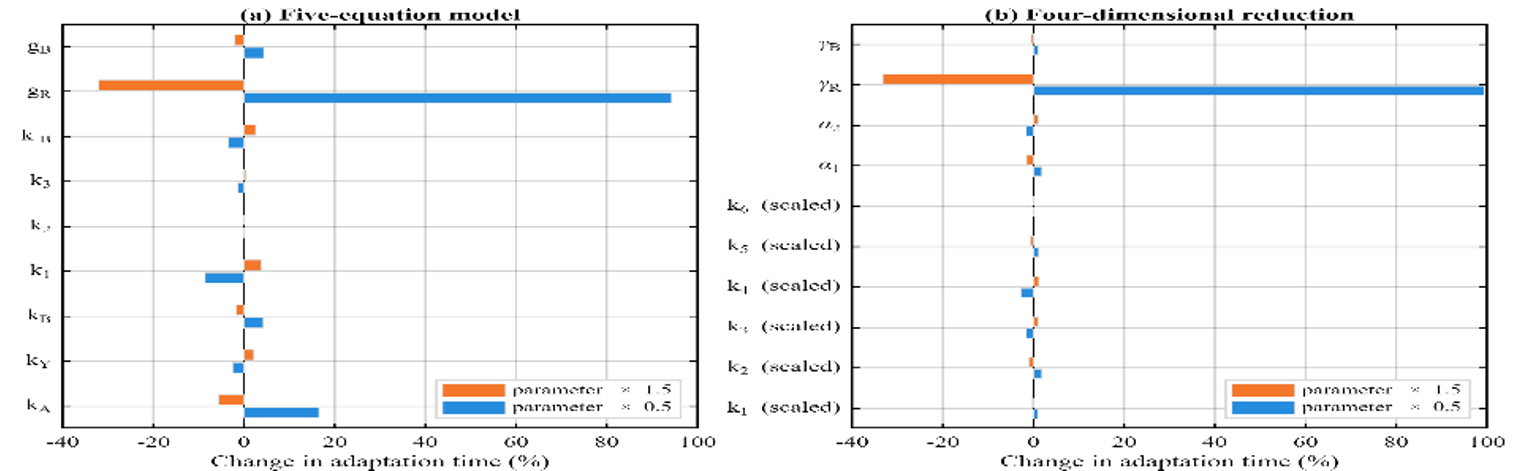
Chemotaxis enables Escherichia coli to respond to changes in its chemical environment through coordinated receptor activity, intracellular phosphorylation and flagellar motor regulation. Mathematical models provide a quantitative framework for investigating these coupled signalling processes. This study compares the five-equation Clausznitzer chemotaxis model with the four-dimensional Edgington–Tindall reduction and examines the influence of four receptor free-energy formulations on signalling behaviour. The nonlinear ordinary differential equations were integrated in MATLAB with the stiff solver ode15s, and the reduced model was converted to physical time with its published scaling. Responses to a step in attractant concentration were evaluated through receptor activity, adaptation, CheY phosphorylation and predicted flagellar motor bias, and the robustness of the results was tested by tolerance refinement and a one-at-a-time parameter sensitivity analysis. Both models gave an adaptation precision of 1.0000. The adaptation times were 86.4 s for the five-equation model and 165.2 s for the reduced model; with the same Tar-only free energy, the five-equation model adapted in 173.6 s, which indicates that most of the difference arises from receptor composition rather than from model reduction. The three Tar-only free-energy formulations gave adapted-state slopes of −1.000, a value that follows from their mathematical structure, whereas the corresponding experimental value is −0.920 ± 0.003; the mixed-receptor formulation gave −0.423. The predicted motor bias differed markedly between the models because of their different protein totals. Quantitative interpretation therefore requires attention to parameter consistency, time scaling and the limited scope of the experimental benchmarks.
References
Antoneli, F., Golubitsky, M., Jin, J., & Stewart, I. (2024). Homeostasis in input-output networks: Structure, classification and applications [Preprint]. arXiv. https://doi.org/10.48550/arXiv.2405.03861
Bano, R., Mears, P., Golding, I., & Chemla, Y. R. (2023). Flagellar dynamics reveal fluctuations and kinetic limit in the Escherichia coli chemotaxis network. Scientific Reports, 13, Article 22891. https://doi.org/10.1038/s41598-023-49784-w
Barkai, N., & Leibler, S. (1997). Robustness in simple biochemical networks. Nature, 387(6636), 913–917. https://doi.org/10.1038/43199
Chatterjee, S. (2022). Short time extremal response to step stimulus for a single cell E. coli. Journal of Statistical Mechanics: Theory and Experiment, 2022(12), Article 123503. https://doi.org/10.1088/1742-5468/aca589
Clausznitzer, D., Oleksiuk, O., Løvdok, L., Sourjik, V., & Endres, R. G. (2010). Chemotactic response and adaptation dynamics in Escherichia coli. PLOS Computational Biology, 6(5), Article e1000784. https://doi.org/10.1371/journal.pcbi.1000784
Edgington, M. P., & Tindall, M. J. (2018). Mathematical analysis of the Escherichia coli chemotaxis signalling pathway. Bulletin of Mathematical Biology, 80(4), 758–787. https://doi.org/10.1007/s11538-018-0400-z
Franco-Oñate, M.-J., Parmeggiani, A., Dorignac, J., Geniet, F., Walter, J.-C., Pedaci, F., Nord, A. L., Palmeri, J., & Walliser, N.-O. (2025). Signature of cooperativity in the stochastic fluctuations of small systems with application to the bacterial flagellar motor. Scientific Reports, 15, Article 32109. https://doi.org/10.1038/s41598-025-14570-3
Kargeti, M., Kalita, I., Hoch, S., Ratnikava, M., Xu, W., Ni, B., Dy, R. L., Colin, R., & Sourjik, V. (2025). Experimental evolution partially restores functionality of bacterial chemotaxis network with reduced number of components. PLOS Genetics, 21(7), Article e1011784. https://doi.org/10.1371/journal.pgen.1011784
Karin, O., & Alon, U. (2021). Temporal fluctuations in chemotaxis gain implement a simulated-tempering strategy for efficient navigation in complex environments. iScience, 24(7), Article 102796. https://doi.org/10.1016/j.isci.2021.102796
Koler, M., Parkinson, J. S., & Vaknin, A. (2024). Signal integration in chemoreceptor complexes. Proceedings of the National Academy of Sciences of the United States of America, 121(14), Article e2312064121. https://doi.org/10.1073/pnas.2312064121
Mandal, S. D., & Chatterjee, S. (2022a). Effect of receptor cooperativity on methylation dynamics in bacterial chemotaxis with weak and strong gradient. Physical Review E, 105(1), Article 014411. https://doi.org/10.1103/PhysRevE.105.014411
Mandal, S. D., & Chatterjee, S. (2022b). Effect of switching time scale of receptor activity on chemotactic performance of Escherichia coli. Indian Journal of Physics, 96(9), 2619–2627. https://doi.org/10.1007/s12648-021-02259-y
Mandal, S. D., & Chatterjee, S. (2025). Bacterial chemotaxis in a traveling wave attractant environment. Journal of Statistical Mechanics: Theory and Experiment, 2025(6), Article 063501. https://doi.org/10.1088/1742-5468/add868
Mattingly, H. H., Kamino, K., Machta, B. B., & Emonet, T. (2021). Escherichia coli chemotaxis is information limited. Nature Physics, 17(12), 1426–1431. https://doi.org/10.1038/s41567-021-01380-3
Mattingly, H. H., Kamino, K., Ong, J., Kottou, R., Emonet, T., & Machta, B. B. (2024). Chemotaxing E. coli do not count single molecules [Preprint]. arXiv. https://doi.org/10.48550/arXiv.2407.07264
Mattingly, H. H., & Tu, Y. (2025). Ultrasensitivity without conformational spread: A mechanical origin for non-equilibrium cooperativity in the bacterial flagellar motor [Preprint]. arXiv. https://doi.org/10.48550/arXiv.2502.03290
Mayo, M., & Soto, R. (2025). Bacterial chemotaxis considering memory effects [Preprint]. arXiv. https://doi.org/10.48550/arXiv.2504.15385
Moore, J. P., Kamino, K., Kottou, R., Shimizu, T. S., & Emonet, T. (2023). Signal integration and adaptive sensory diversity tuning in Escherichia coli chemotaxis [Preprint]. bioRxiv. https://doi.org/10.1101/2023.02.08.527720
Pramanik, R., Yadav, R. K., & Chatterjee, S. (2025). Dynamics of chemoreceptor activity with time-periodic attractant field. The European Physical Journal E, 48, Article 60. https://doi.org/10.1140/epje/s10189-025-00525-z
Yue, C., Zhang, C., Zhang, R., & Yuan, J. (2023). Tethered particle motion of the adaptation enzyme CheR in bacterial chemotaxis. iScience, 26(10), Article 107950. https://doi.org/10.1016/j.isci.2023.107950
Downloads
Published
Issue
Section
Categories
License
Copyright (c) 2026 Zeyad Mohammed Abed

This work is licensed under a Creative Commons Attribution 4.0 International License.


