
Transmission-Term Inconsistencies in Vector-Borne Disease Models: Implications for Reproduction Numbers and Stability
DOI:
https://doi.org/10.33003/fjs-2026-1024-6339Keywords:
Basic reproduction number, Host–vector model, Incidence function, Model consistency, Next-generation matrix, Vector-borne diseaseAbstract
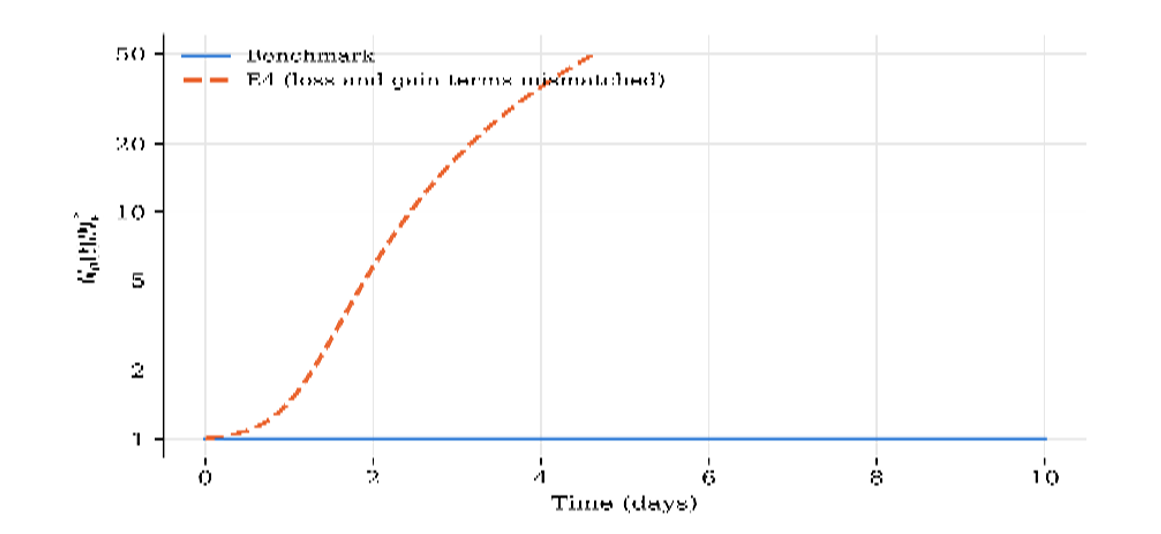
Host–vector models of mosquito-borne disease contain two cross-infection terms, and both must rest on one biting assumption and enter the equations as equal loss and gain terms. This study classified inconsistencies in these terms and derived their consequences for the basic reproduction number (R0), the stability of the disease-free equilibrium and host-population conservation. A Ross–Macdonald-type benchmark model with susceptible, infectious and recovered hosts and susceptible and infectious mosquitoes was formulated under mosquito-limited biting. Its positivity, boundedness, R0 and local stability were established with the next-generation matrix method and symbolic computation in SymPy. Six error types were defined in two groups. Formulation errors change the equations: mixed denominators in either cross-infection term (E1, E2), mass action with a per-mosquito biting rate (E3) and mismatched loss and gain terms (E4). Analysis and reporting errors leave the equations unchanged: an unstated R0 convention (E5) and disagreement between analysed and simulated equations (E6). For each system analysed, the disease-free equilibrium was locally asymptotically stable when its computed R0 was below one, so the threshold theorem did not reveal the error. Instead, E1 and E2 removed the dependence of R0 on the mosquito-to-host ratio, E3 and E4 made R0 depend on the unit in which populations are counted, and E4 broke host-population conservation. With parameter values derived from a published malaria model, R0 was 7.16 for the benchmark, 2.35 under E1 and E2 and 0.77 under a consistent host-limited form. A six-point checklist for detecting these errors is given.
References
Adim, C. C., Asimiea, A. O., & Okengwu, U. A. (2026). Data-driven modelling of malaria transmission among under-five children to inform targeted control strategies in Rivers State, Nigeria. BMC Public Health. https://doi.org/10.1186/s12889-026-29781-0
Aguiar, M., Anam, V., Blyuss, K. B., Estadilla, C. D. S., Guerrero, B. V., Knopoff, D., Kooi, B. W., Srivastav, A. K., Steindorf, V., & Stollenwerk, N. (2022). Mathematical models for dengue fever epidemiology: A 10-year systematic review. Physics of Life Reviews, 40, 65–92. https://doi.org/10.1016/j.plrev.2022.02.001
Anwar, M. N., Smith, L., Devine, A., Mehra, S., Walker, C. R., Ivory, E., Conway, E., Mueller, I., McCaw, J. M., Flegg, J. A., & Hickson, R. I. (2024). Mathematical models of Plasmodium vivax transmission: A scoping review. PLOS Computational Biology, 20(3), e1011931. https://doi.org/10.1371/journal.pcbi.1011931
Atokolo, W., Aja, R. O., Omale, D., Paul, R. V., Amos, J., & Ocha, S. O. (2023). Mathematical modeling of the spread of vector borne diseases with influence of vertical transmission and preventive strategies. FUDMA Journal of Sciences, 7(6), 75–91. https://doi.org/10.33003/fjs-2023-0706-2174
Avram, F., Adenane, R., & Basnarkov, L. (2024). Some probabilistic interpretations related to the next-generation matrix theory: A review with examples. Mathematics, 12(15), 2425. https://doi.org/10.3390/math12152425
Chitnis, N., Hyman, J. M., & Cushing, J. M. (2008). Determining important parameters in the spread of malaria through the sensitivity analysis of a mathematical model. Bulletin of Mathematical Biology, 70(5), 1272–1296. https://doi.org/10.1007/s11538-008-9299-0
Dahlin, K. J.-M., O’Regan, S. M., Han, B. A., Schmidt, J. P., & Drake, J. M. (2024). Impacts of host availability and temperature on mosquito-borne parasite transmission. Ecological Monographs, 94(2), e1603. https://doi.org/10.1002/ecm.1603
Dahlin, K. J.-M., Robert, M. A., & Childs, L. M. (2025). Once bitten, twice shy: A modeling framework for incorporating heterogeneous mosquito biting into transmission models. Bulletin of Mathematical Biology, 87(11), 163. https://doi.org/10.1007/s11538-025-01540-z
Dambazau, Z. B., Cyril-Egware, K., Charles, O., Eshikhena, G., Adegbite, G., Akoma, D., Ojielo, N., Gayawan, E., Gadanya, M., Nelson, E., Sikiru, N. A., & Kaduru, C. (2025). Malaria transmission dynamics and the impact of treatment interventions in Kano State, Nigeria: A compartmental model approach. PAMJ-One Health, 18, 11. https://doi.org/10.11604/pamj-oh.2025.18.11.48342
Dinsa, D. W., Keno, T. D., & Deressa, C. T. (2024). A systematic review of age-structured malaria transmission models (2019–2024). Frontiers in Applied Mathematics and Statistics, 10, 1512390. https://doi.org/10.3389/fams.2024.1512390
Duru, E. C., Mbah, G. C. E., & Anyanwu, M. C. (2025). A mathematical model for malaria with human and vector controls in Nigeria. International Journal of Applied and Computational Mathematics, 11(5), 211. https://doi.org/10.1007/s40819-025-02034-1
Gallo, L., Frasca, M., Latora, V., & Russo, G. (2022). Lack of practical identifiability may hamper reliable predictions in COVID-19 epidemic models. Science Advances, 8(3), eabg5234. https://doi.org/10.1126/sciadv.abg5234
Grosso, A., Hens, N., & Abrams, S. (2025). An integrative review of the combined use of mathematical and statistical models for estimating malaria transmission parameters. Malaria Journal, 24, 173. https://doi.org/10.1186/s12936-025-05415-5
Henderson, A. S., Hickson, R. I., Furlong, M., McBryde, E. S., & Meehan, M. T. (2024). Reproducibility of COVID-era infectious disease models. Epidemics, 46, 100743. https://doi.org/10.1016/j.epidem.2024.100743
Ngwafor, R., Pokharel, S., Aguas, R., White, L., & Shretta, R. (2024). Models for malaria control optimization: A systematic review. Malaria Journal, 23, 295. https://doi.org/10.1186/s12936-024-05118-3
Ogunlade, S. T., Meehan, M. T., Adekunle, A. I., & McBryde, E. S. (2023). A systematic review of mathematical models of dengue transmission and vector control: 2010–2020. Viruses, 15(1), 254. https://doi.org/10.3390/v15010254
Pokutnaya, D., Childers, B., Arcury-Quandt, A. E., Hochheiser, H., & Van Panhuis, W. G. (2023). An implementation framework to improve the transparency and reproducibility of computational models of infectious diseases. PLOS Computational Biology, 19(3), e1010856. https://doi.org/10.1371/journal.pcbi.1010856
Salako, R. B., & Wu, Y. (2024). On degenerate reaction-diffusion epidemic models with mass action or standard incidence mechanism. European Journal of Applied Mathematics, 35(5), 634–661. https://doi.org/10.1017/S0956792523000359
Tompros, A., Dean, A. D., Fenton, A., Wilber, M. Q., Carter, E. D., & Gray, M. J. (2022). Frequency-dependent transmission of Batrachochytrium salamandrivorans in eastern newts. Transboundary and Emerging Diseases, 69(2), 731–741. https://doi.org/10.1111/tbed.14043
van den Driessche, P., & Watmough, J. (2002). Reproduction numbers and sub-threshold endemic equilibria for compartmental models of disease transmission. Mathematical Biosciences, 180, 29–48. https://doi.org/10.1016/S0025-5564(02)00108-6
World Health Organization. (2025). World malaria report 2025. World Health Organization. https://www.who.int/publications/i/9789240117822
Downloads
Published
Issue
Section
Categories
License
Copyright (c) 2026 Timothy Ado Shamaki

This work is licensed under a Creative Commons Attribution 4.0 International License.


