
Whole plant extracts of Dactyloctenium aegyptium prevents carrageenan-induced inflammation in rats
DOI:
https://doi.org/10.33003/Keywords:
paw edema, inflammation, carrageenan, Dactyloctenium aegyptium, glutathionaAbstract
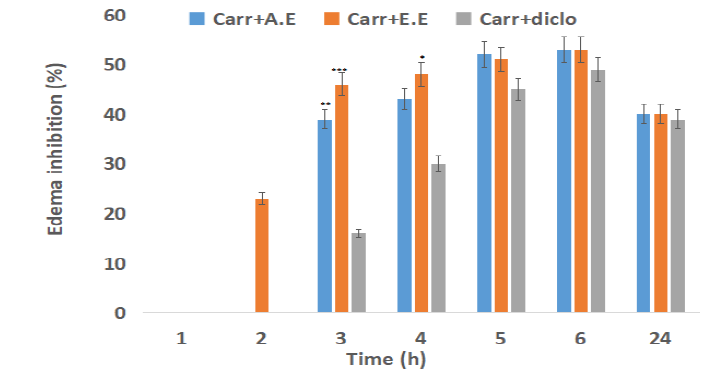
We used a weed plant to develop a novel anti-inflammatory compound. The purpose of this work was to test the anti-inflammatory activities of Dactyloctenium aegyptium (A.E. and E.E.) using a carrageenan-induced paw oedema rat model, as well as their effect on GSH levels.The anti-inflammatory effects of A.E. and E.E were compared to Diclofenac® by measuring the diameter of paw oedema at one-hour intervals over a six-hour period. The rats were then euthanised, and the inflamed paw tissue was removed for study of MDA and GSH levels, as well as histological evaluation. A.E. and E.E. demonstrated significantly stronger anti-inflammatory effects than Diclofenac. After six hours, the oedema inhibition percentages were 53%, 53%, and 49% (p < 0.0001). The administration of D. aegyptium extracts as well as Diclofenac resulted in significant elevations (p < 0.05) in GSH activity and notable reductions in MDA levels in paw tissue following Carr injection, relative to the Carr group. The results of this study indicated that the plant extracts of D. aegyptium may expedite the formulation of new pharmaceuticals that can be utilised as a scientific source for natural health products in the management of inflammation.
References
1. Chen, L., Deng, H., Cui, H., Fang, J., Zuo, Z., Deng, J., Li, Y., Wang, X., & Zhao, L. (2017). Inflammatory responses and inflammation-associated diseases in organs. Oncotarget, 9(6), 7204–7218. https://doi.org/10.18632/oncotarget.23208
2. Zhou, Y., Hong, Y., & Huang, H. (2016). Triptolide attenuates inflammatory response in membranous glomerulonephritis rats via downregulation of the NF-κB signaling pathway. Kidney and Blood Pressure Research, 41(6), 901–910. https://doi.org/10.1159/000452591
3. Fatima, H., Shahid, M., Jamil, A., & Naveed, M. (2021). Therapeutic potential of selected medicinal plants against carrageenan-induced inflammation in rats. Dose-Response, 19, 15593258211058028. https://doi.org/10.1177/15593258211058028
4. Sohail, R., Mathew, M., Patel, K. K., Reddy, S. A., Haider, Z., Naria, M., Habib, A., Abdin, Z. U., Chaudhry, W. R., Akbar, A., & Akbar, A. (2023). Effects of non-steroidal anti-inflammatory drugs (NSAIDs) and gastroprotective NSAIDs on the gastrointestinal tract: A narrative review. Cureus, 15, e37080. https://doi.org/10.7759/cureus.37080
5. Huang, Y., Guo, X., Wu, Y., Chen, X., Feng, L., Xie, N., & Shen, G. (2024). Nanotechnology's frontier in combatting infectious and inflammatory diseases: Prevention and treatment. Signal Transduction and Targeted Therapy, 9, Article 34. https://doi.org/10.1038/s41392-024-01745-z
6. Ibrahim, M., Mohammad, N. A., Shammi, A., Salim, A. M., Farzana, Y. B., Masudur, R., Jahirul, I. M., Faysal, A., Trisha, M., Tauheduzzaman, M., & Masud, R. M. (2018). In vivo analgesic and anti-inflammatory activities in Swiss albino mice and in vitro thrombolytic activity of methanol extract of ten-day-old whole plant of Triticum aestivum. Discovery Phytomedicine, 5(2), 43–47. https://doi.org/10.15562/phytomedicine.2018.68
7. Atanasov, A. G., Waltenberger, B., Pferschy-Wenzig, E. M., Linder, T., Wawrosch, C., Uhrin, P., Temml, V., Wang, L., Schwaiger, S., Heiss, E. H., Rollinger, J. M., Schuster, D., Breuss, J. M., Bochkov, V., Mihovilovic, M. D., Kopp, B., Bauer, R., Dirsch, V. M., & Stuppner, H. (2015). Discovery and resupply of pharmacologically active plant-derived natural products: A review. Biotechnology Advances, 33(8), 1582–1614. https://doi.org/10.1016/j.biotechadv.2015.08.001
8. Gebashe, F., & Van Staden, J. (2019). Grasses in South African traditional medicine: A review of their biological activities and phytochemical content. South African Journal of Botany, 122, 301–329. https://doi.org/10.1016/j.sajb.2018.10.012
9. Grosu, E., & Ichim, M. C. (2020). Turning meadow weeds into valuable species for Romanian ethnomedicine while complying with the environmentally friendly farming requirements of the European Union's Common Agricultural Policy. Frontiers in Pharmacology, 11, 529. https://doi.org/10.3389/fphar.2020.00529
10. Simmler, C., Graham, J. G., Chen, S. N., & Pauli, G. F. (2018). Integrated analytical assets aid botanical authenticity and adulteration management. Fitoterapia, 129, 401–414. https://doi.org/10.1016/j.fitote.2017.11.017
11. Al-Snafi, A. E. (2017). The pharmacological potential of Dactyloctenium aegyptium: A review. Indo American Journal of Pharmaceutical Sciences, 4(1), 153–159. https://doi.org/10.5281/zenodo.292965
12. Adesipe, T. I., Iweala, E. J., & Adebayo, A. H. (2023). Evaluation of antioxidant and antimicrobial properties of silver nanoparticles biosynthesized using weed (Dactyloctenium aegyptium) extracts for sustainable environment, agriculture and ethnomedicine. Materials Today: Proceedings. Advance online publication. https://doi.org/10.1016/j.matpr.2023.06.223
13. Fürst, R., Zündorf, I., & Dingermann, T. (2017). New knowledge about old drugs: The anti-inflammatory properties of ca
rdiac glycosides. Planta Medica, 83(12–13), 977–984. https://doi.org/10.1055/s-0043-105390
14. Jansson, D., Dieriks, V. B., Rustenhoven, J., Smyth, L. C., Scotter, E., Aalderink, M., Feng, S., Johnson, R., Schweder, P., Mee, E., & Heppner, P. (2021). Cardiac glycosides target barrier inflammation of the vasculature, meninges and choroid plexus. Communications Biology, 4, 260. https://doi.org/10.1038/s42003-021-01787-x
15. Obode, O. C., Adebayo, A. H., & Li, C. (2021). Phytochemical and toxicological evaluations of Prosopis africana (Guill. & Perr.) extract on albino Wistar rats. Toxicology Research, 37(2), 183–195. https://doi.org/10.1007/s43188-020-00052-3
16. Organisation for Economic Co-operation and Development (OECD). (2022). Test No. 425: Acute oral toxicity: Up-and-down procedure. OECD Guidelines for the Testing of Chemicals, Section 4. OECD Publishing. https://doi.org/10.1787/9789264071049-en
17. Falade, T., Ishola, I. O., Akinleye, M. O., Oladimeji-Salami, J. A., & Adeyemi, O. O. (2019). Antinociceptive and anti-arthritic effects of aqueous whole plant extract of Trianthema portulacastrum in rodents: Possible mechanisms of action. Journal of Ethnopharmacology, 238, 111831. https://doi.org/10.1016/j.jep.2019.111831
18. Ben Khedir, S., Mzid, M., Bardaa, S., Moalla, D., Sahnoun, Z., & Rebai, T. (2016). In vivo evaluation of the anti-inflammatory effect of Pistacia lentiscus fruit oil and its effects on oxidative stress. Evidence-Based Complementary and Alternative Medicine, 2016, Article 6108203. https://doi.org/10.1155/2016/6108203
19. Rotimi, O. A., Rotimi, S. O., Oluwafemi, F., Ademuyiwa, O., & Balogun, E. A. (2018). Oxidative stress in extrahepatic tissues of rats co-exposed to aflatoxin B1 and a low-protein diet. Toxicological Research, 34(3), 211–220. https://doi.org/10.5487/TR.2018.34.3.211
20. Nwogueze, B. C., Ojieh, A. E., Aloamaka, C. P., Igweh, J. C., & Onyesom, I. (2021). Levels of glutathione-related antioxidants in selected tissues of stressed Wistar rats. Indian Journal of Physiology and Pharmacology, 65, 167–176. https://doi.org/10.25259/IJPP_41_2020
21. Azarbaijani, M., Kian, M., & Soraya, H. (2021). Anti-inflammatory effects of memantine in a carrageenan-induced paw edema model in rats. Journal of Research in Pharmacy Practice, 10(2), 60–65. https://doi.org/10.4103/jrpp.JRPP_37_20
22. Zhang, X., Retyunskiy, V., Qiao, S., Zhao, Y., & Tzeng, C.-M. (2022). Alloferon-1 ameliorates acute inflammatory responses in λ-carrageenan-induced paw edema in mice. Scientific Reports, 12, Article 16689. https://doi.org/10.1038/s41598-022-20648-z
23. Alfaro, R. A., & Davis, D. D. (2023). Diclofenac. In StatPearls. StatPearls Publishing. https://www.ncbi.nlm.nih.gov/books/NBK557879/
24. Labarrere, C. A., & Kassab, G. S. (2022). Glutathione: A Samsonian life-sustaining small molecule that protects against oxidative stress, ageing, and damaging inflammation. Frontiers in Nutrition, 9, Article 1007816. https://doi.org/10.3389/fnut.2022.1007816
25. Elekofehinti, O. O., Kamdem, J. P., Kade, I. J., Rocha, J. B. T., & Adanlawo, I. G. (2013). Hypoglycemic, antiperoxidative, and antihyperlipidemic effects of saponins from Solanum anguivi Lam. fruits in alloxan-induced diabetic rats. South African Journal of Botany, 88, 56–61. https://doi.org/10.1016/j.sajb.2013.04.010
26. Wang, Q., Wu, X., Shi, F., & Liu, Y. (2019). Comparison of antidiabetic effects of saponins and polysaccharides from Momordica charantia L. in streptozotocin-induced type 2 diabetic mice. Biomedicine & Pharmacotherapy, 109, 744–750. https://doi.org/10.1016/j.biopha.2018.09.098
27. Di Giacomo, C., Malfa, G. A., Tomasello, B., Bianchi, S., & Acquaviva, R. (2023). Natural compounds and glutathione: Beyond mere antioxidants. Antioxidants, 12(7), Article 1445. https://doi.org/10.3390/antiox12071445
28. Nor, E., Houda, D., & Noureddine, D. (2018). In vivo anti-inflammatory activity and chemical composition of Algerian pomegranate (Punica granatum L.). International Journal of Biosciences, 12(2), 75–89. https://doi.org/10.12692/ijb/12.2.75-89
29. Nunes, C. D. R., Barreto, A. M., Menezes-de-Faria, P. S., Leandro-da-Costa, C. L., Souza, P. M., Pereira-de-Melo, M. L., Vieira, I. J. C., & Barros-de-Oliveira, D. (2020). Plants as sources of anti-inflammatory agents. Molecules, 25(16), Article 3726. https://doi.org/10.3390/molecules25163726
30. Del Prado-Audelo, M. L., Cortés, H., Caballero-Florán, I. H., González-Torres, M., Escutia-Guadarrama, L., Bernal-Chávez, S. A., Giraldo-Gómez, D. M., Magaña, J. J., & Leyva-Gómez, G. (2021). Therapeutic applications of terpenes on inflammatory diseases. Frontiers in Pharmacology, 12, Article 704197. https://doi.org/10.3389/fphar.2021.704197
31. Zouari Bouassida, K., Makni, S., Tounsi, A., Jlaiel, L., Trigui, M., & Tounsi, S. (2018). Effects of Juniperus phoenicea hydroalcoholic extract on inflammatory mediators and oxidative stress markers in carrageenan-induced paw oedema in mice. BioMed Research International, 2018, Article 3785487. https://doi.org/10.1155/2018/3785487
Downloads
Published
Issue
Section
Categories
License
Copyright (c) 2026 Temitope Iyanuoluwa Adesipe, Olowu, Oluwatobi Victor

This work is licensed under a Creative Commons Attribution 4.0 International License.


