
COMPUTATIONAL SCREENING OF PHYTOCHEMICALS FROM NIGERIAN MEDICINAL PLANTS AS POTENTIAL INHIBITORS OF STAPHYLOCOCCUS AUREUS DNA GYRASE B
DOI:
https://doi.org/10.33003/fjs-2026-1021-6359Keywords:
Antimicrobial resistance, Staphylococcus aureus, DNA gyrase B, Nigerian medicinal plants, phytochemicals, molecular dockingAbstract
The increasing burden of antimicrobial resistance (AMR), particularly in Staphylococcus aureus, underscores the need to identify novel chemical scaffolds for targeting essential bacterial processes. DNA gyrase B (GyrB), the ATPase subunit of bacterial DNA gyrase, represents a promising antibacterial target.
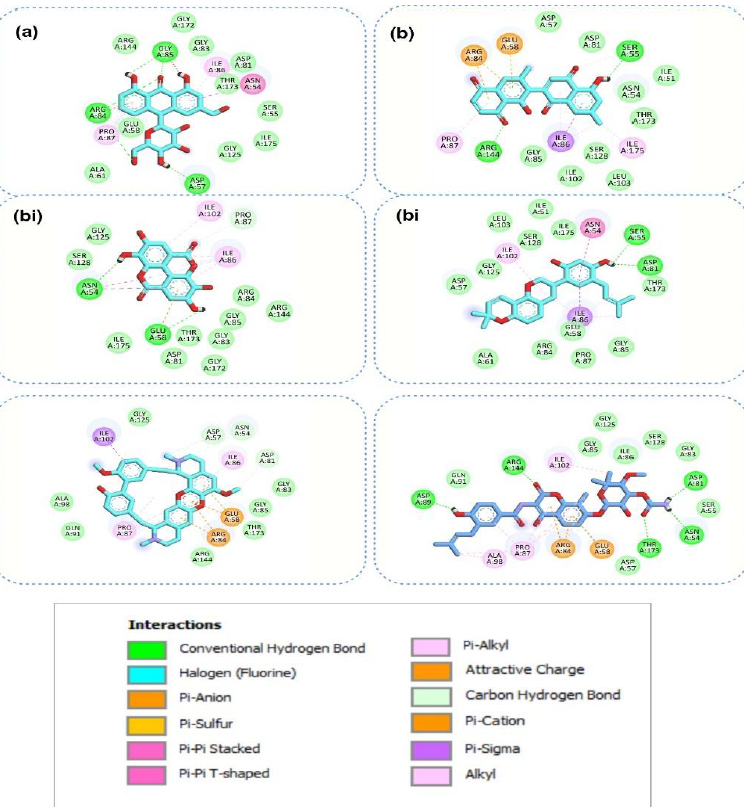
Antimicrobial resistance in Staphylococcus aureus presents a continuing challenge to effective antibacterial treatment. This study computationally screened phytochemicals associated with Nigerian medicinal plants to identify potential inhibitors of S. aureus DNA gyrase B (GyrB). Candidate compounds were selected from published ethnobotanical and phytochemical literature, and their chemical structures were prepared for molecular docking against GyrB (PDB ID: 4URO) using AutoDock Vina through PyRx. Novobiocin was used as the reference inhibitor. Predicted protein–ligand interactions and absorption, distribution, metabolism, excretion, and toxicity (ADMET) properties were subsequently examined. Tiliacorine exhibited the most favourable docking score (−9.5 kcal/mol), followed by ellagic acid (−9.2 kcal/mol), bidebiline (−9.0 kcal/mol), and diospyrin (−8.8 kcal/mol), compared with −8.6 kcal/mol for novobiocin. Interaction analysis indicated recurring predicted contacts involving Asp81 and Gly85, with additional interactions reported for tiliacorine involving Arg84 and Arg144. ADMET predictions suggested comparatively favourable drug-likeness characteristics for diospyrin and ellagic acid, although potential pharmacokinetic and toxicity limitations were identified. Tiliacorine and bidebiline also exhibited predicted safety concerns. These findings identify selected phytochemicals as candidates for further investigation but do not establish GyrB inhibition or antibacterial efficacy. Experimental enzyme-inhibition assays, antibacterial susceptibility testing, and safety evaluation are required to validate their therapeutic potential
References
Achika, J. I., Yusuf, A. J., Ayo, R. G., & Liman, D. U. (2023). Flavonoids from Nigerian indigenous medicinal plants and their bioactivities: A review. Phytomedicine Plus, 3(2), Article 100405. https://doi.org/10.1016/j.phyplu.2023.100405
Adebayo, J. O., Ceravolo, I. P., Gyebi, G. A., Olorundare, O. E., Babatunde, A. S., Penna-Coutinho,J. P., Koketsu, M., & Krettli, A. U. (2022). Iloneoside, an antimalarial pregnane glycoside isolated from Gongronema latifolium leaf, potentiates the activity of chloroquine against multidrug resistant Plasmodium falciparum. Molecular and Biochemical Parasitology, 249, Article 111474. https://doi.org/10.1016/j.molbiopara.2022.111474
Ancuceanu, R., Lascu, B. E., Drăgănescu, D., & Dinu, M. (2025). In silico ADME methods used in the evaluation of natural products.
Pharmaceutics, 17(8), Article 1002. https://doi.org/10.3390/pharmaceutics17081002
Asiamah, I., Obiri, S. A., Tamekloe, W., Armah, F. A., & Borquaye, L. S. (2023). Applications of molecular docking in natural products-based drug discovery. Scientific African, 20, Article e01593. https://doi.org/10.1016/j.sciaf.2023.e01593
Bisacchi, G. S., & Manchester, J. I. (2015). A new-class antibacterial - Almost. Lessons in drug
discovery and development: A critical analysis of more than 50 years of effort toward ATPase inhibitors of DNA gyrase and topoisomerase IV. ACS Infectious Diseases, 1(1), 4–41. https://doi.org/10.1021/id500013t
Cheng, F., Li, W., Zhou, Y., Shen, J., Wu, Z., Liu, G., Lee, P. W., & Tang, Y. (2012). admetSAR: A
comprehensive source and free tool for assessment of chemical ADMET properties. Journal of Chemical Information and Modeling, 52(11), 3099–3105. https://doi.org/10.1021/ci300367a
Chukwudi, C. U., Enwonwu, A., Oyeyemi, O. T., Malami, I., Oyeyemi, I. T., Ibrahim, M. A.,
Adebayo, E. A., Kazeem, M. I., & Atilola, O. (2026). Nigerian medicinal plants on the road to drug discovery: Prospects and challenges. Clinical Phytoscience, 12, Article 16. https://doi.org/10.1186/s40816-026-00429-1
Collin, F., Karkare, S., & Maxwell, A. (2011). Exploiting bacterial DNA gyrase as a drug target:
Current state and perspectives. Applied Microbiology and Biotechnology, 92, 479–497. https://doi.org/10.1007/s00253-011-3557-z
Daina, A., Michielin, O., & Zoete, V. (2017). SwissADME: A free web tool to evaluate
pharmacokinetics, drug-likeness and medicinal chemistry friendliness of small molecules. Scientific Reports, 7, Article 42717. https://doi.org/10.1038/srep42717
Dorcheh, F. A., Balmeh, N., & Sanjari, S. (2022). In-silico investigation of antibacterial herbal
compounds in order to find new antibiotic against Staphylococcus aureus and its resistant subtypes. Informatics in Medicine Unlocked, 28, Article 100843. https://doi.org/10.1016/j.imu.2021.100843
Dallakyan, S., & Olson, A. J. (2015). Small-molecule library screening by docking with PyRx. In
J. E. Hempel, C. H. Williams, & C. C. Hong (Eds.), Chemical biology: Methods and protocols (pp. 243–250). Humana Press. https://doi.org/10.1007/978-1-4939-2269-7_19
Durdagi, S., Ul Qamar, M. T., Salmas, R. E., Tariq, Q., Anwar, F., & Ashfaq, U. A. (2018).
Investigating the molecular mechanism of staphylococcal DNA gyrase inhibitors: A combined ligand-based and structure-based resources pipeline. Journal of Molecular Graphics and Modelling, 85, 122–129. https://doi.org/10.1016/j.jmgm.2018.07.010
El-Shibani, F. A. A., Sulaiman, G. M., Abouzied, A. S., Al Ali, A., Abdulkarim, A. K., Alamami,
A. D., Asiri, M., & Mohammed, H. A. (2023). Polyphenol fingerprint, biological activities, and in silico studies of the medicinal plant Cistus parviflorus L. extract. ACS Omega, 8(50), 48269–48279. https://doi.org/10.1021/acsomega.3c07545
Fu, L., Shi, S., Yi, J., Wang, N., He, Y., Wu, Z., Peng, J., Deng, Y., Wang, W., Wu, C., Lyu, A.,
Zeng, X., Zhao, W., Hou, T., & Cao, D.(2024). ADMETlab 3.0: An updated comprehensive online ADMET prediction platform enhanced with broader coverage, improved performance, API functionality and decision support. Nucleic Acids Research, 52(W1), W422–W431. https://doi.org/10.1093/nar/gkae236
GBD 2021 Antimicrobial Resistance Collaborators. (2024). Global burden of bacterial
antimicrobial resistance 1990–2021: A systematic analysis with forecasts to 2050. The Lancet, 404(10459), 1199–1226. https://doi.org/10.1016/S0140-6736(24)01867-1
Ismael, M. H., Al-Musawi, B. H., Alyasery, R. A., Taha, A. H., Merza, N. A. R., & Farhood, A. N.
(2025). An in-silico study of garlic extract compounds targeting DNA gyrase in Staphylococcus aureus. Plant Science Today, 12(4). https://doi.org/10.14719/pst.9621
Newman, D. J., & Cragg, G. M. (2020). Natural products as sources of new drugs over the nearly
four decades from 01/1981 to 09/2019. Journal of Natural Products, 83(3), 770–803. https://doi.org/10.1021/acs.jnatprod.9b01285
Pereira-Filho, J. L., Mendes, A. G. G., Campos, C. D. L., Almeida, V. S. S., Pereira, A. P. A.,
Moreira, I. V., Monteiro, C. R. A. V., Gomes, L. N., Rhoden, C. R., Cantanhede-Filho, A. J., Silva, L. A., Lopes, A. J. O., Carvalho, R. C., & Monteiro-Neto, V. (2026). Silibinin potentiates antimicrobial action and reduces staphyloxanthin in Staphylococcus aureus. Pharmaceuticals, 19(4), Article 643. https://doi.org/10.3390/ph19040643
Pudipeddi, A., Vasudevan, S., Shanmugam, K., Mohan, S., Vairaprakash, P., Neelakantan, P.,
Balraj, A. S., & Solomon, A. P. (2023). Design, dynamic docking, synthesis, and in vitro validation of a novel DNA gyrase B inhibitor. Journal of Biomolecular Structure and Dynamics, 41(13), 6345–6358. https://doi.org/10.1080/07391102.2022.2107073
Rafiu, B. O., Omotayo, A. O., Lawal, I. O., & Aremu, A. O. (2025). Ethnobotanical uses of
plants in Nigeria: An analysis of current research trends and patterns. Journal of Ethnobiology and Ethnomedicine, 21, Article 57. https://doi.org/10.1186/s13002-025-00788-y
Downloads
Published
Issue
Section
Categories
License
Copyright (c) 2026 Jumai Ohunene Umazayi, Gideon Ampoma Gyebi, Oluchukwu Ogechukwu Anunobi

This work is licensed under a Creative Commons Attribution 4.0 International License.


