
Assessment of the Effects of Heavy Rainfall on the Environment and Human Health in Eti-Osa Local Government Area, Lagos State, Nigeria
DOI:
https://doi.org/10.33003/fjs-2026-1024-6360Keywords:
heavy rainfall, flooding, climate change, human health, environmental hazardAbstract
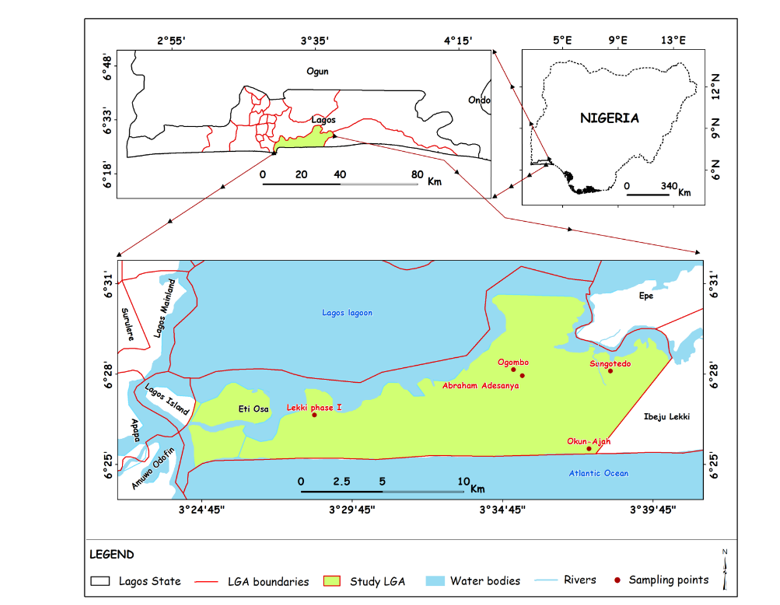
Heavy rainfall and the resulting floods are prominent manifestations of climate variability in low-lying coastal urban areas, with significant implications for environmental quality and public health. This study assessed the environmental and health effects of heavy rainfall on residents of Eti-Osa Local Government Area (LGA), Lagos State, Nigeria. A cross-sectional survey was conducted using structured questionnaires administered to 100 residents (20 per community) across five communities: Abraham Adesanya, Lekki, Sangotedo, Okun-Ajah and Ogombo. Data were analysed using descriptive statistics in SPSS version 20 and Microsoft Excel. Most respondents (95%) perceived rainfall intensity as high. Damage to buildings and loss of property (55%) was identified as the most significant environmental impact, followed by disrupted transportation and water pollution (25%). Common cold (64%), typhoid (18%), malaria (11%), and diarrhoea (7%) were the most frequently reported health problems, while mosquito infestation (90%) and malaria-like symptoms (91%) were widely reported after rainfall events. Town hall meetings (40%) were considered the most effective awareness strategy, while clearing drainage channels (60%) and constructing durable drainage systems (51%) were the preferred mitigation measures. The study concludes that heavy rainfall poses substantial environmental and public health challenges in Eti-Osa LGA, worsened by poor drainage and indiscriminate waste disposal, and contributes community-level evidence on flood risk in Lagos's coastal LGAs. Strengthening drainage infrastructure, enforcing environmental sanitation laws, and promoting community-based awareness programmes are recommended to reduce flood-related risk.
References
Abdulrahim, A., Gulumbe, B.H., Liman, U.U (2022). A catastrophic flood in Nigeria, its impact on health facilities and exacerbations of infectious diseases. Pan African Medical Journal- One Health, 9: 21. https://doi.org/10.11604/pamj-oh.2022.9.21.38023
Aborode, A. T., Otorkpa, O. J., Abdullateef, A. O., Oluwaseun, O. S., Adegoye, G. A., Aondongu, N. J., Oyetunji, I. O., Akingbola, A., Scott, G. Y., Kolawole, B. O., & Komakech, J. J. (2025). Impact of climate change-induced flooding, water-related diseases and malnutrition in Borno State, Nigeria: A public health crisis. Environmental Health Insights, 19, 1–13. https://doi.org/10.1177/11786302251321683
Adesina, M. A., Adedeji, R. T., Oladipupo, I. R., Olufadewa, I. I., Oladele, R. I., Olufadewa, T. A., Adesina, J. A., & Olansile, A. K. (2026). Cholera amid the climate crisis: A systematic review of flooding-driven health risks in West Africa. Discover Public Health, 23, Article 497. https://doi.org/10.1186/s12982-026-01743-2
Akindejoye, A., Viavattene, C., Priest, S. & Windridge, D. (2025). Identifying social vulnerability profiles for coastal flood using supervised and unsupervised machine learning: A case study of Lekki Peninsula, Lagos, Nigeria. International Journal of Disaster Risk Reduction, 127, Article 105693. https://doi.org/10.1016/j.ijdrr.2025.105693
Adesina, M. A., Adedeji, R. T., Oladipupo, I. R., Olufadewa, I. I., Oladele, R. I., Olufadewa, T. A., Adesina, J. A., & Olansile, A. K. (2026). Cholera amid the climate crisis: A systematic review of flooding-driven health risks in West Africa. Discover Public Health, 23: 497. https://doi.org/10.1186/s12982-026-01743-2
Akindejoye, A., Viavattene, C., Priest, S., Windridge, D. (2025). Identifying social vulnerability profiles for coastal flood using supervised and unsupervised machine learning: a case study of Lekki Peninsula, Lagos, Nigeria. International Journal of Disaster Risk Reduction, 127: 105693. https://doi.org/10.1016/j.ijdrr.2025.105693
Aniramu, O., Orimoogunje, O. (2025). Integrating geospatial mapping and stakeholders' perception on sustainable flood solutions in a typical coastal megacity of Nigeria: a SWOT-AHP approach. Frontiers in Sustainable Cities, 7, 1663269. DOI: https://doi.org/10.3389/frsc.2025.1663269
Banire, M. (2011). Climate Change, Urban Flooding and the Nigerian Economy. Centre for Environmental Studies, Lagos.
Birmingham, M.E. (1997). Epidemic cholera in Burundi: patterns in the Great Rift Valley Lake region. Lancet 349(9057): 981-985.
Colwell, R.R. (1996). Global climate and infectious disease: the cholera paradigm. Science 274(5295): 2025-2031.
Curriero, F.C., Patz, J.A., Rose, J.B., Lele, S. (2001). The association between extreme precipitation and waterborne disease outbreaks in the United States, 1948-1994. American Journal of Public Health, 91(8): 1194-1199.
Dossa, K.F., Miassi, Y.E., Bakary, S., & Ogou, F.K. (2025). Drowning in urban growth: rethinking flood resilience and spatial equity in Lagos, Nigeria. Frontiers in Sustainable Resource Management 4, 1659930. https://doi.org/10.3389/fsrma.2025.1659930
European Union (2007). Directive 2007/60/EC of the European Parliament and of the Council on the assessment and management of flood risks. Official Journal of European Union, L288, 27-34.
Idowu, O.A. (2011). Flooding and poverty in Nigeria: implications for sustainable development. Journal of Environment and Earth Science, 1(2): 45-52.
Intergovernmental Panel on Climate Change. (2022). Climate Change 2022: Impacts, Adaptation and Vulnerability. Contribution of Working Group II to the Sixth Assessment Report of the Intergovernmental Panel on Climate Change. Cambridge University Press, Cambridge. https://doi.org/10.1017/9781009325844
Lafferty, K.D. (2009). The ecology of climate change and infectious diseases. Ecology 90(4): 888-900.
Lawanson, O.I., Proverbs, D., & Ibrahim, R.L. (2023). The impact of flooding on poor communities in Lagos State, Nigeria: the case of the Makoko urban settlement. J. Flood Risk Manage. 16(1): e12838. DOI: https://doi.org/10.1111/jfr3.12838
McMichael, A.J; Woodruff, R.E; Hales, S (2006). Climate change and human health: present and future risks. Lancet 367(9513): 859-869.
Moore, S., & Colwell, R. (2025). Climate change and the resurgence of waterborne diseases: focus on Sub-Saharan Africa. Field Actions Science Reports, 27(Special Issue): 66-70.
Ndimele, P. E., Ojewole, A. E., Mekuleyi, G. O., Badmos, L. A., Agosu, C. M., Olatunbosun, E. S., Lawal, O. O., Shittu, J. A., Joseph, O. O., Ositimehin, K. M., Ndimele, F. C., Ojewole, C. O., Abdulganiy, I. O., & Ayodele, O. T. (2024). Vulnerability, resilience and adaptation of Lagos coastal communities to flooding. Earth System Science and Society, 4: 10087. https://doi.org/10.3389/esss.2024.10087
Nwakerendu, I. (2016). Sanitation exercise in Lagos State, Nigeria: the imperative of integrated communication strategy. Convenant Journal of Communication, 3(2): 28-43.
Odubote, O. B., Ikuemonisan, F. E., Okedeyi, S. A., Kayode, Y. O., Ajose, A. S., & Adewopo, A. (2026). Assessing the potential of compound coastal flooding from oceanic surge and rainfall under climate change in the Niger Delta Region, Nigeria. FUDMA Journal of Sciences, 10(9): 299–306. https://doi.org/10.33003/fjs-2026-1009-5192
Olajuyigbe, A.E., Rotowa, O.O., Durojaye, E. (2012). An assessment of flood hazard in Nigeria: the case of Mile 12, Lagos. Mediterranean Journal of Social Sciences, 3(2): 367-375. https://doi.org/10.5901/mjss.2012.v3n2.367
Orimoogunje, O., & Aniramu, O. (2025). Systematic review of flood resilience strategies in Lagos Metropolis: Pathways toward the 2030 Sustainable Development Agenda. Frontiers in Climate,7: 1603798. https://doi.org/10.3389/fclim.2025.1603798
Park, K.J. (2013). Impacts of heavy rainfall and typhoon on allergic diseases. Osong Public Health and Research Perspectives, 4(3): 140-145.
United Nations Educational, Scientific and Cultural Organization. (2006). Guidelines on intercultural education. UNESCO, Paris.
WHO (2003). Climate change and human health - Risks and responses. World Health Organization, Geneva.
Downloads
Published
Issue
Section
Categories
License
Copyright (c) 2026 Yemisi Aramide Tijani, Stephen Taiwo Ogundeji, Noa Abayomi Adedokun

This work is licensed under a Creative Commons Attribution 4.0 International License.


