
Effect of Wind-Measurement Height and Photovoltaic Area on the Least-Cost Hybrid Supply of a University Critical Bus in Kaduna, Nigeria: A Screening-Level Techno-Economic Assessment
DOI:
https://doi.org/10.33003/fjs-2026-1024-6363Keywords:
hybrid renewable system, hub height, levelised cost, screening assessment, university campus, NigeriaAbstract
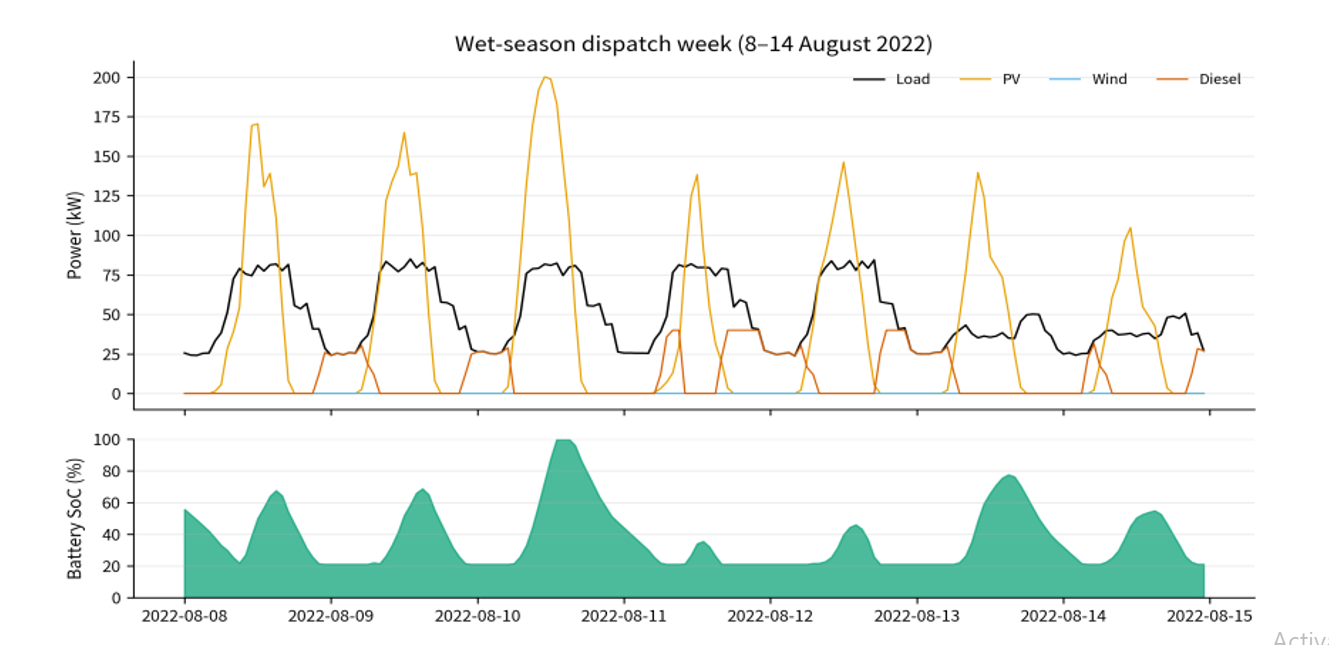
This screening-level assessment tests whether small wind belongs in a least-cost hybrid plant for a critical-facility bus at Kaduna State University (10.52° N, 7.44° E), and whether that answer depends on wind-measurement height and a limit on photovoltaic capacity. An open hourly load-following model used NASA POWER (2026) meteorology for 2022 and a synthesised critical load (peak 97.1 kW; 477 MWh yr−1). A generic turbine curve gave capacity factors of 4.8% at 10 m (mean 3.41 m s−1) and 19.2% at 50 m (mean 5.34 m s−1). Among 1,350 candidate grid combinations retained only if the loss-of-power-supply probability was at most 1%, the unconstrained cost minimum under the assumed prices was 320 kW of photovoltaics, 800 kWh of storage and 40 kW of diesel, with no wind: levelised cost 0.190 USD kWh−1, renewable fraction 91.4%, and diesel CO2 40 t yr−1, against 0.351 USD kWh−1 and 505 t yr−1 for diesel only. Capping photovoltaics at 200 kW brought 40 kW of wind into the optimum and raised the levelised cost to 0.215 USD kWh−1 within the explored design space. The wind-selection result is conditional on the synthetic load, screening costs and single-year resource series; a 10 m mean should not be used as hub-height input for this site.
References
Diyoke, C., Egwuagu, M. O., Onah, T. O., Ugwu, K. C., & Dim, E. C. (2023). Comparison of the grid and off-grid hybrid power systems for application in university buildings in Nigeria. International Journal of Renewable Energy Development, 12(2), 348–365. https://doi.org/10.14710/ijred.2023.49814
Kuhe, A., Ndah, A. A., & Idris, M. A. (2025). Enhancing energy security and cost efficiency in Nigerian higher institutions via hybrid renewable energy systems. Discover Environment, 3, Article 138. https://doi.org/10.1007/s44274-025-00350-3
Lambert, T., Gilman, P., & Lilienthal, P. (2006). Micropower system modeling with HOMER. In F. A. Farret & M. G. Simões (Eds.), Integration of alternative sources of energy (pp. 379–418). Wiley.
Manwell, J. F., McGowan, J. G., & Rogers, A. L. (2009). Wind energy explained: Theory, design and application (2nd ed.). Wiley.
NASA POWER. (2026). Prediction of Worldwide Energy Resources. National Aeronautics and Space Administration. https://power.larc.nasa.gov/
Downloads
Published
Issue
Section
Categories
License
Copyright (c) 2026 Peter Anthony, Abubakar Magaji, Kabiru Koko

This work is licensed under a Creative Commons Attribution 4.0 International License.


