
Demographic and Socioeconomic Determinants of Transport Mode Choice among Commuters in Kano Metropolis
DOI:
https://doi.org/10.33003/fjs-2026-1024-6368Keywords:
Transport Mode Choice, Multinomial Logistic Regression, Demographic Characteristics, Socioeconomic Characteristics, KanoAbstract
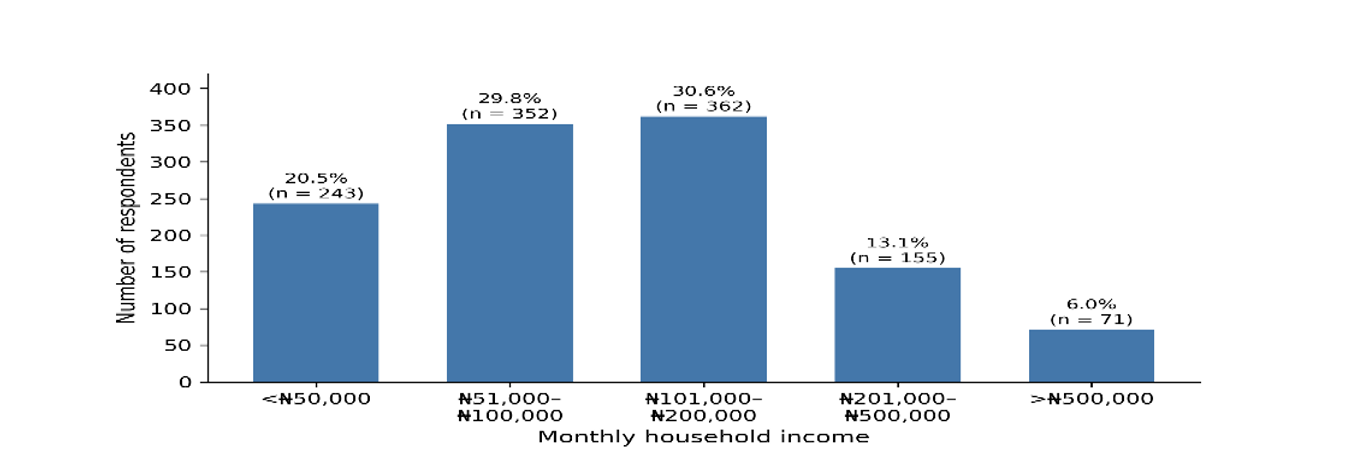
This study examined demographic and socioeconomic associations with transport mode choice in Kano metropolis, Nigeria. A cross-sectional survey provided 1,183 observations across Zoo Road, Hadejia Road, and Katsina Road. Multinomial logistic regression compared Public Bus, Private Motorcycle, Taxi, and Private Car with Keke Napep while adjusting for trip and spatial characteristics. Keke Napep was the most frequently used mode for 48.7% of respondents, followed by Private Car (25.3%), Private Motorcycle (18.5%), Public Bus (3.9%), and Taxi (3.6%). Omnibus likelihood-ratio tests identified gender, age group, education, and monthly household income as significant predictors; occupation (p = .061) and household size (p = .179) were not significant overall. Women had a lower relative risk of Private Motorcycle use (RRR = 0.172, p < .001) and a higher relative risk of Public Bus use (RRR = 6.723, p = .020) than men, relative to Keke Napep. Each increase in household-income category was positively associated with Private Motorcycle (RRR = 1.534, p = .002) and Private Car use (RRR = 3.909, p < .001). McFadden pseudo-R² was 0.7143, and in-sample classification accuracy was 85.55%. The findings support attention to commuter characteristics in transport planning. Sparse mode–predictor combinations and an inconclusive independence-of-irrelevant-alternatives assessment limit interpretation of some estimates. The findings represent adjusted associations rather than causal effects.
References
Abdullahi, A., Abdulganiyu, I. A., Morakinyo, O. E., Abdulquadri, K., & Yusuf, R. (2024). Exploring the efficiency of tricycles as a public transportation mode in Nigeria: A case study of Kano metropolis. Journal of Environmental Spectrum, 4(1), 79–90. https://www.researchgate.net/publication/391326995_Exploring_The_Efficiency_of_Tricycles_as_A_Public_Transportation_Mode_in_Nigeria_A_Case_Study_of_Kano_Metropolis
Agresti, A. (2013). Categorical data analysis (3rd Ed.). Wiley. https://www.wiley.com/en-gb/categorical-data-analysis-3rd-edition-p-9781118710944
Amalahu, C. C., Nwabueze, J. C., Enogwe, S. U., & Ekeadinotu, C. B. (2025). Applying Bayesian dynamic mixed logistic regression to mobility networks. FUDMA Journal of Sciences, 9(5), 101–105. https://doi.org/10.33003/fjs-2025-0905-3654
Fox, J., & Monette, G. (1992). Generalized collinearity diagnostics. Journal of the American Statistical Association, 87(417), 178–183. https://doi.org/10.1080/01621459.1992.10475190
Hair, J. F., Jr., Babin, B. J., Anderson, R. E., & Black, W. C. (2018). Multivariate data analysis (8th Ed.). Cengage Learning. https://www.cengage.uk/c/multivariate-data-analysis-8e-hair-babin-ander-son-black/9781473756540/
Hosmer, D. W., Jr., Lemeshow, S., & Sturdivant, R. X. (2013). Applied logistic regression (3rd Ed.). Wiley. https://doi.org/10.1002/9781118548387
Lenshie, N. E., Ezeibe, C. C., Joshua, M. M., & Nwangwu, C. (2022). From motorcycle to tricycle: Neoliberal political economy, informal transportation, and urban/peri-urban mobility in Nigerian cities. Transportation Journal, 61(2), 195–227. https://doi.org/10.5325/transportationj.61.2.0195
Paulley, N., Balcombe, R., Mackett, R., Titheridge, H., Preston, J. M., Wardman, M. R., Shires, J. D., & White, P. (2006). The demand for public transport: The effects of fares, quality of service, income and car ownership. Transport Policy, 13(4), 295–306. https://doi.org/10.1016/j.tranpol.2005.12.004
Pojani, D., & Stead, D. (Eds.). (2017). the urban transport crisis in emerging economies. Springer International Publishing. https://doi.org/10.1007/978-3-319-43851-1
R Core Team. (2023). R: A language and environment for statistical computing [Software]. R Foundation for Statistical Computing. https://www.r-project.org/
Salon, D., & Gulyani, S. (2010). Mobility, poverty, and gender: Travel 'choices' of slum residents in Nairobi, Kenya. Transport Reviews, 30(5), 641–657. https://doi.org/10.1080/01441640903298998
UN-Habitat. (2022). World cities report 2022: Envisaging the future of cities. United Nations Human Settlements Programme. https://unhabitat.org/world-cities-report-2022-envisaging-the-future-of-cities
World Bank. (2022, November 29). With bus rapid transit, African cities are riding toward a better future. https://www.worldbank.org/en/news/feature/2022/11/28/with-bus-rapid-transit-african-cities-are-riding-toward-a-better-future
Downloads
Published
Issue
Section
Categories
License
Copyright (c) 2026 Musa Yahaya, Razaq Bayo Afolayan

This work is licensed under a Creative Commons Attribution 4.0 International License.


