
Schiff Base Constructed from 2-Thiophene Carbaldehyde and O-Phenylenediamine and its Co (Ii), Ni (Ii), and Cu (Ii) Complexes: Synthesis, Characterisation, and Antimicrobial Studies
DOI:
https://doi.org/10.33003/fjs-2026-1024-6373Keywords:
Schiff Base, Antibacterial, Synthesis, Complexes, CharacterizationAbstract
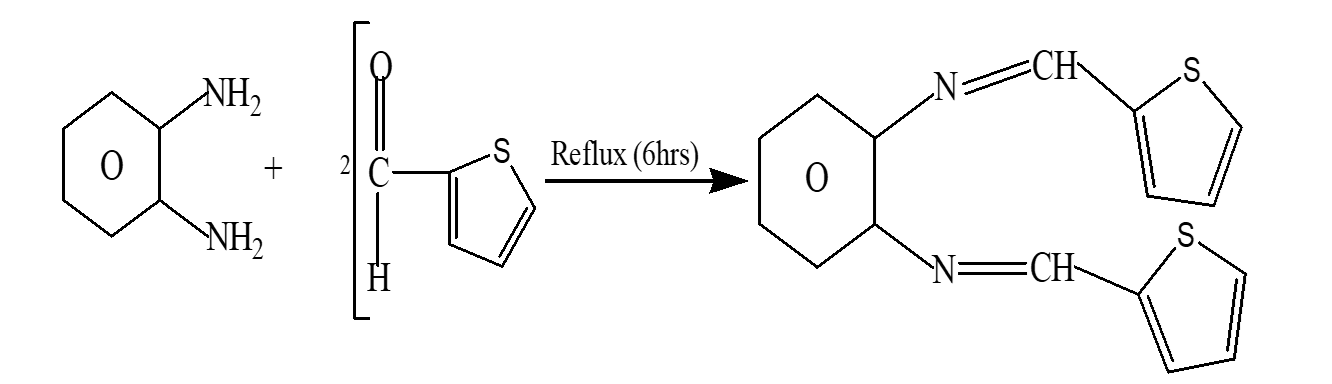
Schiff base derived from 2-thiophene carbaldehyde and o-phenylenediamine was synthesized. The Schiff base underwent reflux with the corresponding metal (II) chlorides to produce Co(II), Ni(II), and Cu(II) complexes. These complexes were characterized through various analytical methods including FT-IR spectroscopy, determination of melting/decomposition temperatures, solubility assessments, magnetic susceptibility measurements, atomic absorption spectroscopy, conductivity analysis, and elemental analysis. In the FT-IR spectra of the Schiff base, a distinctive vibrational peak at 1622 cm-1 was observed, attributed to the azomethine υ(C=N) vibration frequencies. Interestingly, shifts in the vibrational bands (of azomethine) were noted in the complexes, indicating their involvement in complex formation. Absorption bands in the range of 713 – 769 cm-1 in the complexes were linked to M-N bond formation, confirming the presence of metal-nitrogen bonds. The complexes exhibited low molar conductance values (6–13 Ohm-1 cm2 mol-1), indicating their non-electrolytic nature. The Schiff base displayed a melting point of 120°C, whereas the complexes showed decomposition temperatures within the range of 155-196°C, signifying their thermal stability. The magnetic susceptibility values deduced suggested an octahedral geometry for all complexes, ranging between 2.24-3.12BM. Elemental analysis of the Schiff base and its metal(II) complexes for C, H, and N content revealed close agreement between observed and calculated percentages, suggesting a 1:2 metal-Schiff base ratio in all complexes. Qualitative tests confirmed the presence of chloride in the complexes, with estimated percentages falling between 4.62-7.90%. Furthermore, the synthesized Schiff base and its metal (II) complexes were evaluated for their antibacterial and antifungal activities against various microbial species.
References
Aly S.A. &Fathalla S.K., (2020) Preparatrion, characterization of some transition metal complexes of hydrazine derivatives and their antibacterial and antioxidant activities. Arabian Journal of Chemistry 13, 3735-3750.
Abdulbaset A.E., Ahmad M.A. (2014) Preparation, characterization and biological evaluation of Schiff base of some drug substances. Journal of medical and Bioengineering.3 (3), 185-189
Angelici, R.J. (1977): “Synthesis and Techniques in Inorganic Chemistry”, 2nd edition, W.B Savders Company, pp 115-125
Annapoorani S., Krishnan C., (2013); Synthesis and spectroscopic studies of trinuclear N4 Schiff base complexes. International Journal of Chemistry and Technical Research, 5(1): 180-185
Arulmurugan S., Helen P. K., Venkatraman B.R., (2010); Biological activities of Schiff base and its complexes: A Review. Rasayan Journal of Chemistry 3(3) 385-410
Brumfit W. and Hamilton M.(1993), reassessment of the rationale for the combination of sulphonamides with diaminopyrimides, journal of chemotherapy, 5(6): 465-470
Cheesbrough, M. (2002). “District Laboratory Practice in Tropical Countries”. Part 2. Cambridge University Press, UK. 132-143. Debnath
Clinical and Laboratory Standards Institute (CLSI). (2006). Performance Standards for Antimicrobial Disk Susceptibility Tests; Approved Standard-Ninth Edition; CLSI document M2-A9; CLSI: Wayne, PA, USA,
Fatima A. J. A., (2015); Ca (II) and Au (II) sulfamethoxazole sulfa-drug complexes: Synthesis, spectroscopic and anticancer evaluation studies. Oriental Journal of Chemistry 31(3); 1277-1285
Geary WJ (1971). The use of conductivity measurements in organic solvents for characterization of coordination compounds, Coordination Chemistry Review. 7(1):81-122
Gupta, K. C. and Sutar, A. K. (2008); Catalytic activities of Schiff base transition metal complexes. Coordination Chemistry Reviews 252 (12), 1420-1450
Hassan, S. W., Umar, R. A., Lawal, M., Bilbis, L. S. and Muhammad, B. Y. (2006); Evaluation of antifungal activity of Ficussycomorus(moraceae). Biological and Environmental Science Journal for the Tropics 3(2):18-25.
Jurca T., Eleonora M., Gratiela L. V., Eugenia M. M., Luminata F. (2017); Metal Complexes of Pharmaceutical Substances, Spectroscopic Analyses – Developments and applications, DrEramSharmin (Ed), Intech 123-139
Kumble D., Geetha M. P., and Asha F. P. (2017): application of metal complexes of Schiff base as an antimicrobial drug: A review of recent works. International Journal of current pharmaceutical Research 9(3); 27-30
Lee J. D. (1996), Concise Inorganic Chemistry Oxford University Press, 5th edition, Pp 800-834
Suraj B.A. Deshpande M.N. and Deshmukh J.H. (2012), Synthesis and Characterization of transition metal complexes of Schiff base derived Isatin and 2-amino, 4-chlorobenzoic acid. Rayasan J. Chem 4(13): 671 – 673.
Weaver G. W., Elsegood M. R., Tariq M., Amina M. (2016); synthesis and characterization of new Schiff base transition metal complexes derived from drug together with biological potential. Journal of Nuclear Medicine and Radiation Therapy7 (6):1-4.
Yusha’u M. and Sadisu F.U (2011): Inhibition activity of deuterium microcarpum extracts on some clinical isolates. Biological and Environment Science Journal for the Tropics 8(4): 113-117.
Zahid H. C., Hazoor A. S., Claudiu T. S (2012) Synthesis, characterization and biological studies of sulfonamide Schiff bases and some of their metal derivatives, Journal of Enzyme Inhibition and Medicinal Chemistry, 27(1):58-68
Downloads
Published
Issue
Section
Categories
License
Copyright (c) 2026 Habibu Bashir Ado, Nura Nasiru Rabiu, Adam Sulaiman Ahmad, Ahmad Ahmad

This work is licensed under a Creative Commons Attribution 4.0 International License.


