
Insecticidal Activity of Selected Agricultural Plant Ashes and Their Combinations with Clove Powder against Sitophilus Zeamais (Motschulsky) in Stored Maize
DOI:
https://doi.org/10.33003/fjs-2026-1024-6384Keywords:
Infestation, Post-harvest, Food security, Mortality, TreatmentAbstract
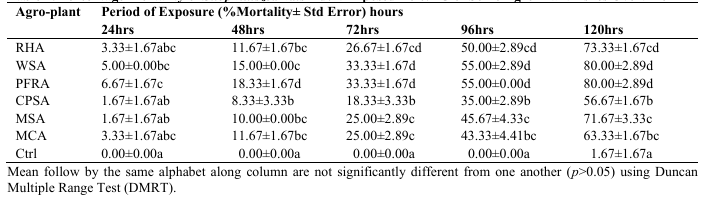
Post-harvest grain loss due to infestation by storage pest remains a challenge for food security and smallholder livelihoods in the developing world, which can occur across the food supply chain from harvesting of crops till consumption. This study investigated the insecticidal efficacy of agricultural plant ashes both as single treatments and in binary combination with clove (Eugenia aromatica) plant powder, against Sitophiluszeamais infesting stored maize grain, the design used was a Completely Randomized Design (CRD) with three replications. The bioassays were conducted at different dosages (0.2 g, 0.4 g, 0.6 g, 0.8 g, and 1.0 g) per 20 g of grain seeds and monitored over exposure intervals of 120 hours. The results demonstrated that all treatments caused a significant (p>0.05) increase in adult mortality. PFRA and WSA exhibited the highest potency, of 91.67% and 90.00% mortality respectively at a 0.6 g dosage after 120 hours of exposure. RHA and MSA also showed high efficacy, while CPSA was the least toxic but still significantly superior to the control. The insecticidal mechanism of the ashes was identified as physical, acting as an abrasive inert dust that compromises the protective epicuticular wax layer of the insect, leading to fatal desiccation, alongside respiratory blockages. Incorporating Eugenia aromatica powder into the ashes to form a binary mixture of ratio 1:1 significantly accelerated weevil mortality. PFRA mixed with Eugenia aromatica powder emerged as the most potent formulation, achieving up to 20.13% mortality within 24 hours at the highest dosage and 33.31% after 48 hours...
References
Abass A.B., Fischler M., Schneider K., Daudi S., Gaspar A., Rüst J., Kabula E., Ndunguru G., Madulu D., Msola D. (2018): On farm comparison of different postharvest storage technologies in a maize farming system of Tanzania Central Corridor. Journal of Stored Products Research 77: 55–65. https://doi.org/10.1016/j.jspr.2018.03.002
Abolusoro O.P, Moshibudi C.K., Washington W. Mechanical and microstructural characteristics of recycled aluminium matrix reinforced with rice husk ash [J]. AIMS Materials Science, 2024, 11(5): 918-934. doi: 10.3934/matersci.2024044
Adediran, J., Taiwo, L.B.,Akande, M., Sobulo, R.A. Application of Organic and Inorganic Fertilizer for Sustainable Maize and Cowpea Yields in NigeriaJournal of Plant Nutrition 27(7):1163-1181DOI:10.1081/PLN-120038542
Adesina J.M. Effectiveness ofSennaoccidentalis(L.) leaves powder in reducing F1 progeny development and seed damage bySitophiluszeamais Mots. (Coleoptera: Curculionidae) in Stored Maize. Intl. J. Appl. Res. Tech. 2012; 1:100–105.
Affognon H., Mutungi C., Sanginga P., Borgemeister C. (2015): Unpacking postharvest losses in sub-Saharan Africa: a meta analysis World Develop. 66: 49–68. https://doi.org/10.1016/j.worlddev.2014.08.002
Afolabi, M. S., Murtadha, M. A., Lamidi, W. A., Waheed, J. A. A., Salami, A. E., & Bello, O. B. (2020). Evaluation of yield and yield components of low n maize (zea mays l.) varieties under low and high nitrogen conditions. African Journal of Agricultural Research, 15(1), 66-72.
Doebley, J. 2004 seminal review article, "The Genetics of Maize Evolution," published in the Annual Review of Genetics (Vol. 38, pp. 37–59),
Fayemiro, S. S. and Abdul, K. O. (2024) Investigation of combined effect of three plant powders with diatomaceous earth against Callosobruchusmaculatus. Journal of agripreneurshipand sustainable development (JASD) 7(3), 2651-6365.
Fajinmi A, Fayemiro SS, Okonji C, Fajinmi OB Protectant effects of Eugenia aromatica and Piper guineense against Callosobruchusmaculatus. Tropical Agriculture, 2015; 92 (1):27-34
Hamel, D., Rozman V., Liška A. (2020): Storage of cereals in warehouses with or without pesticides. Insects 11: 846. http://dx.doi.org/10.3390/insects11120846
Ifie, S. E., Dangana, R.S., Swase, D., Ben Okon, M., Makena, W., Agunloye, M. O., Ugwu, C. N., Ifie, J.E., Odoma, S., Babangida, A.I.,& Aja P.M. Nutritional composition of Zea mays L: A comprehensive review of macronutrients, micronutrients, and bioactive compounds Open Research Africa, 8 (2025), p. 15
Ileke K.D., Adesina J.M., Obajulaye E.O. Synergetic effects of two botanicals entomocides as pest-protectants in maize grains. J. Biol. Res. 2016; 89(2):33–39.
Kumar D., Kalita P. (2017): Reducing postharvest losses during storage of grain crops to strengthen food security in developing countries. Foods 6: 8. https://doi.org/10.3390/foods6010008
Marta, H. E., Suryadi, E., &Ruswandi, D. (2017). Chemical composition and genetics of Indonesian maize hybrids. American Journal of Food Technology, 12(2), 72–85
Nwosu L.C., Adedire C.O. Ogunwolu E.O. (2015): Feeding site preference of Sitophiluszeamais (Coleoptera: Curculionidae) on maize grain. International Journal of Tropical Insect Science 35: 62–68. DOI: https://doi.org/10.1017/S1742758415000065
Odendo, M., De Groote, H., &Odongo, O. M. (2001). Assessment of farmers’ preferences and constraints to maize production in Moist Midaltitude Zone of Western Kenya. Paper presented at the 5th international conference of the African crop science society, Lagos, Nigeria.
Prasanna BM, Palacios-Rojas N, Hossain F. (2020c) Molecular breeding for nutritionally enriched maize: status and prospects. Front Genet 10:1392. https://doi.org/10.3389/fgene.2019.01392
Ranum, P., Peña-Rosas, J. P., & Garcia-Casal, M. N. (2014). Global maize production, utilization, and consumption. Annals of the New York Academy of Sciences, 1312, 105–112. https://doi.org/10.1111/nyas.12396
Rouf, S., Tajamul& Prasad, Kamlesh& Kumar, Pradyuman. (2016). Maize a potential source of human nutrition and health: A review. Cogent Food & Agriculture. 2. 10.1080/23311932.2016.1166995
Shiferaw, B., Prasanna, B. M., Hellin, J., &Bänziger, M. (2011). Crops that feed the world 6: Past successes and future challenges to the role played by maize in global food security. Food Security, 3(3), 307–327.
Tefera, T., Mugo, S., Likhayo, P., &Beyene, Y. (2011). Resistance of three-way cross experimental maize hybrids to post-harvest insect pests, the larger grain borer (prostephanustruncatus) and maize weevil (sitophiluszeamais). International Journal of Tropical Insect Sciences, 63(1–2), 3–12.
Van Duong N., Khanh L.Q., Xuan B.T., Hung C.T. Que L.X. (2020): Using oxygen depletion to maize weevils without chemicals in a storage minienvironment. Vietnam Journal of Chemistry 58: 327–332. https://doi.org/10.1002/vjch.2019000168
Downloads
Published
Issue
Section
Categories
License
Copyright (c) 2026 Segun Samuel Fayemiro, Joy Ejemen Idoko, Kayode David Ileke, Adefunke Adedayo Odetoye, Thomas Inomisan Ofuya

This work is licensed under a Creative Commons Attribution 4.0 International License.


