
Production and Application of Formulated Organic Fertilizer on the Growth and Weed Colonization of (Capsicum Chinense)
DOI:
https://doi.org/10.33003/fjs-2026-1024-6389Keywords:
Germination index,, Encapsulation, Impregnation, Organic Fertilizer, Plant heightAbstract
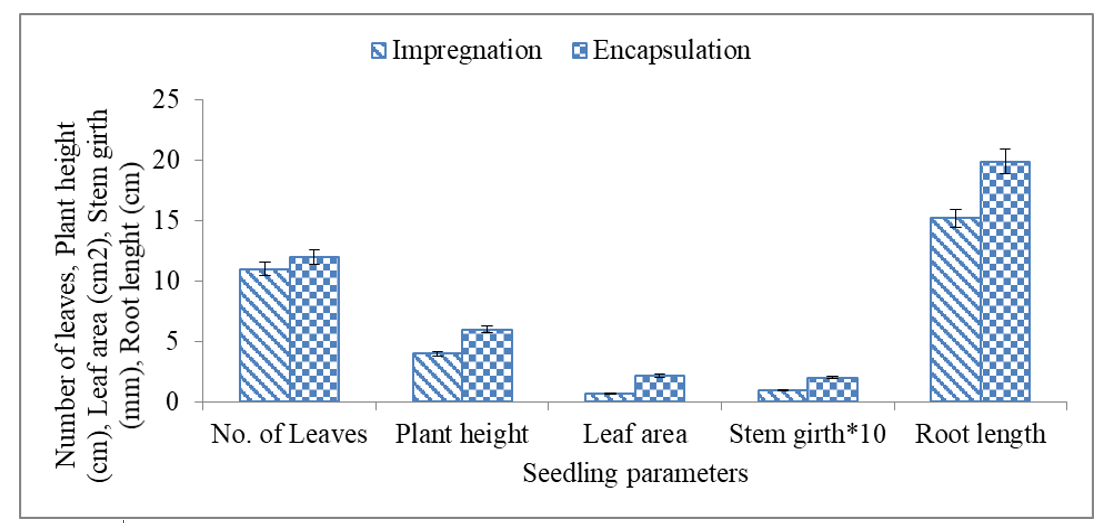
Poor soil fertility continues to hamper Capsicum chinense (C. chinense) growth and productivity. Organic fertilizer was produced using poultry waste, broiler starter feed, cocopeat, biochar and limestone. The influence of formulated organic fertilizer on germination index (GI), electrical conductivity (EC), radicle length, root elongation of seedlings and seedlings growth were evaluated. Best processing technology was investigated and the field trial of the fertilizer was conducted on C. chinense. Treatment coded 74%CP+11%PM+15%CL had highest impact on GI. All treatments showed promising pH for seed germination. Treatment 74%CP+11%PM+15%CL and 76%CP+9%PM+15%CL had highest number of leaves. Organic fertilizer produced via encapsulation technology supported more number of leaves, increased plant height, leaf area, stem girth and root elongation of seedlings. Application of different rate of Encapsulated Organic Fertilizer (EOF) significantly increased leaf area of C. chinense from week 1 after transplanting to week 6 after transplanting. Treatment with 120 kgN/ha gave highest leaf area than control (NPK). Highest plant height was recorded on 120 kgN/ha. Number of leaves of C. chinense significantly (p<0.05) increased on 120 kgN/ha. Highest wet weed weight (19.1 g) was recorded at week 6 on 40kgN/ha application rate while the least (4.1 g) was recorded on 120 kgN/ha. Similar trend was recorded for dry weed weight.
References
Adebayo, A. G., Olatunji, O. M., & Adewale, B. D. (2021). Growth and yield response of pepper (Capsicum spp.) to organic fertilizer application in southwestern Nigeria. Journal of Organic Agriculture and Environment, 9(1), 45–52.
Aliyu, M., Abdulmalik, Z., Bako, Z. M., Jega, R. M., & Kareem, W. (2024). Organic fertilizer production using banana peel, eggshells, and yeast: Effects on Amaranthus growth. FUDMA Journal of Sciences, 8(6), 562 – 567
Das, T. K., Ghosh, P. K., & Rana, K. S. (2020). Weed management in vegetable crops. Indian Journal of Agronomy, 65(3), 345–354.
Kumar, V ., Yadav, S., & Sharma, R. (2021). Biological weed management: Concepts and prospects. Agronomy International, 3(1), 22–34.
Olatunji, O. M., Adebayo, A. G., & Oladipo, O. T. (2021). Growth response of Capsicum chinense to different organic fertilizer treatments. African Journal of Plant Science, 15(3), 73–79.
Singh, G., Mahajan, G ., & Gill, G. (2017). Chemical weed management strategies in horticultural crops. Weed Science Journal, 55(2), 205–212.
Singh, R., Yadav, P., & Kumar, V . (2020). Effect of organic liquid fertilizers on growth and yield of chili (Capsicum annuum). Internati onal Journal of Current Microbiology and
Applied Sciences, 9(5), 2370–2377.
Rouphael, Y., Cardarelli, M., Colla, G., & Rea, E. (2010). Yield, water relations and water use efficiency of grafted mini-watermelon plants under deficit irrigation. HortScience, 45(5), 730–736.
Barakat M.R., Yehia, T.A. & Sayed, B.M. (2012). Response of Newhall Naval Orange to bio-organic Fertilization under Newly Reclaimed Area Conditions I: Vegetative Growth and Nutritional Status. Journal of Horticultural Science of Ornamental Plants. 4(1), 18–25.
Adedayo, R. A., Akanbi, W. B. & Fawole, T. O. (2026). Comparative nutritional, bioactive, and mineral profiling of ten Capsicum cultivars grown in Southwestern Nigeria. Journal of Renewable Agricultural Technology Research, 13(1).
Barboza, G. E., Carrizo García, C., de Bem Bianchetti, L., Romero, M. V. & Scaldaferro, M. (2022). Monograph of wild and cultivated chili peppers (Capsicum L., Solanaceae). PhytoKeys, 200, 1–423.
Timilsina, R. R. R., Khosla, S. K., Rahut, D. B., Jena, P. R. & Sonobe, T. (2025). A comprehensive review of the soil health status for enhancing agricultural sustainability. Frontiers in Environmental Science, 13.
Piccolo, A. & Drosos, M. (2025). The essential role of humified organic matter in preserving soil health. Chemical and Biological Technologies in Agriculture, 12, 21.
Xing, Y., Xie, Y. & Wang, X. (2025). Enhancing soil health through balanced fertilization: A pathway to sustainable agriculture and food security. Frontiers in Microbiology, 16, 1536524.
Mahanty, T., Bhattacharjee, S., Goswami, M., Bhattacharyya, P., Das, B., Ghosh, A. & Tribedi, P. (2017). Biofertilizers: A potential approach for sustainable agriculture development. Environmental Science and Pollution Research, 24(4), 3315–3335.
Kebede, T., Berhe, D. T. & Zergaw, Y. (2023). Effects of biochar and compost application on soil properties and on the growth and yield of hot pepper (Capsicum annuum L.). Applied and Environmental Soil Science, 2023, 8546135.
Ayito, E. O., John, K., Iren, O. B., John, N. M., Mngadi, S., Heung, B. & Moodley, R. (2023). Synergistic effects of biochar and poultry manure on soil and cucumber (Cucumis sativus) performance: A case study from the southeastern Nigeria. Soil Science Annual, 74(4), 183903.
Sarma, B., Borkotoki, B., Narzari, R., Kataki, R. & Gogoi, N. (2017). Organic amendments: effect on carbon mineralization and crop productivity in acidic soil. Journal of Cleaner Production, 152, 157–166.
Schrader, J., Shi, P., Royer, D. L., Peppe, D. J., Gallagher, R. V., Li, Y., Wang, R. & Wright, I. J. (2021). Leaf size estimation based on leaf length, width and shape. Annals of Botany, 128(4), 395–406.
Baidoo, I., Sarpong, D. B., & Bolwig, S. (2016). Biochar amended soils and crop productivity: A critical and meta-analysis of literature. International Journal of Development and Sustainability, Vol. 5, No. 9, pp. 414–432. https://isdsnet.com/ijds-v5n9-1.pdf
Frimpong, K. A., Owusu, S., Darko, R. O., Hanyabui, E., Abbey, A. N. A., & Tetteh, D. A. (2025). Effect of biochar application rates on soil properties and growth of Amaranthus caudatus. Discover Agriculture, 3(1), 21.
Bekchanova, M., Campion, L., Bruns, S., Kuppens, T., Lehmann, J., Jozefczak, M., & Malina, R. (2024). Biochar improves the nutrient cycle in sandy-textured soils and increases crop yield: A systematic review. Environmental Evidence, 13(1). 3.
Singh, S., Devi, N. B., Divya, D., Kumar, A., Singh, S., Singh, G., Nath, A., & Kumar, A. (2024). Soil fertility management: Role of organic amendments and bio-fertilizers: A review. International Journal of Research in Agronomy, 7(12), 766–772.
Downloads
Published
Issue
Section
Categories
License
Copyright (c) 2026 Kola Saheed Olorunnisola, Tajudeen Ajala, Semirah Abidemi Alfanla, Baliqees Bola Haruna, Sanni

This work is licensed under a Creative Commons Attribution 4.0 International License.


