
Exploring Coping and Barriers to Mental Health Help-Seeking Among Unemployed Adults with A History of Suicide in Adamawa State, Nigeria
DOI:
https://doi.org/10.33003/fjs-2026-1021-6396Keywords:
Suicidal Attempts, Unemployed Youth, Coping Strategies, Help-Seeking Behaviour, Mental HealthAbstract
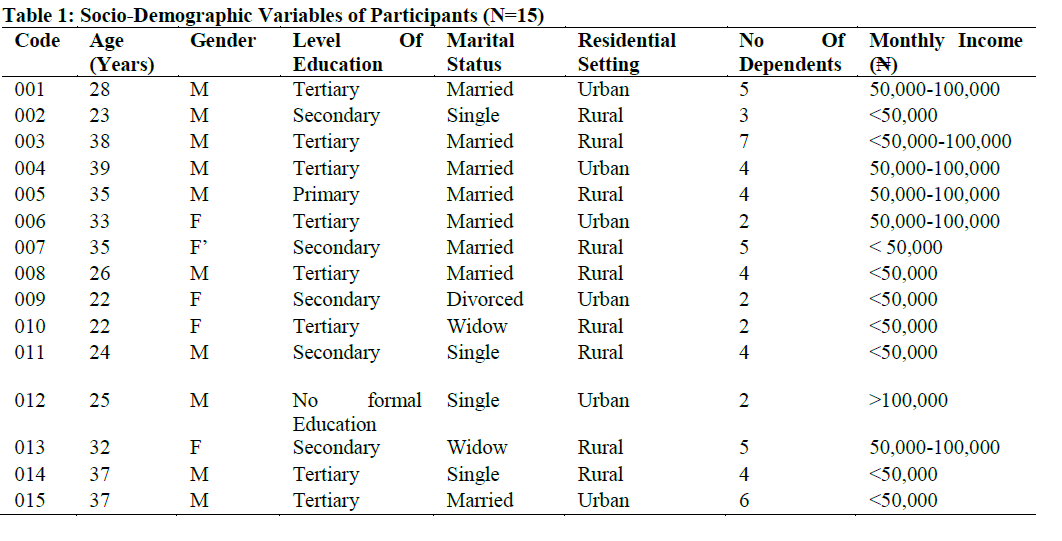
Mental health problems, particularly suicidal attempts, remain a major public health concern among young people in low-resource settings, including Nigeria, where access to formal mental health services remains limited. This study explored coping strategies and barriers to mental health help-seeking among unemployed adults with a history of suicidal attempts in Adamawa State, Nigeria. A phenomenological qualitative design was employed. Participants who met the study eligibility criteria were purposively recruited from the three senatorial zones of Adamawa State, and 11 participants aged 18–45 years who completed the in-depth interviews were included in the final analysis. Data were collected through audio-recorded in-depth interviews, transcribed verbatim, and analysed using Braun and Clarke’s thematic analysis, with NVivo software used to facilitate data management and coding. Participants experienced substantial reliance on informal coping mechanisms, including engagement in daily activities as a means of distraction, social withdrawal, religious practices and culturally based remedies, while some reported seeking information or support through online and artificial intelligence resources. However, participants reported using them, but their accounts did not indicate effective relief or reliable substitution for professional care. Formal mental health services were rarely utilized and were generally sought when distress became severe. Participants identified several barriers to help-seeking, including stigma and fear of social labelling, cultural expectations of self-reliance, financial constraints, negative experiences or perceived negative attitudes from healthcare providers, and delayed recognition of mental health needs.
References
Aghukwa, C. N. (2012). Care seeking and beliefs about the cause of mental illness among Nigerian psychiatric patients and their families. Psychiatric Services, 63(6), 616–618. https://doi.org/10.1176/appi.ps.201000343
Asare-Doku, W., Osafo, J., & Akotia, C. S. (2017). The experiences of attempt survivor families and how they cope after a suicide attempt in Ghana: A qualitative study. BMC Psychiatry, 17, 178. https://doi.org/10.1186/s12888-017-1336-9
Gulliver, A., Griffiths, K. M., & Christensen, H. (2010). Perceived barriers and facilitators to mental health help-seeking in young people: A systematic review. BMC Psychiatry, 10, 113. https://doi.org/10.1186/1471-244X-10-113
Gureje, O., Lasebikan, V. O., Ephraim-Oluwanuga, O., Olley, B. O., & Kola, L. (2005). Community study of knowledge of and attitude to mental illness in Nigeria. The British Journal of Psychiatry, 186, 436–441. https://doi.org/10.1192/bjp.186.5.436
Jidong, D. E., Bailey, D., Sodi, T., Gibson, L., Sawadogo, N., Ikhile, D., Musoke, D., Madhombiro, M., & Mbah, M. (2021). Nigerian cultural beliefs about mental health conditions and traditional healing: A qualitative study. Journal of Mental Health Training, Education and Practice, 16(4), 285–299. https://doi.org/10.1108/JMHTEP-08-2020-0057
Jidong, D. E., et al. (2024). Perspectives on self-harm and suicidal ideation in Nigeria: A mixed-methods study of patients, family caregivers, clinicians, and the public. Archives of Suicide Research, 28(4), 1417–1431. https://doi.org/10.1080/13811118.2024.2314520
Koenig, H. G. (2009). Research on religion, spirituality, and mental health: A review. Canadian Journal of Psychiatry, 54(5), 283–291. https://doi.org/10.1177/070674370905400502
National Bureau of Statistics. (2024). Nigeria labour force survey: Q1 2024. National Bureau of Statistics.
Rickwood, D., Deane, F. P., Wilson, C. J., & Ciarrochi, J. (2005). Young people's help-seeking for mental health problems. Australian e-Journal for the Advancement of Mental Health, 4(3), 218–251.
World Health Organization. (2025a). Suicide worldwide in 2021: Global health estimates. World Health Organization.
World Health Organization. (2025b). Mental health atlas 2024. World Health Organization
Downloads
Published
Issue
Section
Categories
License
Copyright (c) 2026 Bilal Bashir Dausayi, Awwal Ladan Muhammad, Sani Abduljalal Abdulaziz, Kabir Dandago Sumayya, Hassan Murtala Hassan, Hamman Abubakar, Yunusa Umar, Lawal Bello Umar, Mohammad Haddad Mahfuz, Abdulrahman Chiroma Mahmood, Usman Nyakos Umar

This work is licensed under a Creative Commons Attribution 4.0 International License.


