
Mycological and Physicochemical Assessment of Drinking Water from Pupils' Bottles
DOI:
https://doi.org/10.33003/fjs-2026-1021-6403Keywords:
Fungal Contamination, Drinking Water Quality, Physicochemical Parameters, Public Health SurveillanceAbstract
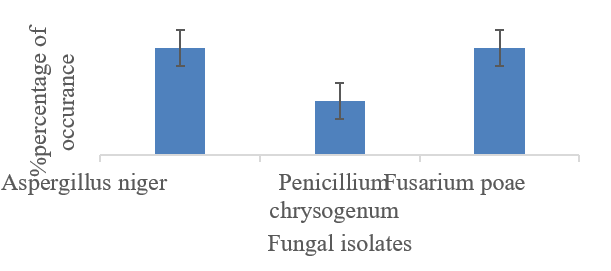
This study investigated the microbial and physicochemical properties of drinking water samples collected from pupils’ water bottles, with a focus on fungal contamination. Water samples were collected aseptically and analysed using standard microbiological and physicochemical methods. Fungi were isolated by serial dilution and cultured on Potato Dextrose Agar, followed by incubation. Morphological and cultural characteristics were examined, and microscopic identification was conducted using lactophenol cotton blue staining. Molecular identification was carried out via PCR amplification targeting the 18S rRNA gene, and amplified products were analysed by gel electrophoresis. The mean microbial load of fungal isolates ranged from 1.04×10⁴ to 2.56×10⁴ sfu/mL, exceeding the WHO permissible limit of 1.0×10² CFU/mL. Identified fungal species included Aspergillus niger, Fusarium poae, and Penicillium chrysogenum, with A. niger and F. poae each accounting for 40% occurrence, and P. chrysogenum 20%. Physicochemical analysis showed that most parameters were within WHO and FEPA limits, except for a slightly elevated pH (8.7) in one sample. Sequencing confirmed the identities of A. niger (573 bp) and F. poae (570 bp). The study highlights the presence of potentially harmful fungi in pupils’ drinking water, emphasizing the need for routine water quality surveillance and public health education.
References
Abaasa, C. N. (2024). Assessing the quality of drinking water from selected water sources in Mbarara City, south-western Uganda. PLOS ONE, 19(3). https://doi.org/10.1371/journal.pone.0297794
Abdulkareem, M. A., Omotunde, O. T., Momoh-Salami, T. M., Bamikole, O. J., & Olajide, T. H. (2023). Bacteriological and physicochemical analysis of surface water: Implications on public health. Biomedical Journal of Scientific & Technical Research, 51(4).
Adebomi, O. H., Okanlawon, T. S., Akinbami, A. M., Otun, M. O., Omobolade, E. S., Omobolade, O., Abadariki, O. O., & Unogwa, G. C. (2026). Characterization of multi-drug resistant bacteria from borehole and sachet water samples in Ilesha, Nigeria. Journal of Pharmaceutical and Allied Sciences, 23(1), 4980–4991
Adetunji, C. O., Mathew, J. T., Inobeme, A., Okanlawon, T. S., Olaniyan, O. T., Ghazanfar, S., & Dauda, W. (2024). Application of biosensors for detection and monitoring of water quality. In S. Das, S. Thomas, & P. P. Das (Eds.), Organic and inorganic materials based sensors (pp. 1065–1077). Wiley. https://doi.org/10.1002/9783527834266.ch46
Alex, F., & Kpormon, L. B. (2023). A comparative assessment of the physicochemical and microbiological qualities of some drinking water sources in Diobu, Portharcourt, Nigeria. South Asian Journal of Research in Microbiology, 17(3), 17–24. https://doi.org/10.9734/sajrm/2023/v17i3329
Avoseh, D. O., Okanlawon, T. S., Ekozin, A. A., Okanlawon, K. P., & Olatunji, E. O. (2024). Assessing the water quality of River Obazagbon, Edo State, Nigeria using physicochemical and bacteriological parameters. Pollution, Bioremediation & Biodegradation Journal, 5(1), 1–7.
Biedunkiewicz, A., Kubiak, K., and Nowakiewicz, A. (2021). Fungi as contaminants of drinking water: Occurrence, health implications, and water system management. Environmental Science and Pollution Research, 28(23), 29731–29744. https://doi.org/10.1007/s11356-021-13119-4
Davies, C. R., Wohlgemuth, F., Young, T., Violet, J., Dickinson, M., Sanders, J. W., ... and Avery, S. V. (2021). Evolving challenges and strategies for fungal control in the food supply chain. Fungal Biology Reviews, 36, 15–26. https://doi.org/10.1016/j.fbr.2020.11.001
Dinolfo, M. I., Castanares, E., and Stenglein, S. A. (2014). Characterization of a Fusarium poae world-wide collection by using molecular markers. European Journal of Plant Pathology, 140(1), 119–132. https://doi.org/10.1007/s10658-014-0448-Z
Enerijiofi, K. E., Adebari, E., Okanlawon, T. S., & Obueh, H. O. (2026). Bioadsorption of some heavy metals by selected bacterial isolates from solid waste dumpsites. Agriculture and Environment, 18, 1–11.
Fisher, M. C., Gurr, S. J., Cuomo, C. A., Blehert, D. S., Jin, H., Stukenbrock, E. H., and Cowen, L. E. (2020). Threats posed by the fungal kingdom to humans, wildlife, and agriculture. mBio, 11(3). https://doi.org/10.1128/mBio.00449-20
Gibert, S., Edel-Hermann, V., Gautheron, E., Gautheron, N., Bernaud, E., Sol, J.-M., Galland, R., Lambert, C., & Steinberg, C. (2022). Identification, pathogenicity and community dynamics of fungi and oomycetes associated with pea root rot in northern France. Plant Pathology, 71(7), 1550–1569.
Hussain, F. (2024). Occurrence of fungal microbial contamination in drinking water of megacity of Karachi (Pakistan) and their physico-chemical control. Heliyon, 10(7), e28926. https://doi.org/10.1016/j.heliyon.2024.e28926
Jain, A., Jain, S., and Rawat, S. (2010). Emerging fungal infections among children: A review on its clinical manifestations, diagnosis, and prevention. Journal of Pharmacy and Bioallied Sciences, 2(4), 314.
Mohapatra, D., Kumar, S., Kotwaliwale, N., and Singh, K. K. (2017). Critical factors responsible for fungi growth in stored food grains and non-chemical approaches for their control. Industrial Crops and Products, 108, 162–182. https://doi.org/10.1016/j.indcrop.2017.06.009
Okafor, C. A., Okanlawon, T. S., Olagunju, A. M., Isatoye, E. F., Oni, T. R., & Adeyemo, S. M. (2023). Invertase activities of lactic acid bacteria isolated from traditional fermented milk (“nono”), agadagidi and palm wine obtained from different locations in Ile-Ife, Osun-State, Nigeria. GSC Biological and Pharmaceutical Sciences, 22(1), 147–156. https://doi.org/10.30574/gscbps.2023.22.1.0503
Okanlawon, T., Olarinre, M., Tobby, U., Oluwasade, A., Ogunniran, J., Ogunrinade, J., Olayori, A. O., Oladeji, D., Oni, J., Adeyemi, A., Hamzat, A, & Oladipo, C. (2026). Microbial Bioprospecting and Antibacterial Potential of Natural Products Against Multidrug-Resistant Pathogens: A Review. BIMA JOURNAL OF SCIENCE AND TECHNOLOGY GOMBE, 10(2), 420-432. https://doi.org/10.64290/bima.v10i2.1622
Okanlawon, T. S., Adeyemo, S. M., & Agbaje, I. S. (2023). Isolation and identification of microorganisms associated with Jollof rice sold at Bukateria in Obafemi Awolowo University, Ile-Ife, Osun State, Nigeria. GSC Biological and Pharmaceutical Sciences, 22(1), 178–185. https://doi.org/10.30574/gscbps.2023.22.1.0274
Okanlawon, T. S., Okanlawon, K. P., Ekozin, A. A., Unogwa, G. C., Fasanya, O. S., Ighodalo, A. J., & Akinsola, O. S. (2024). Physicochemical, bacteriological and enzymatic assessment of water reservoirs in Ogwa and Ebelle communities, Edo State, Nigeria. Journal of Applied Sciences and Environmental Management, 28(10), 3463–3469. https://doi.org/10.4314/jasem.v28i10.63
Okanlawon, T. S., Olarinre, M. A., Hamzat, A. V., Ogunrinade, J. O., Oladeji, D. O., Ogunniran, J. O., Oni, J. O., Tobby, U. E., Olayori, A. O., Samuel, I. O., & Oluwasade, A. M. (2026). Bioprospecting enzyme-producing and antimicrobial microbes from local environments: Opportunities for biotechnology and public health innovation. Bima Journal of Science and Technology, 9(4B), 106–117. https://doi.org/10.64290/bima.v9i4B.1449
Okanlawon, T. S., Isidahomen, D., Akindowo, O. A., Omobolade, O., Isokpehi, N. A., & Oviawe, E. (2026). Bacterial contamination and antimicrobial resistance profiles of street-vended foods in Ogwa and Ebelle, Edo State, Nigeria. FUDMA Journal of Sciences, 10(19), 47–54. https://doi.org/10.33003/fjs-2026-1019-6159 Fudutsinma
Oladeji, Y. G., Adedire, S. A., Okanlawon, T. S., Adebomi, O. H., & Bisi-Johnson, A. M. (2024). Antibiotics susceptibility pattern of Pseudomonas aeruginosa isolated from Obafemi Awolowo University Ile-Ife oxidation pond. International Journal of Basic Science and Technology, 10(1), 81–90. https://doi.org/10.5555/VIWH1609
Olatunji, E. O., Isola, O. B., and Fakeye, D. O. (2019). Characterization and identification of bacteria isolates from different water sources in Uromi, Edo State, Nigeria. SAU Sci-Tech Journal, 4(1), 37–52.
Paterson, R. R. M., and Lima, N. (2017). Filamentous fungal human pathogens from food emphasizing Aspergillus, Fusarium and Mucor. Microorganisms, 5(3), 44. https://doi.org/10.3390/microorganisms5030044
Pereira, V. J., Fernandes, D., Carvalho, G., Benoliel, M. J., and Barreto Crespo, M. T. (2020). Assessment of the presence and dynamics of fungi in drinking water sources using culture and molecular methods. Water Research, 169, 115193. https://doi.org/10.1016/j.watres.2019.115193
Ravikiran, R., Raghu, G., and Praveen, B. (2022). Identification of some Aspergillus species by morphological characteristics from Aqua and Agri Waste Contaminated Water Bodies. International Journal of Pharma and Bio Sciences, 13(1), 71–76. https://doi.org/10.22376/ijpbs.2022.13.1.b71-76
Suhaib, A. B. (2011). Identification of some Penicillium species by traditional approach of morphological observation and culture. African Journal of Microbiology Research, 5(21). https://doi.org/10.5897/AJMR11.677
Yamaguchi, M. U., Pontello Rampazzo, R. C., Yamada-Ogatta, S. F., Nakamura, C. V., Ueda-Nakamura, T., and Dias Filho, B. P. (2007). Yeasts and filamentous fungi in bottled mineral water and tap water from municipal supplies. Brazilian Archives of Biology and Technology, 50(1), 1–9. https://doi.org/10.1590/S1516-89132007000100001
Downloads
Published
Issue
Section
Categories
License
Copyright (c) 2026 Emmanuel O. Olatunji, Gift N. Amos, Taiwo Stephen Okanlawon, Olubi Olawale, Abimbola Orukotan, Ibrissa Kabore, Tawakalit M. Momoh-Salami

This work is licensed under a Creative Commons Attribution 4.0 International License.


