From Extraction to Value Addition: Engineering Pathways for Bridging Nigeria’s Technological Absorptive Capacity Gap in Resource Processing
DOI:
https://doi.org/10.33003/fjs-2026-1024-6405Keywords:
Technological absorptive capacity, Technological capability, Value addition, Resource processing, Local content, NigeriaAbstract
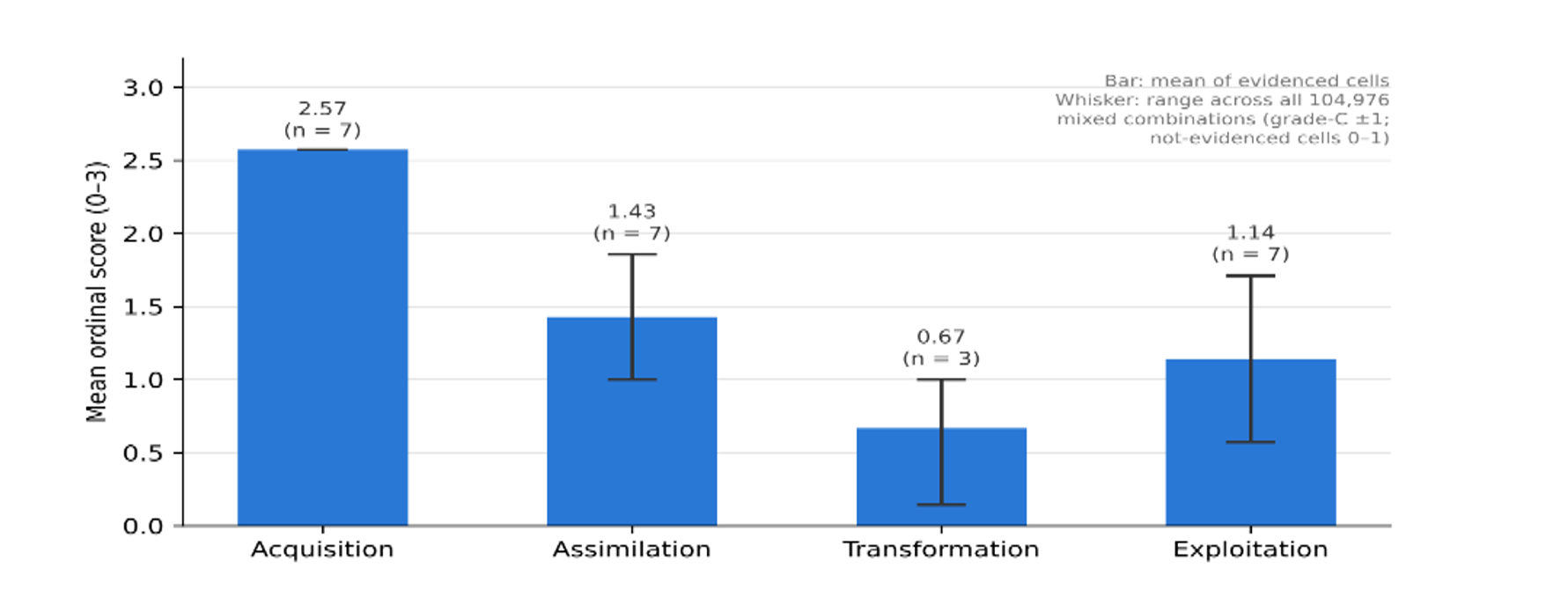
Nigeria holds 37.01 billion barrels of oil and condensate and 215.19 trillion cubic feet of gas in proven-plus-probable reserves, is the world’s largest cassava producer and has documented lithium-bearing pegmatites, yet it captures downstream value unevenly. This critical integrative review argues that, alongside finance, infrastructure and feedstock constraints, the gap reflects an asymmetry in technological absorptive capacity (TAC). The four TAC dimensions (acquisition, assimilation, transformation and exploitation) are articulated as plant level engineering competences and scored using a 0 – 3 rubric for the 7 Nigerian processing cases (NNPC refineries, Dangote refinery, Nigeria LNG, petrochemicals, Ajaokuta Steel, lithium processing and cassava starch).
A case-by-dimension extraction sheet links every score to dated evidence and a confidence grade, and separates verified absence, limited capability and unavailable evidence. Of the 104,976 combinations of scores assessed, Acquisition emerged as the strongest dimension (mean 2.57), while Transformation scored lowest, with only three potential scores and a maximum of 1, placing it in the lowest 95.5% of combinations. Four capability regimes were identified: turnkey-stranded, licensed-operated, foreign-financed nascent, and low-technology fragmented. Of eight headline indicators assessed, three remained unreconciled, one reflected a trend change, and four involved definitional differences. Dangote's crude oil utilisation in early 2025 was approximately 85%, compared with independent auditors' estimates of 54–66%. Priorities include standardising plant performance disclosures, documenting local responsibilities, and independently validating capability assessments. Scores represent single-rater ordinal assessments of observed skills, not quantitative measurements of all domestic engineering capabilities.
References
Abdullahi, N., Umar, N. B., Tsoho, A. U., Sani, A., Yazeed, Z. M., Tsangaya, M. A., Yahaya, Y. A., Yusuf, K., Haruna, S. A., Abdullahi, U. A., Ali, A., Dahiru, U. M., Suleiman, U. A., & Umar, A. A. (2023). Nigerian palm oil: Quality disparity, contamination and processing wastes handling. FUDMA Journal of Sciences, 7(1), 126–135. https://doi.org/10.33003/fjs-2023-0701-1263
Abdulrahman, A. T., Lawal, M., Al amin, H. M., Wada, A. I., & Umar, I. (2026). Technical assessment of diesel obtained from modular refinery for use in industries and transportation. FUDMA Journal of Sciences, 10(16), 618–621. https://doi.org/10.33003/fjs-2026-1016-5864
Acheampong, T., Ashong, M., & Svanikier, V. C. (2016). An assessment of local-content policies in oil and gas producing countries. The Journal of World Energy Law & Business, 9(4), 282–302. https://doi.org/10.1093/jwelb/jww019
Adejumo, O., Ikudayisi, A. A., Omotosho, A. O., & Aderonke, O. (2025). From manual to machine: Profitability and adoption of post-harvest processing technologies among cassava processors in Nigeria. Discover Agriculture, 3, Article 279. https://doi.org/10.1007/s44279-025-00465-4
Adekoya, F. (2023, January 13). Ajaokuta Steel Plant: Like refineries, a story retold, promises unkept. The Guardian Nigeria. https://guardian.ng/business-services/ajaokuta-steel-plant-like-refineries-a-story-retold-promises-unkept/
Adewuyi, A. O., & Oyejide, T. A. (2012). Determinants of backward linkages of oil and gas industry in the Nigerian economy. Resources Policy, 37(4), 452–460. https://doi.org/10.1016/j.resourpol.2012.06.007
allAfrica. (2026a, September 24). Nigeria: Crude supply to Nigerian refineries rises 17 percent in August—NMDPRA. https://allafrica.com/stories/202609240470.html
allAfrica. (2026b, May 14). Nigeria’s petrol imports fall as local refineries raise output—NMDPRA. https://allafrica.com/stories/202605140082.html
Argus Media. (2024, November 26). Nigeria restarts Port Harcourt refinery: Update. https://www.argusmedia.com/de/news-and-insights/latest-market-news/2632644-nigeria-restarts-port-harcourt-refinery-update
Argus Media. (2025a, February 10). Nigeria Dangote targets full capacity within a month. https://www.argusmedia.com/en/news-and-insights/latest-market-news/2656363-nigeria-dangote-targets-full-capacity-within-a-month
Argus Media. (2025b, July 24). Nigeria’s Dangote refinery plans nameplate expansion. https://www.argusmedia.com/en/news-and-insights/latest-market-news/2713569-nigeria-s-dangote-refinery-plans-nameplate-expansion
Atienza, M., Arias-Loyola, M., & Lufin, M. (2020). Building a case for regional local content policy: The hollowing out of mining regions in Chile. The Extractive Industries and Society, 7(2), 292–301. https://doi.org/10.1016/j.exis.2019.11.006
Ayentimi, D. T., Burgess, J., & Brown, K. (2016). Developing effective local content regulations in sub-Sahara Africa. Multinational Business Review, 24(4), 354–374. https://doi.org/10.1108/mbr-08-2015-0040
Azevedo Filho, E. T., Palma, M. A. M., Perestrelo, M., da Hora, H. R. M., & Lira, R. A. (2019). The pre-salt layer and challenges to competitiveness in Brazil: Critical reflections on the local content policy in the oil and gas sector. The Extractive Industries and Society, 6(4), 1168–1173. https://doi.org/10.1016/j.exis.2019.09.009
Billionaires Africa. (2026, September 30). Dangote refinery runs above full capacity for the first time. https://www.billionaires.africa/2026/09/30/dangote-refinery-runs-above-full-capacity-for-the-first-time/
BusinessDay. (2025a, May 21). Dangote to begin global export of polypropylene. https://businessday.ng/news/article/dangote-to-begin-global-export-of-polypropylene/
BusinessDay. (2025b, June 9). Local cassava production falls short of industries’ demand. https://businessday.ng/agriculture/article/local-cassava-production-falls-short-of-industries-demand/
Camba, A., Lim, G., & Gallagher, K. (2022). Leading sector and dual economy: How Indonesia and Malaysia mobilised Chinese capital in mineral processing. Third World Quarterly, 43(10), 2375–2395. https://doi.org/10.1080/01436597.2022.2093180
Centre for Research on Energy and Clean Air, & Center of Economic and Law Studies. (2024). Debunking the value-added myth in nickel downstream industry. https://energyandcleanair.org/publication/debunking-the-value-added-myth-in-nickel-downstream-industry/
Channels Television. (2026, April 2). Nigeria’s oil reserves dropped to 37.01bn barrels in January—NUPRC. https://www.channelstv.com/2026/04/02/nigerias-oil-reserves-dropped-to-37-01bn-barrels-in-january-nuprc
Cohen, W. M., & Levinthal, D. A. (1990). Absorptive capacity: A new perspective on learning and innovation. Administrative Science Quarterly, 35(1), 128–152. https://doi.org/10.2307/2393553
Energy News Network. (2026, August 6). Nigeria lithium processing, what the value-addition rule means for investors. https://energy-news-network.com/industry-news/nigeria-lithium-processing-value-addition/
Figueiredo, P. N., & Piana, J. (2016). When “one thing (almost) leads to another”: A micro-level exploration of learning linkages in Brazil’s mining industry. Resources Policy, 49, 405–414. https://doi.org/10.1016/j.resourpol.2016.07.008
Goje, H. G., Ige, O. O., & Anaegbu, J. O. (2026). Multi-technique characterization of lithium ore deposits from Birnin Gwari, Kaduna State, Nigeria: Emphasis on lithium quantification and radiological assessment of naturally occurring radioactive materials. FUDMA Journal of Sciences, 10(10), 240–243. https://doi.org/10.33003/fjs-2026-1010-5446
Heum, P., Quale, C., Karlsen, J. E., Kragha, M., & Osahon, G. (2003). Enhancement of local content in the upstream oil and gas industry in Nigeria: A comprehensive and viable policy approach (SNF Report No. 25/03). Institute for Research in Economics and Business Administration. https://snf.no/media/nbbjjofl/r25_03.pdf
Hilson, A. E., & Ovadia, J. S. (2020). Local content in developing and middle-income countries: Towards a more holistic strategy. The Extractive Industries and Society, 7(2), 253–262. https://doi.org/10.1016/j.exis.2020.04.014
Iheukwumere, O., Moore, D., & Omotayo, T. A. (2021). A meta-analysis of multi-factors leading to performance challenges across Nigeria’s state-owned refineries. Applied Petrochemical Research, 11(2), 183–197. https://doi.org/10.1007/s13203-021-00272-0
Indorama Eleme Petrochemicals Limited. (n.d.). About Eleme. Retrieved September 15, 2026, from https://indoramaeleme.com/about-elemehttps://indoramaeleme.com/about-eleme
Isaksen, A., & Karlsen, J. (2012). What is regional in regional clusters? The case of the globally oriented oil and gas cluster in Agder, Norway. Industry and Innovation, 19(3), 249–263. https://doi.org/10.1080/13662716.2012.669616
Kim, L. (1998). Crisis construction and organizational learning: Capability building in catching-up at Hyundai Motor. Organization Science, 9(4), 506–521. https://doi.org/10.1287/orsc.9.4.506
Lall, S. (1992). Technological capabilities and industrialization. World Development, 20(2), 165–186. https://doi.org/10.1016/0305-750X(92)90097-F
Leadership. (2026a, September 15). NLNG targets end-2027 for $10bn Train 7 project start-up. https://leadership.ng/?p=700410
Leadership. (2026b, September 16). NLNG Train-7 to boost Nigeria’s gas exports, LPG supply from 2027. https://leadership.ng/?p=700950
Lebdioui, A. (2022). The political economy of moving up in global value chains: How Malaysia added value to its natural resources through industrial policy. Review of International Political Economy, 29(3), 870–903. https://doi.org/10.1080/09692290.2020.1844271
Lima-de-Oliveira, R. (2020). Corruption and local content development: Assessing the impact of the Petrobras’ scandal on recent policy changes in Brazil. The Extractive Industries and Society, 7(2), 274–282. https://doi.org/10.1016/j.exis.2019.08.004
Morris, M., Kaplinsky, R., & Kaplan, D. (2012). “One thing leads to another”—Commodities, linkages and industrial development. Resources Policy, 37(4), 408–416. https://doi.org/10.1016/j.resourpol.2012.06.008
Nairametrics. (2026a, July 8). Ajaokuta Steel revival deal with Chinese firm due before end of 2026—FG. https://nairametrics.com/2026/07/08/ajaokuta-steel-revival-deal-with-chinese-firm-due-before-end-of-2026/
Nairametrics. (2026b, July 3). FG inaugurates 6,000-metric-tonne lithium processing plant, largest in Nigeria. https://nairametrics.com/2026/07/03/fg-inaugurates-6000-metric-tonne-lithium-processing-plant-largest-in-nigeria/
Nairametrics. (2026c, September 24). Petrol imports fall 26% to 14.6 million litres daily in August—NMDPRA. https://nairametrics.com/2026/09/24/petrol-imports-fall-26-to-14-6-million-litres-daily-in-august-nmdpra/
Nigerian Content Development and Monitoring Board. (2017). Nigerian content 10-year strategic roadmap (70% NC by 2027). https://policyvault.africa/wp-content/uploads/policy/NGA181.pdf
Nigerian Upstream Petroleum Regulatory Commission. (2026, April 1). Media release on the national annual petroleum reserves position as at 1st January 2026. https://www.nuprc.gov.ng/?p=21010
Ogunmola, O. O., Oyawole, F. P., & Oladele, B. O. (2019). Evaluating the effects of adoption of improved processing technologies on technical efficiency of palm oil processors in Ogun State, Nigeria. FUDMA Journal of Sciences, 3(4), 190–200. https://fjs.fudutsinma.org.ng/index.php/fjs/article/view/1638
Olajuyi, S. I., Adamu, H. A., Ogunmodimu, O. S., & Afolayan, D. O. (2025). Mechanistic insights into Nigerian lithium ores: Implications for energy and industrial applications. Frontiers in Geochemistry, 3, Article 1659636. https://doi.org/10.3389/fgeoc.2025.1659636
Pietrobelli, C., Marin, A., & Olivari, J. (2018). Innovation in mining value chains: New evidence from Latin America. Resources Policy, 58, 1–10. https://doi.org/10.1016/j.resourpol.2018.05.010
Reuters. (2026, May 13). Nigeria fuel demand rises as Dangote refinery nears capacity. TimesLIVE. https://www.timeslive.co.za/news/2026-05-13-nigeria-fuel-demand-rises-as-dangote-refinery-nears-capacity/
S&P Global. (2025a, February 20). Nigeria’s Dangote refinery captures domestic gasoline market share. https://www.spglobal.com/energy/en/news-research/latest-news/crude-oil/022025-nigerias-dangote-refinery-captures-domestic-gasoline-market-share
S&P Global. (2025b, March 10). Nigeria’s Dangote refinery starts up polypropylene production. https://www.spglobal.com/commodity-insights/en/news-research/latest-news/chemicals/031025-nigerias-dangote-refinery-starts-up-polypropylene-production
Stubrin, L. (2017). Innovation, learning and competence building in the mining industry. The case of knowledge intensive mining suppliers (KIMS) in Chile. Resources Policy, 54, 167–175. https://doi.org/10.1016/j.resourpol.2017.10.009
Sweet Crude Reports. (2022a, February 23). Nigerian Content retains $8bn annually, creates 50,000 jobs in 11 years. https://www.pressreader.com/nigeria/sweetcrude-weekly/20220223/281483574823514
Sweet Crude Reports. (2022b, September 26). Simbi Wabote’s stewardship at the NCDMB. https://sweetcrudereports.com/simbi-wabotes-stewardship-at-the-ncdmb/
Sweet Crude Reports. (2025, July 24). 60 days later, Port Harcourt Refinery inoperable despite $1.5bn revamp. https://sweetcrudereports.com/60-days-later-port-harcourt-refinery-inoperable-despite-1-5bn-revamp/
Tello-Gamarra, J., & Fitz-Oliveira, M. (2023). Technological capability and performance in developing countries: A meta-analysis. Journal of Engineering and Technology Management, 68, Article 101753. https://doi.org/10.1016/j.jengtecman.2023.101753
Volberda, H. W., Foss, N. J., & Lyles, M. A. (2010). Absorbing the concept of absorptive capacity: How to realize its potential in the organization field. Organization Science, 21(4), 931–951. https://doi.org/10.1287/orsc.1090.0503
Zahra, S. A., & George, G. (2002). Absorptive capacity: A review, reconceptualization, and extension. Academy of Management Review, 27(2), 185–203. https://doi.org/10.5465/amr.2002.6587995
Downloads
Published
Issue
Section
Categories
License
Copyright (c) 2026 Ikikiru, Diatachekor Friday, Okpo Samson Onoriode, Edafiadhe Emozino Donatus, Ibobo Uchechukwu Daniel, Olaye Messiah

This work is licensed under a Creative Commons Attribution 4.0 International License.