
Phytochemical and Antimicrobial Evaluation of the Volatile Components of fennel Essential Oil in Jos North, Plateau State, Nigeria
DOI:
https://doi.org/10.33003/fjs-2026-1024-6416Keywords:
Fennel, Essential oil, Antimicrobial, Phytochemicals, Fourier Transform Infrared Spectroscopy (FT-IR), Gas Chromatography-Mass Spectrometer (GC-MS)Abstract
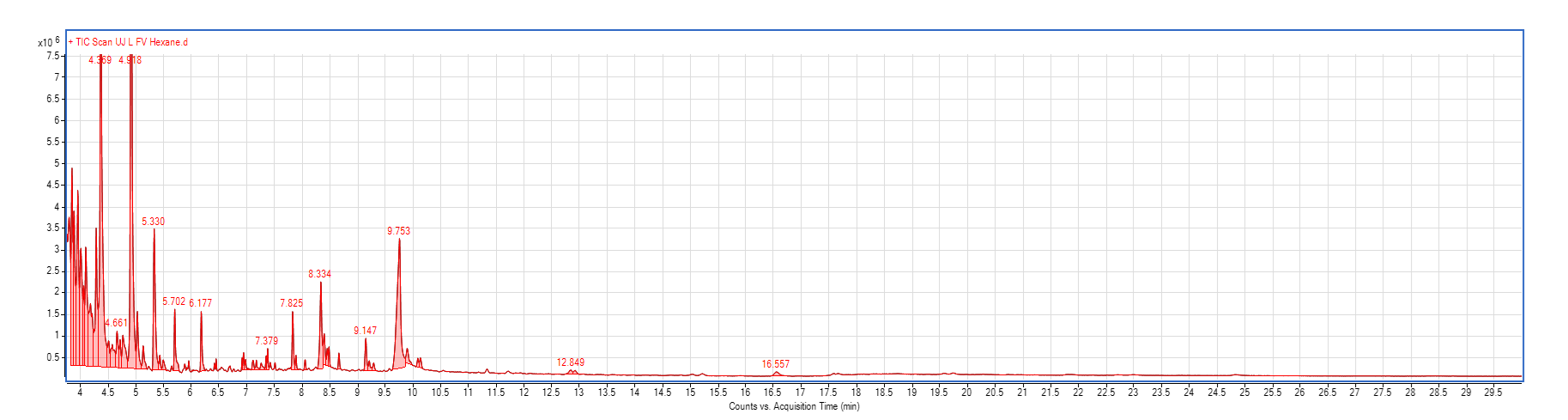
Fennel is a flowering plant species in the carrot family. It is a hardy, perennial herb with yellow flowers and feathery leaves. This study involved extraction of the bioactive phytochemicals from fennel, seed using n-hexane, characterization of the concentrated extract using gas chromatography-mass spectrometer (GC-MS) and Fourier transform-infrared spectrometer (FT-IR), and evaluation of the antimicrobial activities of the essential oil. From the GC-MS analysis, fennel essential oil is seen to contain numerous compounds, majority of which are hydrocarbons and oxygenated hydrocarbons, they are generally unsaturated compounds. Result of the analysis revealed that the major constituents of fennel essential oil are; Anethole (65%), Estragole (15%), Vaccenic acid (7.7%), 1-Cyclohexylheptene (5.5%), 5,10-Pentadecadienoic acid (5.1%), N-Hexadecanoic acid (2.7%) and p-anisic aldehyde (1.6%). Antimicrobial evaluation revealed that fennel oil is active against both gram-positive bacteria. However, the results obtained indicate that the antibacterial effects of fennel essential oil against the test organisms varied as follows; Escherichia coli > Salmonella typhi > Staphylococcus aureus > Streptococcus Pneumoniae respectively. Therefore, the result implies that fennel seed essential oil has more effect on gram-negative bacteria as compared to gram-positive bacteria.
References
Ali, S., Sameeh, M., Mohamed, A.A., Abd El-Razik, T.M., (2016). Gamma-irradiation affects volatile oil constituents, fatty acid composition and antimicrobial activity of fennel (Foeniculum vulgare) seeds extract. Research Journal of Pharmaceutical, Biological and Chemical Sciences, 7, 524–531.
Astrilia Damayanti and Eko Setyawan (2012) Essential Oil Extraction of Fennel Seed (Foeniculum vulgare) Using Steam Distillation. International Journal of Science and Engineering, Vol. 3(2):12-14.
Badgujar, Shamkant B.; Patel, Vainav V.; Bandivdekar, Atmaram H. (2014). "Foeniculum Vulgare Mill: A Review of Its Botany, Phytochemistry, Pharmacology, Contemporary Application, and Toxicology". Biological Medicine Research International, ISSN 2314-6133.
Bodsgard, B. R.; Lien, N. R.; Waulters, Q. T. (2016). Liquid CO2 Extraction and NMR Characterization of Anethole from Fennel Seed: A General Chemistry Laboratory. Journal of Chemical Education, 93 (2): 397–400.
Calucci, L.; Pinzino, C.; Zandomeneghi, M.; Capocchi, A.; Ghiringhelli, S.; Saviozzi, F.; Tozzi, S.; Galleschi, L. (2017). "Effects of gamma-irradiation on the free radical and antioxidant contents in nine aromatic herbs and spices". Journal of Agricultural and Food Chemistry. 51 (4): 927–34.
Dua A, Mittal A, Gupta S, Mahajan R. (2013). Bioreactive compounds and antioxidant properties of methanolic extract of fennel (Foeniculum vulgare). International Research Journal of Pharmaceutical, 4(5):203-208.
Ghanem, M., Radwan, H., Mahdy, E., (2012) Phenolic compounds from Foeniculum vulgare (Subsp: Piperitum) (Apiaceae) herb and evaluation of hepatoprotective antioxidant activity. Pharmacognosy, 4, 104–108.
Kanadea R, and Bhatkhandeb D.S. (2016) Extraction of Fennel Oil Using Different Methods and Effect of Solvents, Time, Temperature to Maximize Yield. International Journal of Advances in Science, Engineering and Technology, 4(3): 241-244.
Nassar, M.I., Aboutabl, E.A., Makled, Y.A., El-Khrisy, E.-D.A., Osman, A.F., (2010). Secondary metabolites and pharmacology of Foeniculum vulgare mill: Subsp. piperitum. Review of Latinoam Química, 38, 103–112.
Nyerges, C. (2016). Foraging Wild Edible Plants of North America: More than 150 Delicious Recipes Using Nature's Edibles. Rowman & Littlefield, p. 77. ISBN 978-1-4930-14996.
Uusitalo, L; Salmenhaara, M; Isoniemi, M; Garcia-Alvarez, A; Serra-Majem, L; Ribas-Barba, L; Finglas, P; Plumb, J; Tuominen, P; Savela, K (2016). "Intake of selected bioactive compounds from plant food supplements containing fennel (Foeniculum vulgare) among Finnish consumers". Food Chemistry. 194: 619–25.
Vihiior Burbwa, Ekirigwe Ogah, Christopher Nyerere Abah, Folashade Omotehinwa Benjamin Abu Emmanuel, Yikura Lawan, Augustine Ekpo amd Adanu JEA. (2026). FJS Evaluation of the Quality and Antibacterial Efficacy of Some Alcohol-Based Hand Sanitizers Sold in Benue South, Nigeria. FUDMA Journal of Sciences (FJS), 10 (12), pp 94 – 100 DOI: https://doi.org/10.33003/fjs-2026-1012-5567
Zhang, Hongwei; Lim, Candy Li-Fen; Zaki, Muhammad; Jaenicke, Stephan; Chuah, Gaik Khuan (2018). A Dual-Functional Catalyst for Cascade Meerwein–Pondorf–Verley Reduction and Dehydration of 4′-Methoxypropiophenone to Anethole. Chemical Susceptibility Chemistry, 11 (17): 3007–3017.
Downloads
Published
Issue
Section
Categories
License
Copyright (c) 2026 Yikura Lawan, Folashade Omotehinwa Habibat, Abu Benjamin Emmanuel, Philip Solomon, Pamakcha Dauda Hoini, Augustine Ekpo, Adanu James Emmanuel Agahu

This work is licensed under a Creative Commons Attribution 4.0 International License.