
Exploring the Analgesic and Anti-inflammatory Effects of Ethyl Acetate Extract of Tapinanthus Globiferus Growing on Acacia Nilotica
DOI:
https://doi.org/10.33003/fjs-2026-1022-6417Keywords:
Phytochemicals, Acute Toxicity, Tapinanthus Globiferus, Analgesic, Anti-InflammatoryAbstract
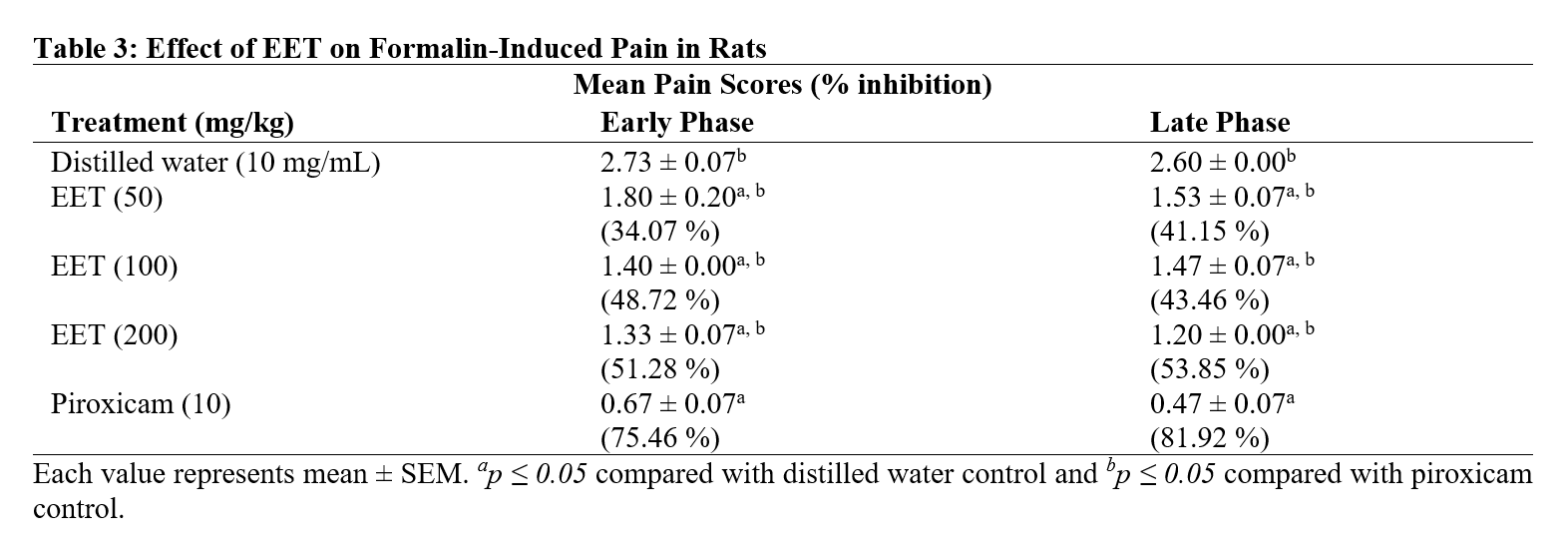
Tapinanthus globiferus is a Nigerian medicinal plant used traditionally for the management of pain and inflammation. The aim of the work is to conduct phytochemical screening, acute toxicity as well as analgesic and anti-inflammatory evaluation ethylacetate extract (EET) of T. globiferus growing on Acacia nilotica. The preliminary phytochemical screening was performed using standard methods, acute toxicity (i.p) was assessed using Lorke’s method while analgesic and anti-inflammatory effect were assessed using formalin-induced pain test and paw oedema in rats, respectively. The results of preliminary phytochemical screening revealed the presence of carbohydrates, alkaloids, glycosides, tannins, flavonoids, saponins, steroids and triterpenes while the LD50 value of the EET was estimated to be 3808 mg/kg indicating the extract is relatively toxic. EET exhibited significant (p ≤ 0.05) analgesic activity in dose-dependent manner, with inhibition ranging from 34.07 & 41.15 % to 51.28 & 53.85 % at 50 to 200 mg/kg while the control had 75.46 & 81.92 %. Additionally, EET significantly inhibited the paw oedema during the 1st to 4th hrs at 200 mg/kg with inhibition ranging from 27.50, 29.20, 34.19 and 35.40 % and no significant inhibition was observed at doses of 50 and 100 mg/kg, the standard drug-piroxicam used had 46.90 to 55.75%. The findings from the study unveiled the potential of EET to significantly exhibit the analgesic and anti-inflammatory activities, thus suggest for isolation and characterization of bioactive compounds for use in the management of pain and inflammation.
References
Abdullahi, Z., Jimoh, A. A and Patrick, E. B (2016). Analgesic, Anti-inflammatory and Anti-pyretic activities of Tapinanthus dodoneifolius (DC) Danser extract using several experimental models in rodents. Journal of Biology and Genetic Research (2):1www.iiardpub.org
Abubakar K, Adebisi I. M, Ugwah-Oguejiofor J. C (2016). Phytochemical screening and anticonvulsantactivity of the residual aqueous fraction of tapinanthus globiferus growing on ficus glums. Herbal Medicine; 2:2. https://doi.org/10.21767/2472-0151.100013
Amos S, Kolawole E, Akah P, Wambebe C and Gamaniel K. Behavioral effects of the aqueous extract of Guiera senegalensis in mice and rats. Phytomedicine. 2001; 8(5); 356- 361.
Assays. Springer-Verlaag. Berlin. Heldelberg.Baumann, T. K (2002). Physiologic anatomy of nociception. In: Burchiel KJ, editor. Surgical Management of Pain. New York Thieme. Pp: 2-24.
Bertram, G. K. (2001). Basic and Clinical Pharmacology. 8ed. McGraw-Hill Companies.
Burkill, H. M. (2000). Useful plants of West Tropical Africa. Vol. 5 2rd edition Royal Botanic Gardens, Kew, U.K. 3:522.
Cragg G. M and Newman D. J (2005). Biodiversity: A continuing source of novel drug leads. Pure and Applied Chemistry 77: 7–24. https://doi.org/10.1351/pac200577010007
Dubuisson, D. and Dennis, S. R. (1977). The formalin test: A quantitative study of the analgesic effects of morphine, meperidine and brain stem stimulation in rats and cats. Pain. 4:161- 174.
H. O., Gamaniel, K. S. (2004a). Anti-nociceptive profile of the methanolic extract of Neurautanenia mitis root in rats and mice. Journal of Ethnopharmacology 92: 317-324.
Halilu ME, Hassan LG, Liman MG, Babagana A, Ugwah Oguejiofor CJ, Audu Y (2017). Comparative studies on phytochemical and antioxidant activities of Tapinanthus globiferus (A. Rich) and its host plant Piliostigma thonningii (Schum, Advance). Pharmaceutical J; 2(5)
Howland, R. D. and Mycek, M. J. (2006). Lippincotts’ illustration Review: Pharmacology.Harvey,R. A., Champe P. C (eds) Lippincott Williams and Wilkins publishers London.157 – 168.
Insel PA (1996). Analgesic–antipyretic and anti-inflammatory agents and drugs employed in the treatment of gout. In: Hardman, J.G.and Limbird, L.E., eds, Goodman. Pp17-25.
Lorke, D. (1983). A New Approach to Practical Acute Toxicity Testing. Archives of Toxicology. 54: 275-287.Mann, J (2002). Natural products in cancer chemotherapy: past, present and future. Nat Rev Cancer.2(2):143-8.
Muhammad, K. Buhari, Sani, M. Dangoggo, Misbahu, L. Mohammed, Hassan, Abubakar,Abubakar, A. Muhammad, Mubarak, B. Dambatta and Amina, J. Yusuf (2022). Isolation and characterization of some flavonoids from the leaf of Tapinanthus globiferus growing on Acacia nilotica. Caliphate Journal of Science & Technology (CaJoST).1: 40 – 45.
Nasir, I., Yusuf, A. J., Abdullahi, M. I., Uba, A., Muntaka, A., Bello, S. S., Umar, A., Alhasan, A. M., Alebiosu, C. O., Yahaya, M. Kabir, M., Ottah C. U. and Ibrahim, S (2017). Analgesic and Anti-inflammatory activities of the n-butanol fraction of Vernonia glaberrima. Journal of Pharmaceutical and Allied Sciences 14 (2): 2470 – 2477.
Parekh, J., Jadeja, D. and Chanda, S (2005). Efficacy of aqueous and methanol extracts of some medicinal plants for potential antibacterial activity. Turk. J. Biol., 29: 203-210.
Pithayanukal, P., Tubpraset, J. and Wuthi-Udomlert, M. (2007). In vitro Antimicrobial activity of Zingiber cassumnar (plai) oil and a 5 % plai oil gel. Phyto-therapy Research, 21: 164-169.
Romulo, J. S., Andrea, S. C., Valber, S. P., Luiz, A. A. (2013). Natural products as a source for New Anti-inflammatory and Analgesic compounds through the inhibition of purinergic P2X Receptors. Pharmaceuticals. 650 – 658.
Trease, K. and Evans, W.C (1996). Text Book of Pharmacognosy, 14th edition, Balliere, Tindall, London; 251 – 293.
Vogel, H. G., Vogel, W. H. (Eds). (1997). Drug discovery and Evaluation: Pharmacological
Vongtau, H. O., Abbah, J., Masugu, O., Chindo, B. A., Ngala, I. E., Salawu, A. O., Kwanashie,
Yusuf, A. J., Abdullahi, M. I., Musa, A. M., Haruna, A. K., Mzozoyana, V., Abubakar, H. (2019b). Bioactive (+)-catechin-3-O-rhamnopyranoside from Neocarya macro phylla (Sabine) Prance (Chrysobalanaceae). Egyptian Journal of Basic and Applied Sciences, 6:1, 124- 136. https://doi.org/10.1080/2314808X.2019.1673549
Yusuf, A.J., Abdullahi, M.I., Haruna A.K., Musa A.M., Ibrahim Z.Y.Y., Uba A. (2015). Acute Toxicity Studies and Evaluation of Analgesic Property of the Methanol Stem Bark Extract of Neocarya macrophylla. Journal of Applied Pharmaceutical Sciences. 5 (Suppl1): 061 - 064
Downloads
Published
Issue
Section
Categories
License
Copyright (c) 2026 Muhammad Koko Buhari, Sani Muhammad Dangoggo, Misbahu Ladan Mohammed, Mustapha Salihu, Abubakar Alhaji Muhammad, Abdullahi Salisu

This work is licensed under a Creative Commons Attribution 4.0 International License.


