
Estimation of Radiological Risks in Soils from Selected oil-Spill Communities in the Niger Delta, Nigeria
DOI:
https://doi.org/10.33003/fjs-2026-1023-6431Keywords:
Activity concentration, Gamma spectroscopy, Lifetime fatality risk, Oil spill, Soil sampleAbstract
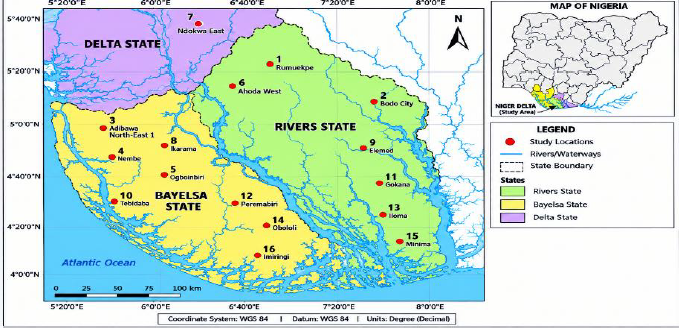
The estimation of radiological risks in soils from selected oil-spill communities in the Niger Delta, Nigeria has been carried out using Sodium Iodide detector dopped with Thallium based on gamma spectroscopy, NaI(TI)Ɣ, followed by mathematical computations. The activity concentrations of radionuclides of 226Ra, 232Th, and 40K ranged from 25.23±2.30 to 50.12±4.22 Bq/kg, 42.18 ± 4.01 to 60.01±2.30 Bq/kg, and 150.29±8.31 to 210.00±8.18 Bq/kg respectively. Also, the mean values of the activity concentration of radionuclides of 226Ra, 232Th, and 40K were 37.34, 50.72, and 181.57 Bq/kg respectively. The mean values of the annual gonadal dose equivalent (AGDE), representative gamma index, (Iγ), external hazard index (Hex), internal hazard index (Hin), and radium equivalent activity (Raeq) were 384.42 μSv/y, 1.509, 0.334, 0.435, and 123.90 Bq/kg, respectively. The mean of the annual effective doses for infants, children, teenagers, and adults were 32.726x10⁻³, 26.086x10-3,24.522x10-3, and 23.135x10⁻³mSv/y respectively. the obtained value was all below the recommended safe limit of 1.0 mSv/y. The corresponding mean of lifetime fatality risks were 37.16 x10⁻⁶, 73.98 x10⁻⁶, 74.21 x10⁻⁶, and 68.13x10⁻⁶ for infants, children, teenagers, and adults, respectively. The results indicated that higher estimated risk was recorded within the teenage age group. In general, the results showed that the investigated soil samples do not constitute any significant radiological health hazard under the existing exposure conditions. However, use of high-power germanium detector is recommended for further study
References
Nwii, A.A., Avwiri G.O. and Ononugbo, C.P. (2022). Gamma Radiation Level of Some Selected Government Farms in Rivers State, Nigeria. Asian Journal of Physical and Chemical Sciences, 9(2) 44-54
Agbalagba E.O., Avwiri, G.O. & Chad-Umoreh, Y.E. (2012). Gamma Spectroscopy
Measurement of Natural Radioactivity and Assessment of Radiation Hazard indices in Soil Samples from Oil Field Environment of Delta State, Nigeria. Journal of Environmental Radioactivity, 109, 64-70
Agbalagba, E. O., Avwiri, G. O., & Ononugbo, C. P. (2011). Evaluation of natural radioactivity in soil, sediment and water samples of Niger Delta (Biseni) flood plain lakes, Nigeria. Journal of Environmental Radioactivity. 2011;102(7):667–671. DOI: 10.1016/j.jenvrad.2011.03.002.
Anekwe, U.L., Uzoekwe, S.A., & Ibe, S.O. (2023). Estimation of Health Risks in Borehole Water Supply, Case Study in Ogbia, Nigeria. OSP Journal of Health Care and Medicine, 4(1) 1- 8
Avwiri, G. O., & Agbalagba, E. O. (2018). Review of the status of radioactivity profile in the oil and gas producing areas of the Niger Delta region of Nigeria. Environmental Geochemistry
and Health, 40(5), 1915–1935.
Chandrasekaran A, Ravisankar R, Senthilkumar G, Thillaivelavand K, Dhinakaran B, Vijayagopal P, Bramha SN, Venkatraman B. (2015). Spatial distribution and lifetime cancer risk due to gamma radioactivity in Yelagiri Hills, Tamilnadu, India. Egypt. J. Basic Appl. Sci. 1: 38– 48.
Ewim, D. R. E., Orikpete, O. F., Scott, T. O., Onyebuchi, C. N., Onukogu, A. O., Uzougbo, C. G., (2023). Survey of wastewater issues due to oil spills and pollution in the Niger Delta area of Nigeria: A secondary data analysis. Bulletin of the National Research Centre, 47, 116.
Guembou Shouop CJ, Ndontchueng Moyo M, Chene G, Jilbert Nguelem Mekontso E, Motapon O, Kayo SA, Strivay D. (2017). Assessment of natural radioactivity and associated radiation hazards in sand building material used in Douala Littoral Region of Cameroon, using gamma spectrometry. Environ. Earth Sci. 76:164.
ICRP (International Commission on Radiological Protection (2014) compendium of dose coefficients base on ICRP Publication 119. Ann ICRP41(Suppl.).
ICRP (International Commission on Radiological Protection), (2007). The optimization of radiological protection broadening the protecting the process (ICRP Publication101b). Ann. ICRP 36 (3).
Igbudu, O., Ogan, A. C., & Ogboeli, G. P. (2025). Assessment of ingested radionuclide dose from groundwater sources in Rumuekpe, Rivers State, Nigeria. FNAS Journal of Applied and Physical Sciences, 2(2), 84–94
International Commission on Radiological Protection (2020). approach for radiological protection from naturally occurring radioactive material (NORM) in industrial processes. Annals of the ICRP, 49(1Suppl.), 84–97.
International Commission on Radiological Protection. (2020). ICRP Publication 146: Radiological Protection of People and the Environment in the Event of a Large Nuclear Accident. Annals of the ICRP, 49(4).
James, G. K., Adegoke, J. O., Osagie, S., Ekechukwu, S., & Nwilo, P. (2014). Land surface dynamics and environmental challenges of the Niger Delta, Africa: Remote sensing-based analyses spanning three decades (1986–2013). International Journal of Applied Earth Observation and Geoinformation.
Jibiri, N.A., Oridela, A.A., and Ujiagbodon, C., (1999). Natural radioactivity concentration levels in soil and water around cement factory, Ewekoro, Ogun State, Nigeria. Nigerian Journal of Physics, 11 ;12-16.
Muhammad, A., & Abbasi, A. (2025). Determination of natural radioactivity concentrations and risk assessment in soil from mining sites in Minna environs, Niger State, Nigeria. Journal of Radioanalytical and Nuclear Chemistry, 334, 4021–4029
Ola, I., Drebenstedt, C., Burgess, R. M., Mensah, M., Hoth, N., Okoroafor, P., et al. (2024). Assessing petroleum contamination in parts of the Niger Delta based on a sub-catchment delineated field assessment. Environmental Monitoring and Assessment, 196, 585.
Orisakwe, O. E. (2021). Crude oil and public health issues in Niger Delta, Nigeria: Much ado about the inevitable. Environmental Research, 194, 110725. https://doi.org/10.1016/j.envres.2021.110725.
Ozigis, M. S., Kaduk, J. D., & Jarvis, C. H. (2019). Mapping terrestrial oil spill impact using machine learning random forest and Landsat 8 OLI imagery: A case site within the Niger Delta region of Nigeria. Environmental Science and Pollution Research, 26, 3621–3635.
Ukhurebor, K. E., Athar, H., Adetunji, C. O., Aigbe, U. O., Onyancha, R. B., & Abifarin, O. (2021). Environmental implications of petroleum spillages in the Niger Delta region of Nigeria: A review. Journal of Environmental Management, 293, 112872. https://doi.org/10.1016/j.jenvman.2021.112872.
Ukpong, I. G., Balcombe, K. G., Fraser, I. M., & Areal, F. J. (2019). Preferences for mitigation of the negative impacts of the oil and gas industry in the Niger Delta region of Nigeria. Environmental and Resource Economics, 74, 811–843.
Azeem, U., Younis, H., Ullah, N., Mehboob, K., Ajaz, M., Hidayat, A., & Muhammad, W. (2024)
Radionuclide concentrations in agricultural soil and lifetime cancer risk due to gamma radioactivity in district Swabi, KPK, Pakistan. Journal of Nuclear Engineering and Technology 56(1) 207-215
United Nations Scientific Committee on the Effects of Atomic Radiation UNSCEAR (2022). Report: Sources, Effects and Risks of Ionizing Radiation. United Nations.
United Nations Scientific Committee on the Effects of Atomic Radiation (UNSCEAR, 2025). Report. United Nations Scientific Committee on the Effects of Atomic Radiation. (2022). Sources, effects and risks of ionizing radiation: UNSCEAR 2020/2021 Report to the General Assembly, with Scientific Annexes. United Nations.
United Nations Scientific Committee on the Effects of Atomic Radiation. (2020). Report to the General Assembly. United Nations. USEPA (2001) Risk Assessment Guidance for Superfund (RAGS) Volume III Part A: Process for Conducting Probabilistic Risk Assessment. http://www.epa.gov/sites/production/ files/ 2015- 09/documents/rags3adt_complete.p
Downloads
Published
Issue
Section
Categories
License
Copyright (c) 2026 Uzochukwu Anekwe, Abel Nwii

This work is licensed under a Creative Commons Attribution 4.0 International License.


