
Correlation of Dose-Volume Histogram Metrics with Radiobiological Indices in Cervical Cancer Patients Undergoing Brachytherapy
DOI:
https://doi.org/10.33003/fjs-2026-1024-6438Keywords:
Cervical Cancer, Brachytherapy, Dose-Volume Histogram, Tumor control Probability, Normal Tissue Complication Probability, EQD2, Pearson CorrelationAbstract
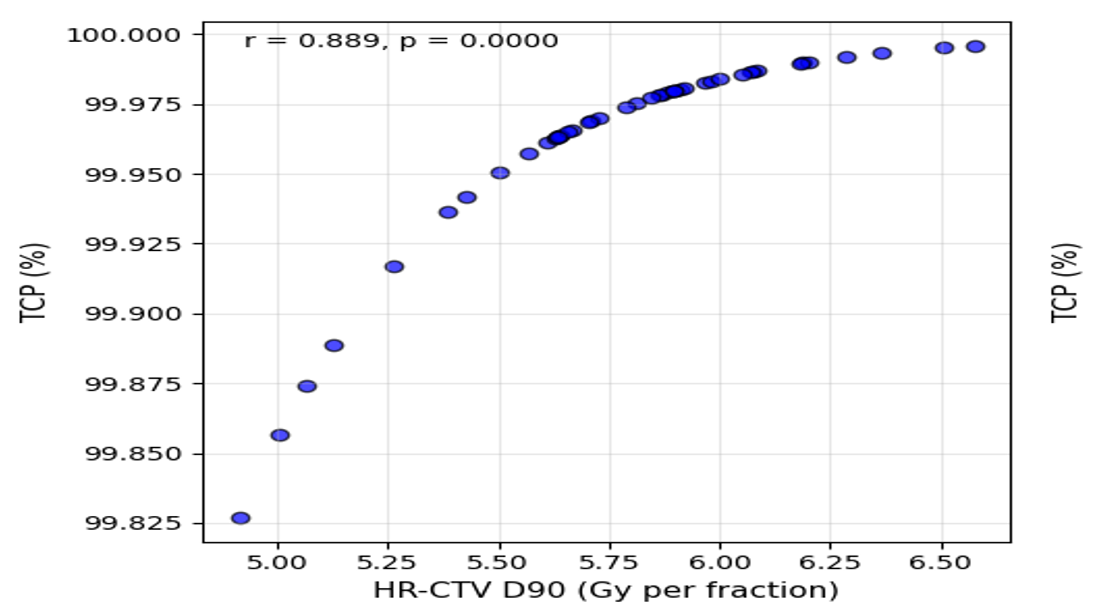
Dose-volume histogram (DVH) metrics are routinely used to evaluate brachytherapy plans for cervical cancer and their association with radiobiological outcomes is seldom verified for individual institutional datasets. This study presents a correlational analysis of DVH metrics with radiobiological indices of 45 cervical cancer patients undergoing brachytherapy at National Hospital, Abuja. CT-based treatment planning was used to contour the high-risk clinical target volume (HR-CTV), intermediate-risk clinical target volume (IR-CTV), bladder, and rectum. DVH metrics (HR-CTV D90, D98 and EQD2-converted D2cc for bladder and rectum) were extracted from the treatment planning system (TPS). Tumor Control Probability (TCP) was computed using linear-quadratic (LQ) model, while Normal Tissue Complication Probability (NTCP) was estimated using Lyman-Kutcher-Burman (LKB) model. Pearson correlation analysis was performed using Python to determine the strength and significance of associations between DVH metrics and radiobiological indices. From the results, the mean ± SD doses were found to be 5.78 ± 0.35 Gy (HR-CTV D90) and 4.24 ± 0.29 Gy (IR-CTV D90). TCP modeling yielded high control probabilities for HR-CTV (99.97% for D90; 99.99% for D98) and lower values for IR-CTV (85.38% and 92.04%, respectively). NTCP remained negligible (0.0004%) for both bladder and rectum, with all D2cc values below the 90 Gy EQD2 GEC-ESTRO constraint. Strong positive correlations were observed between TCP and HR-CTV D90 EQD2 (r = +0.889, p < 0.001). In contrast, TCP correlated weakly and non-significantly with HR-CTV D98 (r = +0.239, p = 0.1143). For organs at risk, rectum D2cc showed a strong correlation with NTCP (r = +0.836),
References
Burman, C., Kutcher, G. J., Emami, B., & Goitein, M. (1991). Fitting of normal tissue tolerance data to an analytic function. International Journal of Radiation Oncology, Biology, Physics, 21(1), 123–135.
Cibula, D., Pötter, R., Planchamp, F., Avall-Lundqvist, E., Fischerova, D., Meder, C., Kohler, C., Landoni, F., Lax, S., Lindeque, G., Mahantshetty, U., McCluggage, G. W., McCormack, M., Nout, R., Pignata, S., Raspollini, M. R., Rau, J., Sehouli, J., Sturdza, A., & Bois, A. (2018). The European Society of Gynaecological Oncology/European Society for Radiotherapy and Oncology/European Society of Pathology guidelines for the management of patients with cervical cancer. International Journal of Gynaecological Cancer, 28(4), 641–655.
Dale, R. G., & Jones, B. (2007). Radiobiological modelling in radiation oncology. British Institute of Radiology, 2(5), 23-30.
Dimopoulos, J. C. A., Pötter, R., Lang, S., Waldhäusl, C., Wachter-Gerstner, N., Weitmann, H., Georg, P., Schmid, M. P., Kirisits, C., & Sturdza, A. (2009). Dose–effect relationship for local control of cervical cancer by magnetic resonance image-guided brachytherapy. Radiotherapy and Oncology, 93(2), 311–315.
Douglas, B. G., & Fowler, J. F. (1976). The effect of multiple small doses of x rays on skin reactions in the mouse and a basic interpretation. Radiation Research, 66(2), 401–426.
Georg, P., Lang, S., Dimopoulos, J. C. A., Dörr, W., Stürmer, T., Wachter-Gerstner, N., Weitmann, H., Pötter, R., & Kirisits, C. (2011). Dose-volume histogram parameters and late side effects in magnetic resonance image-guided adaptive cervical cancer brachytherapy. International Journal of Radiation Oncology, Biology, Physics, 79(2), 356–362.
Hall, E. J., & Giaccia, A. J. (2019). Radiobiology for the radiologist (8th ed.). Wolters Kluwer.
Kutcher, G. J., Burman, C., Brewster, L., Goitein, M., & Mohan, R. (1991). Histogram reduction method for calculating complication probabilities for three-dimensional treatment planning evaluations. International Journal of Radiation Oncology, Biology, Physics, 21(1), 137–146.
Lawal, S. R., Ibrahim, U., Samson, D. Y., Mundi, A. A., & Mustapha, M. I. (2025). Evaluation of radiation exposure of some selected Uranium-Ore pits within Zing, Yorro and Jalingo Local Government Area of Taraba State. FUDMA Journal of Sciences, 9(11), 151-156
Lyman, J. T. (1985). Complication probability as assessed from dose-volume histograms. Radiation Research, 104(1), 13–19.
Pötter, R., Haie-Meder, C., Van Limbergen, E., Barillot, I., De Brabandere, M., Dimopoulos, J., Dumas, I., Erickson, B., Lang, S., Nulens, A., Petrow, P., Rownd, J., & Kirisits, C. (2006). Recommendations from gynaecological (GYN) GEC ESTRO working group (II): Concepts and terms in 3D image-based treatment planning in cervix cancer brachytherapy 3D dose volume parameters and aspects of 3D image-based anatomy, radiation physics, radiobiology. Radiotherapy and Oncology, 78(1), 67–77.
Pötter, R., Tanderup, K., Schmid, M. P., Jürgenliemk-Schulz, I., Haie-Meder, C., Fokdal, L. U., Sturdza, A. E., Hoskin, P., Mahantshetty, U., Segedin, B., Bruheim, K., Rai, B., Huang, F., van der Steen-Banasik, E. M., Nkiwane, K., Lindegaard, J. C., Mance, A., Zotomayor, J., Blondal, K., & Lindegaard, J. (2023). MRI-guided adaptive brachytherapy in locally advanced cervical cancer (EMBRACE-I): A multicentre prospective cohort study. The Lancet Oncology, 24(6), 568–581.
Sturdza, A., Pötter, R., Fokdal, L. U., Haie-Meder, C., Tan, L. T., Mazeron, R., Petrow, P., Georg, P., Lössl, K., Segedin, B., Rai, B., & Kirisits, C. (2016). Image guided brachytherapy in locally advanced cervical cancer: Improved pelvic control and survival in RetroEMBRACE, a multicenter cohort study. Radiotherapy and Oncology, 120(3), 428–433.
Sung, H., Ferlay, J., Siegel, R. L., Laversanne, M., Soerjomataram, I., Jemal, A., & Bray, F. (2021). Global Cancer Statistics 2020: GLOBOCAN estimates of incidence and mortality worldwide for 36 cancers in 185 countries. CA: A Cancer Journal for Clinicians, 71(3), 209–249.
Viswanathan, A. N., Thomadsen, B., & American Brachytherapy Society Cervical Cancer Recommendations Committee. (2012). American Brachytherapy Society consensus guidelines for locally advanced carcinoma of the cervix. Part II: High-dose-rate brachytherapy. Brachytherapy, 11(1), 47–52.
Downloads
Published
Issue
Section
Categories
License
Copyright (c) 2026 Marafa Abdulaziz, Ibrahim Umar, Idris Mustapha, Abdullahi Mundi

This work is licensed under a Creative Commons Attribution 4.0 International License.


