
Mathematical and Scenario Analysis of an Improved Six-Compartment Japa Model Incorporating Anticipated Rewards and Talent Retention Using LADM and NBS 2023 Population Data
DOI:
https://doi.org/10.33003/fjs-2026-1024-6441Keywords:
Brain Drain, Talent Retention, Anticipated Rewards, Media Awareness, LADM, Sensitivity AnalysisAbstract
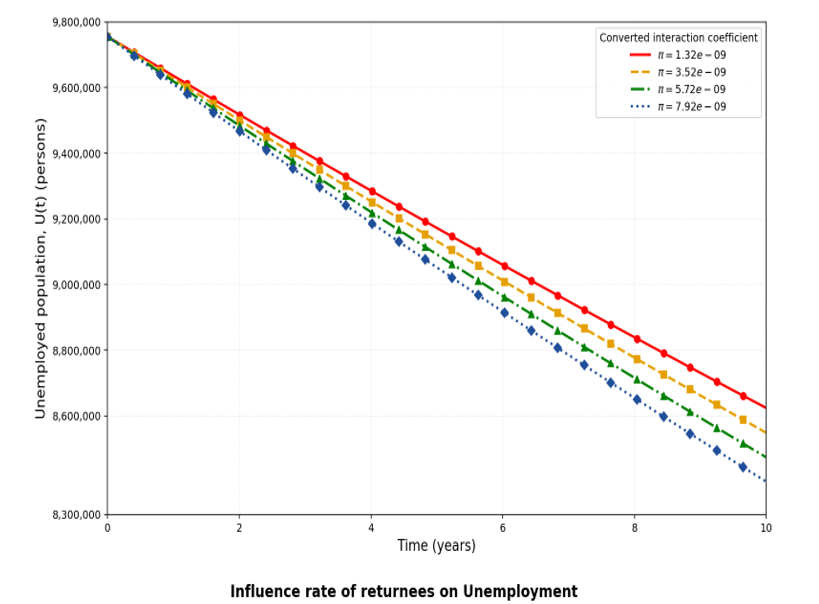
In this work, we develop and analyze a six-compartmental mathematical model on brain drain dynamics within a source country. The compartments of interest include the source population, employment opportunities, frustrated population due to corruption, unemployment population, immigrants, and emigrants. In addition, the work explores the impacts of anticipated rewards, talent retention, and media awareness on changes in the above compartmental populations. We explore non-negativity and boundedness of the system, determine brain-drain-free and persistent equilibria, compute the basic reproduction number, and investigate parameter sensitivity. For the initial population, we use statistical data of Nigeria's National Bureau of Statistics while others are from the literature or are assumed. With the updated baseline parameter set, the value of R₀ is 0.0126874 which is less than one and meets the threshold condition for the local asymptotic stability of the brain-drain-free equilibrium under the assumed conditions. Numerical solution of the model is obtained using the restarted two-correction scheme of Laplace-Adomian decomposition method (LADM) algorithm and analyzed using Radau IIA and LSODA algorithms. With reduction of the time step, the maximum scaled error is decreased from 8.20 × 10⁻⁶ to while the maximum scaled difference between Radau IIA and LSODA is approximately .The Scenario results provide away to compare how selected parameter values relate to the modeled corruption-frustrated and unemployment trajectories.
References
Adeniji, A., Dansu, E., Adeniyi, M., Ale, S., Ekum, M., Shatalov, M., & Enoch, O. (2024). Japa model: A mathematical framework for analyzing brain drain in Africa. Scientific African, 25, Article e02329. https://doi.org/10.1016/j.sciaf.2024.e02329
Adomian, G. (1988). A review of the decomposition method in applied mathematics. Journal of Mathematical Analysis and Applications, 135(2), 501–544. https://doi.org/10.1016/0022-247X(88)90170-9
Birkhoff, G., & Rota, G.-C. (1989). Ordinary differential equations (4th ed.). John Wiley & Sons.
Czaika, M., Bijak, J., & Prike, T. (2021). Migration decision-making and its key dimensions. The Annals of the American Academy of Political and Social Science, 697(1), 15–31. https://doi.org/10.1177/00027162211052233
Docquier, F., & Rapoport, H. (2007). Skilled migration: The perspective of developing countries (IZA Discussion Paper No. 2873). Institute for the Study of Labor. https://docs.iza.org/dp2873.pdf
Hagen-Zanker, J., Hennessey, G., & Mazzilli, C. (2023). Subjective and intangible factors in migration decision-making: A review of side-lined literature. Migration Studies, 11(2), 349–359. https://doi.org/10.1093/migration/mnad003
Hairer, E., & Wanner, G. (1999). Stiff differential equations solved by Radau methods. Journal of Computational and Applied Mathematics, 111(1–2), 93–111. https://doi.org/10.1016/S0377-0427(99)00134-X
Hindmarsh, A. C. (1983). ODEPACK, a systematized collection of ODE solvers. In R. S. Stepleman (Ed.), Scientific computing: Applications of mathematics and computing to the physical sciences (Vol. 1, pp. 55–64). North-Holland.
Khuri, S. A. (2001). A Laplace decomposition algorithm applied to a class of nonlinear differential equations. Journal of Applied Mathematics, 1(4), 141–155. https://doi.org/10.1155/S1110757X01000183
King, R., & Kuschminder, K. (Eds.). (2022). Handbook of return migration. Edward Elgar Publishing. https://doi.org/10.4337/9781839100055
LaSalle, J. P. (1960). Some extensions of Liapunov’s second method. IRE Transactions on Circuit Theory, 7(4), 520–527. https://doi.org/10.1109/TCT.1960.1086720
National Bureau of Statistics. (2023). Annual abstract of statistics 2023.
https://microdata.nigerianstat.gov.ng/index.php/catalog/180/download/1354/Annual_Abstract_2023.pdf
van den Driessche, P., & Watmough, J. (2002). Reproduction numbers and sub-threshold endemic equilibria for compartmental models of disease transmission. Mathematical Biosciences, 180(1–2), 29–48. https://doi.org/10.1016/S0025-5564(02)00108-6
Downloads
Published
Issue
Section
Categories
License
Copyright (c) 2026 Adebisi Folasade Ajimot, Muideen Odunayo Ogunniran, Tajudeen Omotayo Ganiyu

This work is licensed under a Creative Commons Attribution 4.0 International License.


