
Land Surface Temperature-Aware Optimization of Grid-Connected Photovoltaic Systems for Enhanced Energy Yield: A Comparative Assessment of Metaheuristic Algorithms in Adamawa State, Nigeria
DOI:
https://doi.org/10.33003/fjs-2026-1024-6454Keywords:
Photovoltaic Systems, Land Surface Temperature, Particle Swarm Optimization, Genetic Algorithm, Energy Yield, PV Optimization, Adamawa State, Grid-Connected PVAbstract
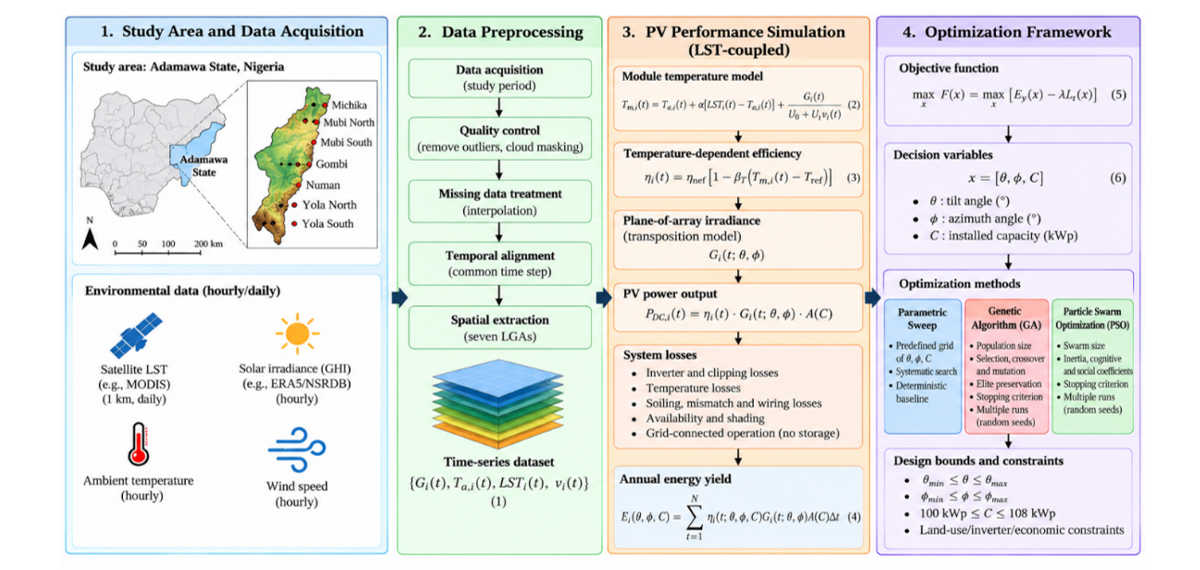
Accurate photovoltaic (PV) energy-yield estimation in thermally variable environments requires consideration of spatial differences in environmental conditions beyond conventional solar-resource assessment. This study developed and comparatively evaluated a land surface temperature (LST)-aware optimization framework for grid-connected PV systems across seven locations in Adamawa State, Nigeria: Yola North, Yola South, Mubi North, Mubi South, Gombi, Numan, and Michika. Global horizontal irradiance, ambient temperature, wind speed, and satellite-derived LST were integrated within a temperature-coupled PV performance model in which LST was treated as a thermal indicator rather than being directly equated with module temperature. PV tilt angle, azimuth orientation, and installed capacity were optimized using Parametric Sweep, Genetic Algorithm (GA), and Particle Swarm Optimization (PSO). Performance was evaluated using specific energy yield, improvement relative to baseline configurations, convergence behaviour, and solution stability. The optimized configurations exhibited tilt angles of 12–16°, azimuth angles of 165–180°, and installed capacities of 100–108 kWp, demonstrating spatial variation in the preferred PV configuration. At the algorithm level, PSO achieved the highest average specific yield of 2,550 kWh/kWp and a 7.6% improvement over its corresponding baseline, followed by GA at 2,530 kWh/kWp and 7.3%, and Parametric Sweep at 2,475 kWh/kWp and 6.5%. PSO also reached the reported convergence point at 30 iterations, compared with 45 iterations for GA, and exhibited lower reported variability (standard deviation = 1.8 versus 2.5). At the site level, LST exhibited a strong inverse association with optimization gain (Spearman’s ρ = −0.964, p = 0.00045).
References
Areola, A. A., Ojo, O. O., & Bello, T. K. (2026). Integrating environmental and spatial variables into photovoltaic system assessment in tropical climates. Renewable Energy and Sustainable Systems, 14(2), 112–128.
Bello, M. A., & Abdulsemiu, K. O. (2026). Spatial environmental information and metaheuristic optimization for photovoltaic performance modelling. Journal of Solar Energy Engineering, 148(3), Article 031005.
Benaissa, M., Chergui, S., & Bouzid, A. (2026). Environmental and spatial factors in photovoltaic optimization under high thermal stress conditions. Solar Energy, 285, 112–125.
Bouaichi, A., El Alami, M., & Belkaid, A. (2026). Metaheuristic algorithms for nonlinear renewable-energy system sizing and configuration: A comparative review. Energy Conversion and Management, 312, Article 118456.
de Souza Muniz, R. F., Santos, L. P., & Oliveira, C. A. (2026). Thermal and meteorological influences on photovoltaic performance in hot and variable climates. Renewable Energy, 238, 121–135.
Ibrahim, A., Hassan, M. A., & Yusuf, S. (2025). Temperature dependence of photovoltaic electrical performance under elevated operating conditions. Journal of Photovoltaic Technology, 15(4), 289–304.
Obayya, M., Al-Qahtani, H., & Rahman, F. (2026). Remotely sensed land surface temperature in photovoltaic suitability assessment and sustainable PV planning. Remote Sensing Applications: Society and Environment, 38, Article 101245.
Orozco-Bañol, J. A., García-López, M., & Ramírez-Santos, P. (2026). Interacting design variables in photovoltaic system optimization: Tilt, azimuth and capacity. Applied Energy, 378, Article 124567.
Wang, Y., Li, X., Zhang, H., & Chen, L. (2026). Spatial photovoltaic studies using land surface temperature and environmental variables for site selection. ISPRS Journal of Photogrammetry and Remote Sensing, 210, 45–62.
Yadav, A. K., Singh, R., & Kumar, P. (2025). Influence of temperature, wind speed and irradiance on module operating temperature and PV output. Solar Energy Materials and Solar Cells, 280, Article 113012.
Zarate-Perez, E., Mendoza-Camacho, J., & Torres-Hernández, R. (2026). Artificial-intelligence and metaheuristic techniques for multi-variable photovoltaic system optimization. Energy Reports, 12, 1567–1585.
Downloads
Published
Issue
Section
Categories
License
Copyright (c) 2026 Ogbaka, Medugu, Lazarus

This work is licensed under a Creative Commons Attribution 4.0 International License.


