Enzymatic Hydrolysis and Microbial Fermentation for Nutritional, Functional and Sustainable Food Processing: A Systematic Review
DOI:
https://doi.org/10.33003/fjs-2026-1024SI-6456Keywords:
Enzyme-assisted Fermentation, Enzymatic Hydrolysis, Microbial Fermentation, Bioactive Compounds, Functional Foods, Nutritional SecurityAbstract
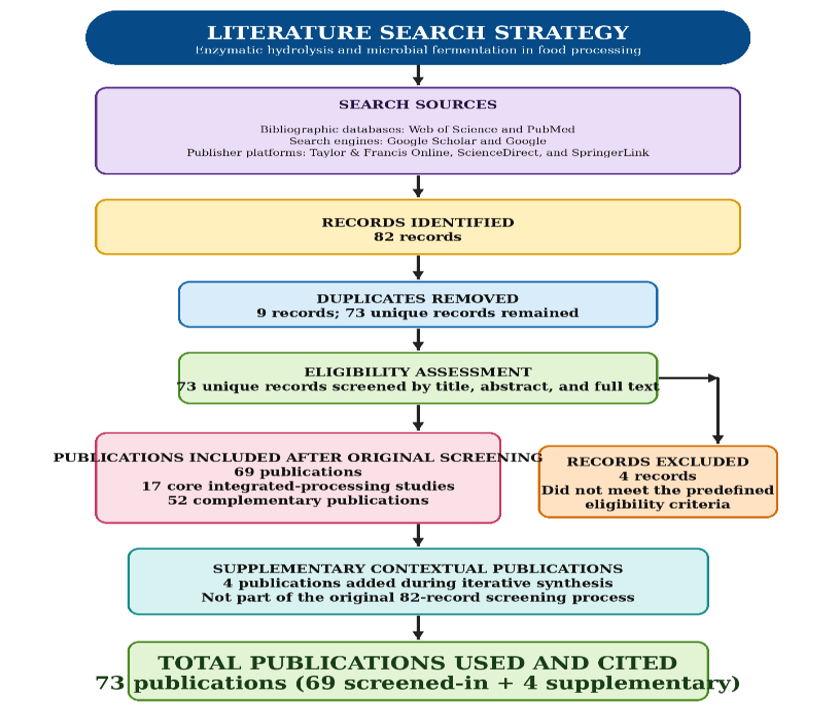
Enzymatic hydrolysis and microbial fermentation combine the precision of biocatalysis with the metabolic diversity of microorganisms and are increasingly investigated as complementary approaches for improving food quality, nutrient availability, functional properties, and recovery of bioactive compounds. This systematic review synthesizes evidence on their applications in food and food-related matrices, with emphasis on integrated processing. An assembled set of 82 records was identified; nine duplicates were removed, leaving 73 records for eligibility assessment. Four records were excluded, resulting in 69 publications in the screened evidence base. Four additional contextual publications were incorporated during iterative synthesis, giving 73 publications used in the review. Seventeen primary experimental studies examined integrated enzymatic-microbial processing or formulation-level combinations and formed the comparative evidence. Across plant proteins, cereals, fruits, pulses, fermented beverages, microalgae, and food by-products, integrated processing modified protein and cell-wall structures, enhanced the release or accessibility of phenolics and flavonoids, improved protein digestibility or solubility, reduced antinutritional factors, and influenced texture, aroma, and flavour. Outcomes varied according to substrate composition, enzyme class, microbial strain, processing conditions, and treatment sequence. Enzyme-first configurations were advantageous in several cell-wall-rich matrices, whereas fermentation followed by hydrolysis produced pronounced effects in protein systems. Evidence for antioxidant, ACE-inhibitory, and antidiabetic activities was predominantly derived from in vitro assays and should not be interpreted as direct evidence of clinical efficacy. The review highlights the need for standardized enzyme and inoculum levels, treatment sequence, kinetics, bioaccessibility, sensory assessment, safety evaluation, and scale-up economics to support translation into functional foods and sustainable food-processing applications.
References
Abdullahi, N., Atiku, M. K., & Umar, N. B. (2021). The roles of enzyme in food processing an overview. FUDMA Journal of Sciences, 5(1), 157–164. https://doi.org/10.33003/fjs-2021-0501-549
Adil, M. Z., Oztekin, S., Aziz, A., Gunal-Koroglu, D., Capanoglu, E., Moreno, A., Khalid, W., & Esatbeyoglu, T. (2026). Fermentation-based valorization of agro-industrial cereal wastes and by-products. Trends in Food Science & Technology, 168, Article 105464. https://doi.org/10.1016/j.tifs.2025.105464
Akbarian, M., Khani, A., Eghbalpour, S., & Uversky, V. N. (2022). Bioactive peptides: Synthesis, sources, applications, and proposed mechanisms of action. International Journal of Molecular Sciences, 23, 1445. https://doi.org/10.3390/ijms23031445
Aregbe, A. Y., Murtaza, S., Falade, E. O., Rahman, M. H., & Ma, Y. (2025). Synergistic effect of enzyme-assisted fermentation on phytochemical content, volatile profile, and antioxidant, antidiabetic, and ACE inhibitory properties of sea buckthorn-based cereal beverages. Food Science & Nutrition, 13, e71217. https://doi.org/10.1002/fsn3.71217
Arvelli, S., Jeong, D., Zhang, M., Jia, L., Peng, H., Ji, Q., Arabi, N., Babaei, S., Oh, E. J., & Zhao, J. (2026). Integrated multi-stream valorization of kitchen food waste through enzymatic hydrolysis and selective fermentation. RSC Sustainability, 4, 987–995. https://doi.org/10.1039/D5SU00778J
Babatuyi, C. Y., Oyetayo, V. O., & Akinyosoye, F. A. (2022). Chemical composition and functional properties of Citrullus vulgaris fermented with mutant and non-mutant strains of Bacillus subtilis to produce ogiri. FUDMA Journal of Sciences, 6(6), 31–43. https://doi.org/10.33003/fjs-2022-0606-1102
Bilgin, H., Aboobacker, S., Šipailienė, A., Kitrytė-Syrpa, V., & Syrpas, M. (2026). Enhancing bioactivity of Chlorella vulgaris through enzymatic pretreatment and lactic acid fermentation. Bioresources and Bioprocessing, 13, 50. https://doi.org/10.1186/s40643-026-01050-3
Borthakur, D., Sharma, B. K., & Duncan, T. (2026). Sustainable flavor engineering in fermented foods: Biochemical routes and technological applications of lactic acid bacteria. Frontiers in Industrial Microbiology, 4, Article 1834783. https://doi.org/10.3389/finmi.2026.1834783
Bruce, B. B., Boateng, I. D., & Boateng, C. (2025). Recent advances in bioactive peptides from fermented plant-based foods and their bioactivities. Food Chemistry: X, 25, 103291. https://doi.org/10.1016/j.fochx.2025.103291
Chakrabarti, S., Guha, S., & Majumder, K. (2018). Food-derived bioactive peptides in human health: Challenges and opportunities. Nutrients, 10, 1738. https://doi.org/10.3390/nu10111738
Chen, A.-X., Meng, F.-B., Li, J.-J., Chen, X.-C., Li, Y.-C., & Jiang, L.-S. (2024). Quinoa protein hydrolysates improved the qualities and volatiles of yogurt fermented by Lactobacillus plantarum. Frontiers in Sustainable Food Systems. https://doi.org/10.3389/fsufs.2024.1432631
Chen, Y., Chen, L., Xiao, Z., & Gao, L. (2022). Effects of enzymolysis and fermentation on the antioxidant activity and functional components of a coarse cereal compound powder based on principal component analysis and microstructure study. Journal of Food Science, 87, 3573–3587. https://doi.org/10.1111/1750-3841.16217
Chen, Y., Huang, H., Li, D., Zou, L., Yu, W., Dong, W., Yu, X., Feng, Y., Liu, J., Zhao, S., Liang, Y., Hu, Y., & Peng, N. (2025). Improving nutritional quality and aflatoxin detoxification of peanut meal by co-fermentation with Weizmannia coagulans, Bacillus subtilis, and supplemented enzymes. Microbial Cell Factories, 24, 190. https://doi.org/10.1186/s12934-025-02816-8
Cho, E. J., Lee, W.-H., Lee, Y. G., Van Ta, Q., Kim, H. Y., & Bae, H.-J. (2025). Optimizing the treatment and valorization of spent coffee grounds through the integration of sequential pretreatment steps, enzymatic hydrolysis, and selective fermentation. Food Chemistry: X. https://doi.org/10.1016/j.fochx.2025.102606
Cruz-Casas, D. E., Aguilar, C. N., Ascacio-Valdés, J. A., Rodríguez-Herrera, R., Chávez-González, M. L., & Flores-Gallegos, A. C. (2021). Enzymatic hydrolysis and microbial fermentation: The most favorable biotechnological methods for the release of bioactive peptides. Food Chemistry: Molecular Sciences, 3, 100047. https://doi.org/10.1016/j.fochms.2021.100047
Daliri, E. B.-M., Oh, D. H., & Lee, B. H. (2017). Bioactive peptides. Foods, 6, 32. https://doi.org/10.3390/foods6050032
Fan, X., Li, X., Zhang, T., Guo, Y., Shi, Z., Wu, Z., Zeng, X., & Pan, D. (2022). Novel millet-based flavored yogurt enriched with superoxide dismutase. Frontiers in Nutrition, 8, Article 791886. https://doi.org/10.3389/fnut.2021.791886
Fan, Y., Li, W., Sui, Y., Ju, N., Sun, Z., & Zhao, J. (2025). Development of cheese-flavored butter essence through enzymatic hydrolysis and lactic acid fermentation. Food Chemistry: X, 32, 103239. https://doi.org/10.1016/j.fochx.2025.103239
Farias, S. S., & Kempka, A. P. (2026). Plant proteins as sources of bioactive peptides: Biochemical characteristics and modification by fermentation and enzymatic hydrolysis. Food Bioscience, 81, Article 109139. https://doi.org/10.1016/j.fbio.2026.109139
Feng, X., Ng, K., Ajlouni, S., Zhang, P., Liang, Z., & Fang, Z. (2025). Enhancement of protein hydrolysis and bioactivity in hempseed cake via solid-state fermentation using Aspergillus niger, Bacillus subtilis, and Lactobacillus rhamnosus. Food and Bioprocess Technology, 18, 8633–8651. https://doi.org/10.1007/s11947-025-03940-4
Fitsum, S., Gebreyohannes, G., & Sbhatu, D. B. (2025). Bioactive compounds in fermented foods: Health benefits, safety, and future perspectives. Applied Food Research, 5, 101097. https://doi.org/10.1016/j.afres.2025.101097
Gai, L., Ren, E.-F., Tian, W., Niu, D., Sun, W., Hang, F., & Li, K. (2022). Ultrasonic-assisted dual-alkali pretreatment and enzymatic hydrolysis of sugarcane bagasse followed by Candida tropicalis fermentation to produce xylitol. Frontiers in Nutrition, 9, 913106. https://doi.org/10.3389/fnut.2022.913106
García-Arteaga, V., Demand, V., Kern, K., Strube, A., Szardenings, M., Muranyi, I., Eisner, P., & Schweiggert-Weisz, U. (2022). Enzymatic hydrolysis and fermentation of pea protein isolate and its effects on antigenic proteins, functional properties, and sensory profile. Foods, 11, 118. https://doi.org/10.3390/foods11010118
González-Quijano, G. K., González-Reyes, J. R., Monroy-Rodríguez, I., Rangel-Vargas, E., Muñoz-Llandes, C. B., & Guzmán-Ortiz, F. A. (2026). Applied advances in whey bioactive peptides: Enzymatic generation, mechanisms of action, and health-related applications. Applied Biosciences, 5(2), Article 30. https://doi.org/10.3390/applbiosci5020030
Hassan, M. A., Abdelshafy, A. M., Hussien, S. M., Sorour, M. A., & Mahmoud, E. A. (2025). Improving wheat bran properties using potential bioprocesses for application in functional bread production. Food Safety and Health, 3, 482–491. https://doi.org/10.1002/fsh3.70016
Idowu, O. A., & Yupanqui, C. T. (2025). Enzymatic hydrolysis with pepsin enhanced the nutrient compositions of unfractionated soy protein hydrolysate and its cell viability and nitric oxide activities. Food Science & Nutrition, 13, e71147. https://doi.org/10.1002/fsn3.71147
Igbokwe, K., & Igbokwe, A. (2026). Nutritional quality, functional properties, and sensory acceptability of complementary food porridge blends formulated from fermented millet, pigeon pea, and carrot flour. FUDMA Journal of Sciences, 10(10), 183–189. https://doi.org/10.33003/fjs-2026-1010-5188
Irazoqui, J. M., Santiago, G. M., Mainez, M. E., Amadio, A. F., & Eberhardt, M. F. (2024). Enzymes for production of whey protein hydrolysates and other value-added products. Applied Microbiology and Biotechnology, 108, 354. https://doi.org/10.1007/s00253-024-13117-2
Ju, J., Zhang, G., Xiao, M., Dong, C., Zhang, R., Du, L., Zheng, Y., Wei, M., Wei, M., & Wu, B. (2023). Effects of cellulase and Lactiplantibacillus plantarum on the fermentation quality, microbial diversity, gene function prediction, and in vitro rumen fermentation parameters of Caragana korshinskii silage. Frontiers in Food Science and Technology, 2, Article 1108043. https://doi.org/10.3389/frfst.2022.1108043
Kaškonienė, V., Damulienė, V., & Kaškonas, P. (2026). Multi-stage bioprocessing of bee pollen by LAB fermentation and enzymatic hydrolysis: Enhancing phenolic and flavonoid content and bioactivity. Foods, 15, 3056. https://doi.org/10.3390/foods15173056
Kim, H. D., Lee, K. S., Lee, K. E., Suh, H. J., & Kim, B.-Y. (2024). Improved digestibility and bioavailability of pea protein following enzymatic treatment and fermentation by lactic acid bacteria. Food Science and Biotechnology, 33, 607–615. https://doi.org/10.1007/s10068-023-01335-9
Künili, İ. E., Akdeniz, V., Akpınar, A., Budak, Ş. Ö., Curiel, J. A., Guzel, M., Karagözlü, C., Berkel Kasikci, M., Caruana, G. P. M., Starowicz, M., Humblot, C., Keyvan, E., Chassard, C., Pracer, S., Vergères, G., & Kesenkaş, H. (2025). Bioactive compounds in fermented foods: A systematic narrative review. Frontiers in Nutrition, 12, 1625816. https://doi.org/10.3389/fnut.2025.1625816
Li, X., Jin, Y., Li, F., Yu, M., Du, J., Yi, Q., Zhao, T., Yuan, B., & Wang, P. (2024). Effects of Lactobacillus plantarum and cellulase on mixed silages of Amaranthus hypochondriacus and cornmeal: Fermentation characteristics, nutritional value, and aerobic stability. Fermentation, 10, 378. https://doi.org/10.3390/fermentation10080378
Li, Y., Guo, L., Mao, X., Ji, C., Li, W., & Zhou, Z. (2024). Changes in the nutritional, flavor, and phytochemical properties of Citrus reticulata Blanco cv. ‘Dahongpao’ whole fruits during enzymatic hydrolysis and fermentation. Frontiers in Sustainable Food Systems, 8, 1474760. https://doi.org/10.3389/fsufs.2024.1474760
Li, Y., Wang, H., Zhang, Y., Ji, Y., Guo, L., Hao, L., & Lin, K. (2025). Influence of Lactobacillus plantarum and cellulase on fermentation quality and microbial community in mixed silage of Solanum rostratum and alfalfa. Frontiers in Microbiomes. https://doi.org/10.3389/frmbi.2024.1510774
Liu, M., Hu, M., Zhou, H., Dong, Z., & Chen, X. (2023). High-level production of Aspergillus niger prolyl endopeptidase from agricultural residue and its application in beer brewing. Microbial Cell Factories, 22, 93. https://doi.org/10.1186/s12934-023-02087-1
Liu, M., Li, Z., Wang, J., Deng, N., Ni, P., Chen, Z., Fu, H., Li, H., & Van der Meeren, P. (2026). Synergistic improvement of flavor development in fermented chili paste through microbial co-fermentation and enzymatic hydrolysis. Food Chemistry: X, 38, 104322. https://doi.org/10.1016/j.fochx.2026.104322
Liu, N., An, X., Wang, Y., Qi, J., Jia, Y., Li, X., Zhang, Z., & Chen, X. (2024). Polyphenol composition and antioxidant activity of fermentation combined with enzymatic hydrolysis modified Astragalus membranaceus stems. Chemical and Biological Technologies in Agriculture, 11, 153. https://doi.org/10.1186/s40538-024-00674-x
Lu, S., Li, K., Su, Q., Wen, Y., Li, H., Wang, J., & Sun, B. (2025). Exploring the combination effect of cellulase hydrolysis and Lactobacillus plantarum P-8 fermentation on the textural properties of whole brown rice. Food Frontiers, 6, 1903–1912. https://doi.org/10.1002/fft2.70049
Luithui, Y., Nisha, R. B., & Meera, M. S. (2019). Cereal by-products as an important functional ingredient: Effect of processing. Journal of Food Science and Technology. https://doi.org/10.1007/s13197-018-3461-y
Luparelli, A., Trisciuzzi, D., Schirinzi, W. M., Caputo, L., Smiriglia, L., Quintieri, L., Nicolotti, O., & Monaci, L. (2025). Whey proteins and bioactive peptides: Advances in production, selection and bioactivity profiling. Biomedicines, 13, 1311. https://doi.org/10.3390/biomedicines13061311
Majura, J. J., Cao, W., Chen, Z., Htwe, K. K., Li, W., Du, R., Zhang, P., Zheng, H., & Gao, J. (2022). The current research status and strategies employed to modify food-derived bioactive peptides. Frontiers in Nutrition, 9, 950823. https://doi.org/10.3389/fnut.2022.950823
Mannott, I., Bosse, R., & Gibis, M. (2026). Recent advances in egg white biotechnology, microbiology, and quality. Comprehensive Reviews in Food Science and Food Safety, 25(3), e70495. https://doi.org/10.1111/1541-4337.70495
Moirangthem, K., Koirala, P., Maina, H. N., Rai, D. K., & Coda, R. (2024). Impact of pre-treatments and bioprocessing on the carbohydrate and polyphenol profile of brewers’ spent grain. Food and Bioproducts Processing, 148, 62–71. https://doi.org/10.1016/j.fbp.2024.08.017
Moon, S.-H., & Kim, C.-H. (2026). Antioxidant and anti-inflammatory effects of bioactive peptides derived from whey protein using lactic acid bacteria. Food Science of Animal Resources, 46(1), Article 6. https://doi.org/10.1007/s44463-025-00023-y
Mora, L., & Toldrá, F. (2023). Advanced enzymatic hydrolysis of food proteins for the production of bioactive peptides. Current Opinion in Food Science, 49, 100973. https://doi.org/10.1016/j.cofs.2022.100973
Murtaza, M. A., Irfan, S., Hafiz, I., Ranjha, M. M. A. N., Rahaman, A., Murtaza, M. S., Ibrahim, S. A., & Siddiqui, S. A. (2022). Conventional and novel technologies in the production of dairy bioactive peptides. Frontiers in Nutrition, 9, 780151. https://doi.org/10.3389/fnut.2022.780151
Ning, H., Chen, J., Liu, Y., Tang, Z., Dai, J., Tang, J., & Lin, H. (2026). Fermentation-driven function enhancement of faba bean (poly) phenols: Bioactivity augmentation and intestinal flora modulation. Food Chemistry: X, 103563. https://doi.org/10.1016/j.fochx.2026.103563
Raei, P., Khomeiri, M., Sadeghi Mahoonak, A., Moayedi, A., & Kashiri, M. (2025). Evaluation of antibacterial and antioxidant activities of sesame (Sesamum indicum) meal protein hydrolysate produced by Bacillus coagulans fermentation. Scientific Reports. https://doi.org/10.1038/s41598-025-21765-1
Rafique, H., Dong, R., Wang, X. L., Alim, A., Aadil, R. M., Li, L., Zou, L., & Hu, X. Z. (2022). Dietary-nutraceutical properties of oat protein and peptides. Frontiers in Nutrition, 9, 950400. https://doi.org/10.3389/fnut.2022.950400
Rubak, Y. T., Nuraida, L., Iswantini, D., & Prangdimurti, E. (2022). Angiotensin-I-converting enzyme inhibitory peptides in goat milk fermented by lactic acid bacteria isolated from fermented food and breast milk. Food Science of Animal Resources, 42, 46–60. https://doi.org/10.5851/kosfa.2021.e55
Salihu, N., Tanko, H. I., & Zubairu, A. (2026). Precision fermentation for sustainable food production: Technological advances, food applications, sustainability, challenges and future perspectives. FUDMA Journal of Sciences, 10(18), 260–270. https://doi.org/10.33003/fjs-2026-1018-5892
Santos-Sánchez, G., Cruz-Chamorro, I., Márquez-López, J. C., Pedroche, J., Álvarez-López, A. I., Millán-Linares, M. C., Lardone, P. J., & Carrillo-Vico, A. (2024). Characterisation and beneficial effects of a Lupinus angustifolius protein hydrolysate obtained by immobilisation of the enzyme Alcalase®. Food & Function. https://doi.org/10.1039/D3FO05086F
Schlegel, K., Lidzba, N., Ueberham, E., Eisner, P., & Schweiggert-Weisz, U. (2021). Fermentation of lupin protein hydrolysates Effects on their functional properties, sensory profile and the allergenic potential of the major lupin allergen Lup an 1. Foods, 10, 281. https://doi.org/10.3390/foods10020281
Schlegel, K., Sontheimer, K., Eisner, P., & Schweiggert-Weisz, U. (2020). Effect of enzyme-assisted hydrolysis on protein pattern, technofunctional, and sensory properties of lupin protein isolates using enzyme combinations. Food Science & Nutrition, 8, 3041–3051. https://doi.org/10.1002/fsn3.1286
Schlegel, K., Sontheimer, K., Hickisch, A., Wani, A. A., Eisner, P., & Schweiggert-Weisz, U. (2019). Enzymatic hydrolysis of lupin protein isolates Changes in the molecular weight distribution, technofunctional characteristics, and sensory attributes. Food Science & Nutrition, 7, 2747–2759. https://doi.org/10.1002/fsn3.1139
Sentís-Moré, P., Robles-Rodríguez, I., Leonard, K., Tchoumtchoua, J., Escoté-Miró, X., del Bas-Prior, J. M., & Ortega-Olivé, N. (2025). Microbial biotransformation of agro-industrial fibre-rich by-products into functional beverages. Antioxidants, 14, 1332. https://doi.org/10.3390/antiox14111332
Singkhum, U., & Tanganurat, P. (2026). Comparative study of enzyme-assisted extraction and two-stage fermentation for vinegar production from Nymphaea pubescens and Nelumbo nucifera rhizome. Discover Food. https://doi.org/10.1007/s44187-026-01165-8
Song, H., Zhang, Z., Li, Y., Zhang, Y., Yang, L., Wang, S., He, Y., Liu, J., Zhu, D., & Liu, H. (2022). Effects of different enzyme extraction methods on the properties and prebiotic activity of soybean hull polysaccharides. Heliyon, 8, e11053. https://doi.org/10.1016/j.heliyon.2022.e11053
Song, Y., Sun, L., Zhang, S., Fan, K., Wang, H., Shi, Y., Shen, Y., Wang, W., Zhang, J., Han, X., Mao, Y., Wang, Y., & Ding, Z. (2022). Enzymes and microorganisms jointly promote the fermentation of rapeseed cake. Frontiers in Nutrition, 9, 989410. https://doi.org/10.3389/fnut.2022.989410
Sun, M., Yu, Z., Zhang, S., Liu, C., Guo, Z., Xu, J., Zhang, G., & Wang, Z. (2024). Enzymatic hydrolysis pretreatment combined with glycosylation for soybean protein isolate applying in dual-protein yogurt. Food Chemistry: X. https://doi.org/10.1016/j.fochx.2024.101837
Sun, X. D. (2011). Enzymatic hydrolysis of soy proteins and the hydrolysates utilisation. Journal of Food Science and Technology. https://doi.org/10.1111/j.1365-2621.2011.02785.x
Tadesse, S. A., & Emire, S. A. (2020). Production and processing of antioxidant bioactive peptides: A driving force for the functional food market. Heliyon, 6, e04765. https://doi.org/10.1016/j.heliyon.2020.e04765
Vaccalluzzo, A., Solieri, L., Tagliazucchi, D., Cattivelli, A., Martini, S., Pino, A., Caggia, C., & Randazzo, C. L. (2022). Metabolomic and transcriptional profiling of oleuropein bioconversion into hydroxytyrosol during table olive fermentation by Lactiplantibacillus plantarum. Applied and Environmental Microbiology, 88(6), e02019-21. https://doi.org/10.1128/AEM.02019-21
Verni, M., Demarinis, C., Rizzello, C. G., & Baruzzi, F. (2020). Design and characterization of a novel fermented beverage from lentil grains. Foods, 9, 893. https://doi.org/10.3390/foods9070893
Wei, M., Chen, P., Zheng, P., Tao, X., Yu, X., & Wu, D. (2023). Purification and characterization of aspartic protease from Aspergillus niger and its efficient hydrolysis applications in soy protein degradation. Microbial Cell Factories, 22, 42. https://doi.org/10.1186/s12934-023-02047-9
Xiang, H., Sun-Waterhouse, D., Waterhouse, G. I. N., Cui, C., & Ruan, Z. (2019). Fermentation-enabled wellness foods: A fresh perspective. Food Science and Human Wellness, 8(3), 203–243. https://doi.org/10.1016/j.fshw.2019.08.003
Xu, W., Wu, X., Xia, C., Guo, Z., Zhai, Z., Cheng, Y., & Qiu, J. (2024). Optimization of enzymatic hydrolysis and fermentation processing for set-type oat yogurt with favorable acidity and coagulated texture. Foods, 13, 4180. https://doi.org/10.3390/foods13244180
Yang, J., Hong, J., Aihaiti, A., Mu, Y., Yin, X., Zhang, M., Liu, X., & Wang, L. (2024). Preparation of sea buckthorn seed meal peptide by mixed fermentation and its effect on volatile compounds and hypoglycemia. Frontiers in Nutrition, 11, 1355116. https://doi.org/10.3389/fnut.2024.1355116
Zhang, X., Li, X., & Liu, S.-Q. (2023). Enzymatic hydrolysis of minced chicken carcasses for protein hydrolysate production. Poultry Science, 102, 102791. https://doi.org/10.1016/j.psj.2023.102791
Zhao, L., Liu, X., Wang, S., Yin, Z., An, T., Zhang, J., & Liu, Y. (2024). Research progress on fermentation-produced plant-derived bioactive peptides. Frontiers in Pharmacology, 15, 1438947. https://doi.org/10.3389/fphar.2024.1438947
Zhao, R., Zhou, Y., Shen, H., Guan, L., Wang, Y., Shen, X., Wang, F., & Yao, X. (2025). Preparation and encapsulation of DPP-IV inhibitory peptides: Challenges and strategies for functional food development. Foods, 14, 1479. https://doi.org/10.3390/foods14091479
Zhu, Y., Chen, G., Diao, J., & Wang, C. (2023). Recent advances in exploring and exploiting soybean functional peptides a review. Frontiers in Nutrition, 10, 1185047. https://doi.org/10.3389/fnut.2023.1185047
Downloads
Published
Issue
Section
Categories
License
Copyright (c) 2026 Salihu Nura, Tanko Hashimu Imam, Abdulhakim Zubairu, Ahmed Kayode Rufai, Jabir Danyaya Aliyu

This work is licensed under a Creative Commons Attribution 4.0 International License.