
Assessment of Universal Design Compliance in Selected Shopping Malls in Abuja, Nigeria
DOI:
https://doi.org/10.33003/fjs-2026-1024-6459Keywords:
Universal Design, Accessibility, Inclusion, Shopping Malls, Architectural Design, AbujaAbstract
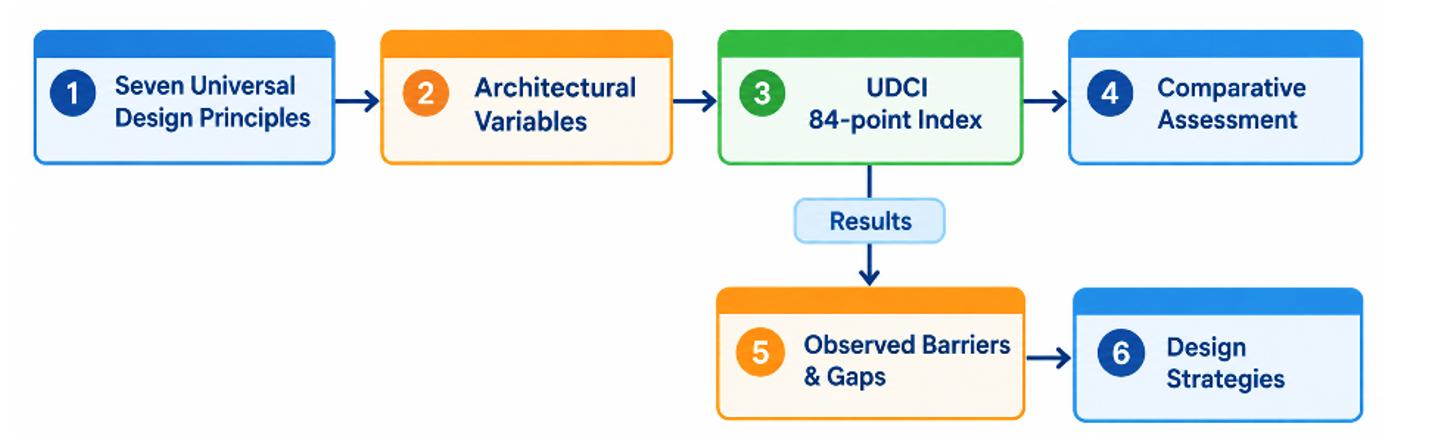
Shopping malls are important public spaces that combine retail, dining, entertainment and social activities, yet their physical configuration often creates barriers for users with diverse mobility, sensory and cognitive abilities. Universal Design (UD) provides ways of addressing these barriers by integrating accessibility and usability into architectural design. Therefore, this study examines the utilisation of seven Universal Design principles in three selected shopping malls in Abuja, Nigeria. The study employed a multiple-case study design, combining architectural observation with quantitative scoring. The three malls were purposively selected to provide cases for the comparative assessment of Universal Design compliance. An observation checklist comprising four architectural criteria for each of the seven Universal Design principles was developed, producing a proposed Universal Design Compliance Index (UDCI) with a maximum score of 84 points. The assessment was based on structured observational ratings of architectural features and provisions rather than user-experience evaluation. The seven principles assessed included equitable use, flexibility in use, simple and intuitive use, perceptible information, tolerance for error, low physical effort, and size and space for approach and use. The UDCI assessment revealed that Ceddi Plaza recorded 48/84 (57.14%), Silverbird Entertainment Centre 36/84 (42.86%), and Jabi Lake Mall 63/84 (75.00%). These findings suggest that newer shopping malls do not necessarily demonstrate more comprehensive universal accessibility and that deficiencies may persist even where physical access provisions are strong.
References
Adewale, B. A., Jegede, F. O., & Sogbetun, O. T. (2022). Evaluation of the effectiveness of perceptible principle of Universal Design in shopping malls in Southwest Nigeria. IOP Conference Series: Earth and Environmental Science, 1054(1), 012020. https://doi.org/10.1088/1755-1315/1054/1/012020
Aigbe, J. I., Maina, J. J., & Sagada, M. L. (2024). Exploring spatial configuration for effective way-finding in the design of shopping malls in Abuja–Nigeria. Architecture and Planning Journal, 30(1), 1–21. https://doi.org/10.54729/2789-8547.1248
Ajobiewe, T. O., Adeleye, O. I., & Shaibu, S. (2019). Access to public buildings by the physically challenged in Ibadan metropolis. 31st Annual Conference of the National Association of Special Education Teachers, Osogbo, Osun State, Nigeria.
Akeredolu, P., Jayeoba, S., & Badedale, L. S. (2025). Evaluating the effectiveness of space allocation in controlling traffic and circulation in shopping mall designs. African Journal of Environment and Sustainable Development, 3(3), 102–113. https://doi.org/10.5281/zenodo.17078598
Aniekan, E. D. (2021). Assessment of accessibility and disability planning in Nigerian construction industry. ASRIC Journal on Engineering Sciences, 1, 32–39.
Auwalu, F. K., & Bello, M. (2023). Exploring the contemporary challenges of urbanization and the role of sustainable urban development: A study of Lagos City, Nigeria. Journal of Contemporary Urban Affairs, 7(1), 175–188. https://doi.org/10.25034/ijcua.2023.v7n1-12
Auwalu, F. K., & Oluigbo, S. N. (2016). Built environment for rehabilitation: Case studies of selected juvenile rehabilitation centres in Nigeria. Journal of Design and Built Environment, 16(2), 15–29. https://doi.org/10.22452/jdbe.vol16no2.3
Connell, B. R., Jones, M., Mace, R., Mueller, J., Mullick, A., Ostroff, E., Sanford, J., Steinfeld, E., Story, M., & Vanderheiden, G. (1997). The principles of Universal Design (Version 2.0). The Center for Universal Design, North Carolina State University.
Federal Republic of Nigeria. (2018). Discrimination against Persons with Disabilities (Prohibition) Act, 2018.
Heyik, M. A., Castellanos-Escobar, M. C., Romero-Martínez, J. M., & Çalışkan, Z. (2024). Exploring citizens' perspectives on participatory design and planning: A comparative study across three capital cities. Urban Governance, 4(2), 101–112. https://doi.org/10.1016/j.ugj.2024.03.003
Hosseini, Z., Yeganeh, M., & Jalali, S. (2024). Exploring the impact of vertical access elements on visual richness and space quality within shopping mall atriums. Buildings, 14(9), Article 2724. https://doi.org/10.3390/buildings14092724
Makinde, O., Gbiri, O. A., & Makinde, O. T. (2026). Evaluation of spatial layout and accessibility performance of selected High Court buildings in Southwest Nigeria. FUDMA Journal of Sciences, 10(18), 196–212. https://doi.org/10.33003/fjs-2026-1018-5915
Mshelia, L. B., Idakwoji, W. A., & Audu, J. (2025). An assessment of the level of integration of inclusive design principles in a neighbourhood shopping mall in Abuja, Nigeria. IIARD International Journal of Geography & Environmental Management, 11(8), 77–90. https://doi.org/10.56201/ijgem.vol.11.no8.2025.pg77.90
Ngia, N. P., & Enwin, A. D. (2024). Enhancing wayfinding and circulation in shopping mall design. International Journal of Research Publication and Reviews, 5(8), 2744–2749.
Obakin, O. A., & Amosa, M. A. (2026). Assessment of circulation systems and accessibility in shopping malls towards the design of sustainable malls in Nigeria. African Journal of Applied Research & Sustainable Development, 4(2), 162–169. https://doi.org/10.54117/8tvt2709
Olawale, S. F., Morakinyo, K. O., Adedayo, O. F., Alonge, T. S., Adebambo, O. I., Farodoye, S. O., & Mustapha, A. (2026). Assessment of the functional nature of contemporary city malls in Nigeria. Journal of Science Research and Reviews, 3(3), 61–72. https://doi.org/10.70882/josrar.2026.v3i3.214
Olawale, S. F., Morakinyo, K. O., Adedayo, O. F., Alonge, T. S., Adebambo, O. I., Farodoye, S. O., & Mustapha, A. (2026). Assessment of the functional nature of contemporary city malls in Nigeria. Journal of Science Research and Reviews, 3(3), 61–72. https://doi.org/10.70882/josrar.2026.v3i3.214
Olodeoku, M., Alokun, A., Alagbe, O., Egwabor, J., & Buseri, J. (2024). Exploring Universal Design principles in the built environment: An empirical review. African Journal of Environmental Sciences and Renewable Energy, 16(1), 84–98. https://doi.org/10.62154/ajesre.2024.016.010352
Oluigbo, C. U., Okonta, E. D., Osamor, S. N., & Ndubuisi, C. B. (2026). User accessibility in shopping malls: Towards compliance and inclusive design. ABC2: Journal of Architecture, Building, Construction, and Cities, 2026(3), 35–59. https://doi.org/10.66408/abc2.2026.36
Qi, J., Mazumdar, S., & Vasconcelos, A. C. (2024). Understanding the relationship between urban public space and social cohesion: A systematic review. International Journal of Community Well-Being, 7(2), 155–212. https://doi.org/10.1007/s42413-024-00204-5
Selanon, P., & Chuangchai, W. (2024). Improving accessibility to urban greenspaces for people with disabilities: A modified Universal Design approach. Journal of Planning Literature, 39(1), 79–83. https://doi.org/10.1177/08854122231212662
Sholanke, A. B., & Adisa, O. S. (2025). Compliance of accessibility features of selected shopping malls with Universal Design strategies in Nigeria. Civil Engineering and Architecture, 13(4), 3144–3159. https://doi.org/10.13189/cea.2025.130422
Story, M. F. (1998). Maximizing usability: The principles of Universal Design. Assistive Technology, 10(1), 4–12. https://doi.org/10.1080/10400435.1998.10131955
Udefuna, P. N., Yerima, H., & Nandi, L. A. (2026). Bridging accessibility barriers for Nigerians with disabilities: A look at the Disability Act and urgent need for legislative action. https://ir.nilds.gov.ng/handle/123456789/3472
Downloads
Published
Issue
Section
Categories
License
Copyright (c) 2026 Hussain Abdallah Mashi, Faisal Auwalu Koko, Chinwe Sam-Amobi

This work is licensed under a Creative Commons Attribution 4.0 International License.