
Evaluating the Role of the Calcitriol and Renal Indices in the Patients with the Chronic Renal Failure and their Correlation with the Impairments Severity
DOI:
https://doi.org/10.33003/fjs-2026-1024-6467Keywords:
Chronic Kidney Disease, Calcitriol, 1,25-Dihydroxyvitamin D, Albuminuria, Cross-Sectional Study, IraqAbstract
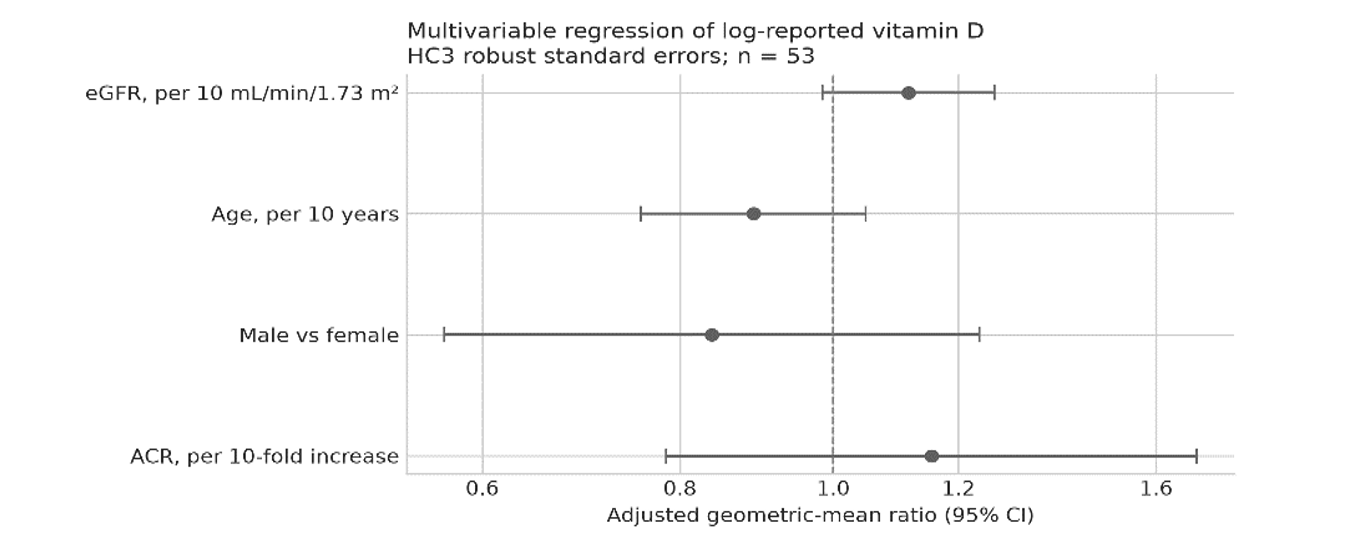
Chronic kidney disease (CKD) alters vitamin D metabolism, but circulating 1,25-dihydroxyvitamin D [1,25(OH)₂D] is not a measure of vitamin D stores. This exploratory cross-sectional study examined its primary association with estimated glomerular filtration rate (eGFR) and secondary associations with urine albumin-to-creatinine ratio (ACR) and GFR categories in 53 complete records of patients with investigator-diagnosed CKD in Baghdad, Iraq. Analyses used Spearman’s rank correlation with bootstrap confidence intervals (CIs), Kruskal–Wallis tests, and regression of natural-log-transformed 1,25(OH)₂D with HC3 robust standard errors, adjusted for age, sex, and log₁₀ ACR. Mean age was 61.0 ± 17.1 years; 28 participants (52.8%) were male. Median eGFR was 41.0 mL/min/1.73 m² and median ACR was 533.0 mg/g. The reported 1,25(OH)₂D median was 2,279.5 fmol/L (interquartile range, 1,609.6–3,377.8), but assay identity, units, and calibration must be resolved before biological interpretation. Correlations were weak and nonsignificant for eGFR (ρ = 0.096; 95% CI, −0.165 to 0.341; P = .495) and ACR (ρ = 0.102; P = .466). Differences across G2–G4 categories were also nonsignificant (P = .442). The adjusted eGFR ratio was 1.115 per 10 mL/min/1.73 m² (95% CI, 0.984–1.264; P = .086). These exploratory estimates are inconclusive: nonsignificance does not establish absence of association. Assay and eligibility limitations preclude clinical classification or treatment recommendations. Validated assays and adequately powered prospective studies are needed.
References
Bikbov, B., Purcell, C. A., Levey, A. S., Smith, M., Abdoli, A., Abebe, M., Adebayo, O. M., Afarideh, M., Agarwal, S. K., Agudelo-Botero, M., Ahmadian, E., Al-Aly, Z., Alipour, V., Almasi-Hashiani, A., Al-Raddadi, R. M., Alvis-Guzman, N., Amini, S., Andrei, T., Andrei, C. L., Vos, T. (2020). Global, regional, and national burden of chronic kidney disease, 1990–2017: A systematic analysis for the Global Burden of Disease Study 2017. The Lancet, 395(10225), 709–733. https://doi.org/10.1016/S0140-6736%2820%2930045-3
Bikle, D. D. (2014). Vitamin D metabolism, mechanism of action, and clinical applications. Chemistry & Biology, 21(3), 319–329. https://doi.org/10.1016/j.chembiol.2013.12.016
Bosworth, C., & de Boer, I. H. (2013). Impaired vitamin D metabolism in CKD. Seminars in Nephrology, 33(2), 158–168. https://doi.org/10.1016/j.semnephrol.2012.12.016
Bosworth, C. R., Levin, G., Robinson-Cohen, C., Hoofnagle, A. N., Ruzinski, J., Young, B., Schwartz, S. M., Himmelfarb, J., Kestenbaum, B., & de Boer, I. H. (2012). The serum 24,25-dihydroxyvitamin D concentration, a marker of vitamin D catabolism, is reduced in chronic kidney disease. Kidney International, 82(6), 693–700. https://doi.org/10.1038/ki.2012.193
Chonchol, M., & Scragg, R. (2007). 25-Hydroxyvitamin D, insulin resistance, and kidney function in the Third National Health and Nutrition Examination Survey. Kidney International, 71(2), 134–139. https://doi.org/10.1038/sj.ki.5002002
Cozzolino, M., Bernard, L., & Csomor, P. A. (2021). Active vitamin D increases the risk of hypercalcaemia in non-dialysis chronic kidney disease patients with secondary hyperparathyroidism: A systematic review and meta-analysis. Clinical Kidney Journal, 14(11), 2437–2443. https://doi.org/10.1093/ckj/sfab091
de Zeeuw, D., Agarwal, R., Amdahl, M., Audhya, P., Coyne, D., Garimella, T., Parving, H.-H., Pritchett, Y., Remuzzi, G., Ritz, E., & Andress, D. (2010). Selective vitamin D receptor activation with paricalcitol for reduction of albuminuria in patients with type 2 diabetes (VITAL study): A randomised controlled trial. The Lancet, 376(9752), 1543–1551. https://doi.org/10.1016/S0140-6736%2810%2961032-X
Inker, L. A., Eneanya, N. D., Coresh, J., Tighiouart, H., Wang, D., Sang, Y., Crews, D. C., Doria, A., Estrella, M. M., Froissart, M., Grams, M. E., Greene, T., Grubb, A., Gudnason, V., Gutiérrez, O. M., Kalil, R., Karger, A. B., Mauer, M., Navis, G., Levey, A. S. (2021). New creatinine- and cystatin C–based equations to estimate GFR without race. New England Journal of Medicine, 385(19), 1737–1749. https://doi.org/10.1056/NEJMoa2102953
Isakova, T., Wahl, P., Vargas, G. S., Gutiérrez, O. M., Scialla, J., Xie, H., Appleby, D., Nessel, L., Bellovich, K., Chen, J., Hamm, L., Gadegbeku, C., Horwitz, E., Townsend, R. R., Anderson, C. A. M., Lash, J. P., Hsu, C.-Y., Leonard, M. B., & Wolf, M. (2011). Fibroblast growth factor 23 is elevated before parathyroid hormone and phosphate in chronic kidney disease. Kidney International, 79(12), 1370–1378. https://doi.org/10.1038/ki.2011.47
Kandula, P., Dobre, M., Schold, J. D., Schreiber, M. J., Jr., Mehrotra, R., & Navaneethan, S. D. (2011). Vitamin D supplementation in chronic kidney disease: A systematic review and meta-analysis of observational studies and randomized controlled trials. Clinical Journal of the American Society of Nephrology, 6(1), 50–62. https://doi.org/10.2215/CJN.03940510
Kidney Disease: Improving Global Outcomes CKD-MBD Update Work Group. (2017). KDIGO 2017 clinical practice guideline update for the diagnosis, evaluation, prevention, and treatment of chronic kidney disease–mineral and bone disorder (CKD-MBD). Kidney International Supplements, 7(1), 1–59. https://doi.org/10.1016/j.kisu.2017.04.001
Kidney Disease: Improving Global Outcomes CKD Work Group. (2024). KDIGO 2024 clinical practice guideline for the evaluation and management of chronic kidney disease. Kidney International, 105(4S), S117–S314. https://doi.org/10.1016/j.kint.2023.10.018
Kim, C. S., & Kim, S. W. (2014). Vitamin D and chronic kidney disease. The Korean Journal of Internal Medicine, 29(4), 416–427. https://doi.org/10.3904/kjim.2014.29.4.416
Levey, A. S., Stevens, L. A., Schmid, C. H., Zhang, Y., Castro, A. F., III, Feldman, H. I., Kusek, J. W., Eggers, P., Van Lente, F., Greene, T., & Coresh, J. (2009). A new equation to estimate glomerular filtration rate. Annals of Internal Medicine, 150(9), 604–612. https://doi.org/10.7326/0003-4819-150-9-200905050-00006
Levin, A., Bakris, G. L., Molitch, M., Smulders, M., Tian, J., Williams, L. A., & Andress, D. L. (2007). Prevalence of abnormal serum vitamin D, PTH, calcium, and phosphorus in patients with chronic kidney disease: Results of the study to evaluate early kidney disease. Kidney International, 71(1), 31–38. https://doi.org/10.1038/sj.ki.5002009
Mehrotra, R., Kermah, D., Budoff, M., Salusky, I. B., Mao, S. S., Gao, Y. L., Takasu, J., Adler, S., & Norris, K. (2008). Hypovitaminosis D in chronic kidney disease. Clinical Journal of the American Society of Nephrology, 3(4), 1144–1151. https://doi.org/10.2215/CJN.05781207
National Institute of Diabetes and Digestive and Kidney Diseases. (2025, May). eGFR equations for adults. https://www.niddk.nih.gov/research-funding/research-programs/kidney-clinical-research-epidemiology/laboratory/glomerular-filtration-rate-equations/adults
Ravani, P., Malberti, F., Tripepi, G., Pecchini, P., Cutrupi, S., Pizzini, P., Mallamaci, F., & Zoccali, C. (2009). Vitamin D levels and patient outcome in chronic kidney disease. Kidney International, 75(1), 88–95. https://doi.org/10.1038/ki.2008.501
Shimada, T., Hasegawa, H., Yamazaki, Y., Muto, T., Hino, R., Takeuchi, Y., Fujita, T., Nakahara, K., Fukumoto, S., & Yamashita, T. (2004). FGF-23 is a potent regulator of vitamin D metabolism and phosphate homeostasis. Journal of Bone and Mineral Research, 19(3), 429–435. https://doi.org/10.1359/JBMR.0301264
Shroff, R., Egerton, M., Bridel, M., Shah, V., Donald, A. E., Cole, T. J., Hiorns, M. P., Deanfield, J. E., & Rees, L. (2008). A bimodal association of vitamin D levels and vascular disease in children on dialysis. Journal of the American Society of Nephrology, 19(6), 1239–1246. https://doi.org/10.1681/ASN.2007090993
Thadhani, R., Appelbaum, E., Pritchett, Y., Chang, Y., Wenger, J., Tamez, H., Bhan, I., Agarwal, R., Zoccali, C., Wanner, C., Lloyd-Jones, D., Cannata, J., Thompson, B. T., Andress, D., Zhang, W., Packham, D., Singh, B., Zehnder, D., Shah, A., Solomon, S. D. (2012). Vitamin D therapy and cardiac structure and function in patients with chronic kidney disease: The PRIMO randomized controlled trial. JAMA, 307(7), 674–684. https://doi.org/10.1001/jama.2012.120
von Elm, E., Altman, D. G., Egger, M., Pocock, S. J., Gøtzsche, P. C., & Vandenbroucke, J. P. (2007). The Strengthening the Reporting of Observational Studies in Epidemiology (STROBE) statement: Guidelines for reporting observational studies. PLOS Medicine, 4(10), Article e296. https://doi.org/10.1371/journal.pmed.0040296
Wang, A. Y.-M., Fang, F., Chan, J., Wen, Y.-Y., Qing, S., Chan, I. H.-S., Lo, G., Lai, K.-N., Lo, W.-K., Lam, C. W.-K., & Yu, C.-M. (2014). Effect of paricalcitol on left ventricular mass and function in CKD—the OPERA trial. Journal of the American Society of Nephrology, 25(1), 175–186. https://doi.org/10.1681/ASN.2013010103
Yeung, W.-C. G., Palmer, S. C., Strippoli, G. F. M., Talbot, B., Shah, N., Hawley, C. M., Toussaint, N. D., & Badve, S. V. (2023). Vitamin D therapy in adults with CKD: A systematic review and meta-analysis. American Journal of Kidney Diseases, 82(5), 543–558. https://doi.org/10.1053/j.ajkd.2023.04.003
Downloads
Published
Issue
Section
Categories
License
Copyright (c) 2026 Sara Ali Mutashar, Mohammed Abd Al-Hussein Khalil, Ayman Fayek

This work is licensed under a Creative Commons Attribution 4.0 International License.


