
Environmental Microbiology and Neuroscience: The Nexus
DOI:
https://doi.org/10.33003/fjs-2026-1024-6472Keywords:
Antimicrobial resistance, Environmental microbiology, Microbiota–gut–brain axis, Neuroinflammation, Neurotoxins, One HealthAbstract
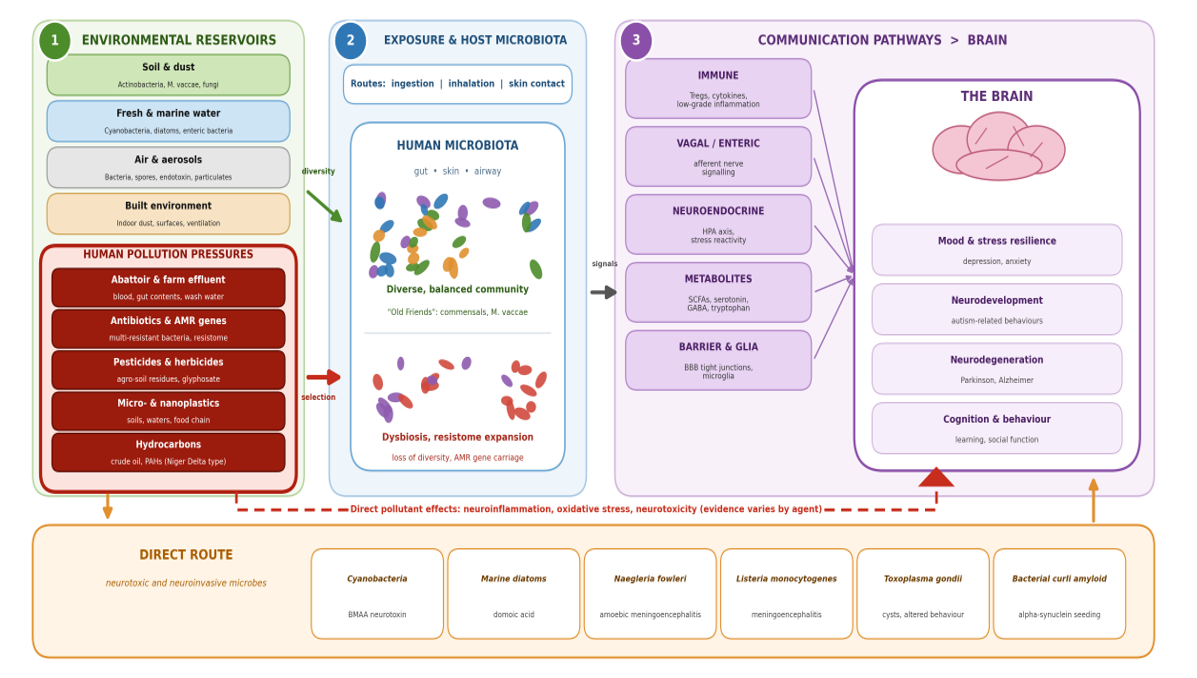
The brain has long been studied as a self-contained organ, and environmental microbes have long been studied as agents of ecosystem function and disease. A growing body of researches now reveal the intersection between both fields. Microbial communities in soil, water, air, and the built environment seed and reshape the human microbiota, which in turn modulates immune responses, endocrine stress responses, neural signaling, and the development and ageing of the central nervous system. Environmental microorganisms and their metabolites can also act on neural tissue directly, either as neurotoxins or as neuroinvasive pathogens, and anthropogenic pressures such as antibiotic resistance, agrochemicals, microplastics, and polluted air alter these relationships. This review integrates evidence from environmental microbiology, microbial ecology, immunology, and neuroscience. It; maps the environmental reservoirs and exposure routes that feed the human microbiome, summarizes the mechanistic pathways connecting microbial exposure to brain function, evaluates the biodiversity and "Old Friends" hypotheses, examines neurotoxic and neuroinvasive environmental taxa, considers pollution and antimicrobial resistance as modifiers, and identifies methodological weaknesses and research priorities. Most mechanistic evidence were derived from animal models, while, human data were largely associative. A well-controlled, longitudinal, and geographically diverse studies are needed before environmental microbial exposure can be treated as a modifiable determinant of brain health.
References
Abey, N.O. (2026). Glial futures and fermented traditions: A perspective on perinatal consumption of traditional African synbiotics, epigenetic glial programming, and offspring stress resilience. Glial Health Research, 3. Article 100020
Aerts, R., Honnay, O., & Van Nieuwenhuyse, A. (2018). Biodiversity and human health: Mechanisms and evidence of the positive health effects of diversity in nature and green spaces. British Medical Bulletin, 127(1), 5–22. https://doi.org/10.1093/bmb/ldy021
Adeniyi, O. A., Odumosu, B. T., & Odutayo, F. O. I. (2019). Physiological analysis and bacteriological quality of Ogun River, Nigeria. FUDMA Journal of Sciences, 3(2), 143–148. https://fjs.fudutsinma.edu.ng/index.php/fjs/article/view/1494
Agus, A., Planchais, J., & Sokol, H. (2018). Gut microbiota regulation of tryptophan metabolism in health and disease. Cell Host & Microbe, 23(6), 716–724. https://doi.org/10.1016/j.chom.2018.05.003
Ajuzieogu, C.A. (2026). Phenotypic profiling of multi-antibiotic resistant bacteria from abattoir effluent-impacted soil: implications for environmental health and food safety. International Journal of Pathogen Research, 15(5), 135-145. https://doi.org/10.9734/ijpr/2026/v15i5492
Asad, A., Kirk, M., Zhu, S., Dong, X., & Gao, M. (2025). Effects of prebiotics and probiotics on symptoms of depression and anxiety in clinically diagnosed samples: Systematic review and meta-analysis of randomized controlled trials. Nutrition Reviews, 83(7), e1504–e1520. https://doi.org/10.1093/nutrit/nuae177
Atukunda, D. (2025). Environmental microbiomes and health: A narrative review. IDOSR Journal of Applied Sciences, 10(3), 21-30. https://doi.org/10.59298/IDOSRJAS/2025/103.2130
Banerjee, S., & van der Heijden, M. G. A. (2023). Soil microbiomes and one health. Nature Reviews Microbiology, 21(1), 6–20. https://doi.org/10.1038/s41579-022-00779-w
Berdoy, M., Webster, J. P., & Macdonald, D. W. (2000). Fatal attraction in rats infected with Toxoplasma gondii. Proceedings of the Royal Society B: Biological Sciences, 267(1452), 1591–1594. https://doi.org/10.1098/rspb.2000.1182
Berman, M.G., Stier, A.J., & Akcelik, G.N. (2019). Environmental neuroscience. The American Psychologist, 74(9), 1039-1052. https://doi.org/10.1037/amp0000583
Block, M. L., & Calderón-Garcidueñas, L. (2009). Air pollution: Mechanisms of neuroinflammation and CNS disease. Trends in Neurosciences, 32(9), 506–516. https://doi.org/10.1016/j.tins.2009.05.009
Blum, W. E. H., Zechmeister-Boltenstern, S., & Keiblinger, K. M. (2019). Does soil contribute to the human gut microbiome? Microorganisms, 7(9), Article 287. https://doi.org/10.3390/microorganisms7090287
Bogerd, N., Dijkstra, S.C., Koole, S., Seidell, J., & Maas, J. (2020). Greening the classroom: Three field experiments on the effects of indoor nature on students’ attention, well-being, and perceived environmental quality. Building and Environment, 171, 106675
Bradley, W. G., & Mash, D. C. (2009). Beyond Guam: The cyanobacteria/BMAA hypothesis of the cause of ALS and other neurodegenerative diseases. Amyotrophic Lateral Sclerosis, 10(Suppl. 2), 7–20. https://doi.org/10.3109/17482960903286009
Braniste, V., Al-Asmakh, M., Kowal, C., Anuar, F., Abbaspour, A., Tóth, M., Korecka, A., Bakocevic, N., Ng, L. G., Kundu, P., Gulyás, B., Halldin, C., Hultenby, K., Nilsson, H., Hebert, H., Volpe, B. T., Diamond, B., & Pettersson, S. (2014). The gut microbiota influences blood–brain barrier permeability in mice. Science Translational Medicine, 6(263), Article 263ra158. https://doi.org/10.1126/scitranslmed.3009759
Bravo, J. A., Forsythe, P., Chew, M. V., Escaravage, E., Savignac, H. M., Dinan, T. G., Bienenstock, J., & Cryan, J. F. (2011). Ingestion of Lactobacillus strain regulates emotional behavior and central GABA receptor expression in a mouse via the vagus nerve. Proceedings of the National Academy of Sciences, 108(38), 16050–16055. https://doi.org/10.1073/pnas.1102999108
Chen, S. G., Stribinskis, V., Rane, M. J., Demuth, D. R., Gozal, E., Roberts, A. M., Jagadapillai, R., Liu, R., Choe, K., Shivakumar, B., Son, F., Jin, S., Kerber, R., Adame, A., Masliah, E., & Friedland, R. P. (2016). Exposure to the functional bacterial amyloid protein curli enhances alpha-synuclein aggregation in aged Fischer 344 rats and Caenorhabditis elegans. Scientific Reports, 6, Article 34477. https://doi.org/10.1038/srep34477
Chen, Y., Xu, J., & Chen, Y. (2021). Regulation of neurotransmitters by the gut microbiota and effects on cognition in neurological disorders. Nutrients, 13(6), Article 2099. https://doi.org/10.3390/nu13062099
Cisse, M., Moulle, V., Brossaud, R., Oullier, T., & Neunlist, M. (2026). Microbiota-Gut-Brain Axis in neurodegenerative diseases: The role of bacterial amyloids. Cellular and Molecular Gastroenterology and Hepatology, 20(8), 101802. https://doi.org/10.1016/j.jcmgh.2026.101802
Cox, P. A., Banack, S. A., Murch, S. J., Rasmussen, U., Tien, G., Bidigare, R. R., Metcalf, J. S., Morrison, L. F., Codd, G. A., & Bergman, B. (2005). Diverse taxa of cyanobacteria produce β-N-methylamino-L-alanine, a neurotoxic amino acid. Proceedings of the National Academy of Sciences, 102(14), 5074–5078. https://doi.org/10.1073/pnas.0501526102
Cryan, J. F., & Dinan, T. G. (2012). Mind-altering microorganisms: The impact of the gut microbiota on brain and behaviour. Nature Reviews Neuroscience, 13(10), 701–712. https://doi.org/10.1038/nrn3346
Dalile, B., Van Oudenhove, L., Vervliet, B., & Verbeke, K. (2019). The role of short-chain fatty acids in microbiota–gut–brain communication. Nature Reviews Gastroenterology & Hepatology, 16(8), 461–478. https://doi.org/10.1038/s41575-019-0157-3
Delgado-Baquerizo, M., Oliverio, A. M., Brewer, T. E., Benavent-González, A., Eldridge, D. J., Bardgett, R. D., Maestre, F. T., Singh, B. K., & Fierer, N. (2018). A global atlas of the dominant bacteria found in soil. Science, 359(6373), 320–325. https://doi.org/10.1126/science.aap9516
Diaz Heijtz, R., Wang, S., Anuar, F., Qian, Y., Björkholm, B., Samuelsson, A., Hibberd, M. L., Forssberg, H., & Pettersson, S. (2011). Normal gut microbiota modulates brain development and behavior. Proceedings of the National Academy of Sciences, 108(7), 3047–3052. https://doi.org/10.1073/pnas.1010529108
Dinan, T. G., Stanton, C., & Cryan, J. F. (2013). Psychobiotics: A novel class of psychotropic. Biological Psychiatry, 74(10), 720–726. https://doi.org/10.1016/j.biopsych.2013.05.001
Disson, O., & Lecuit, M. (2012). Targeting of the central nervous system by Listeria monocytogenes. Virulence, 3(2), 213–221. https://doi.org/10.4161/viru.19586
Dunlop, R. A., Cox, P. A., Banack, S. A., & Rodgers, K. J. (2013). The non-protein amino acid BMAA is misincorporated into human proteins in place of L-serine causing protein misfolding and aggregation. PLOS ONE, 8(9), Article e75376. https://doi.org/10.1371/journal.pone.0075376
Engemann, K., Pedersen, C. B., Arge, L., Tsirogiannis, C., Mortensen, P. B., & Svenning, J.-C. (2019). Residential green space in childhood is associated with lower risk of psychiatric disorders from adolescence into adulthood. Proceedings of the National Academy of Sciences, 116(11), 5188–5193. https://doi.org/10.1073/pnas.1807504116
Erny, D., Hrabě de Angelis, A. L., Jaitin, D., Wieghofer, P., Staszewski, O., David, E., Keren-Shaul, H., Mahlakoiv, T., Jakobshagen, K., Buch, T., Schwierzeck, V., Utermöhlen, O., Chun, E., Garrett, W. S., McCoy, K. D., Diefenbach, A., Staeheli, P., Stecher, B., Amit, I., & Prinz, M. (2015). Host microbiota constantly control maturation and function of microglia in the CNS. Nature Neuroscience, 18(7), 965–977. https://doi.org/10.1038/nn.4030
Forsberg, K. J., Reyes, A., Wang, B., Selleck, E. M., Sommer, M. O. A., & Dantas, G. (2012). The shared antibiotic resistome of soil bacteria and human pathogens. Science, 337(6098), 1107–1111. https://doi.org/10.1126/science.1220761
Forsythe, P., & Kunze, W.A. (2013). Voices from within: gut microbes and the CNS. Cellular and Molecular Life Sciences, 70(1), 55-69.
Gibson, G. R., Hutkins, R., Sanders, M. E., Prescott, S. L., Reimer, R. A., Salminen, S. J., Scott, K., Stanton, C., Swanson, K. S., Cani, P. D., Verbeke, K., & Reid, G. (2017). Expert consensus document: The International Scientific Association for Probiotics and Prebiotics (ISAPP) consensus statement on the definition and scope of prebiotics. Nature Reviews Gastroenterology & Hepatology, 14(8), 491–502. https://doi.org/10.1038/nrgastro.2017.75
Gilbert, J. A., Blaser, M. J., Caporaso, J. G., Jansson, J. K., Lynch, S. V., & Knight, R. (2018). Current understanding of the human microbiome. Nature Medicine, 24(4), 392–400. https://doi.org/10.1038/nm.4517
Haahtela, T. (2019). A biodiversity hypothesis. Allergy, 74(8), 1445–1456. https://doi.org/10.1111/all.13763
Hanski, I., von Hertzen, L., Fyhrquist, N., Koskinen, K., Torppa, K., Laatikainen, T., Karisola, P., Auvinen, P., Paulin, L., Mäkelä, M. J., Vartiainen, E., Kosunen, T. U., Alenius, H., & Haahtela, T. (2012). Environmental biodiversity, human microbiota, and allergy are interrelated. Proceedings of the National Academy of Sciences, 109(21), 8334–8339. https://doi.org/10.1073/pnas.1205624109
Harris, E. (2023). To invade the brain, pathogens exploit pain, immune cells. Journal of American Medical Association, 329(13), 1054. https://doi.org/10.1001/jama.2023.3313.
Hsiao, E. Y., McBride, S. W., Hsien, S., Sharon, G., Hyde, E. R., McCue, T., Codelli, J. A., Chow, J., Reisman, S. E., Petrosino, J. F., Patterson, P. H., & Mazmanian, S. K. (2013). Microbiota modulate behavioral and physiological abnormalities associated with neurodevelopmental disorders. Cell, 155(7), 1451–1463. https://doi.org/10.1016/j.cell.2013.11.024
Huang, R., & Liu, Y. (2024). Efficacy of Bifidobacterium-related preparations on depression: The first meta-analysis. Frontiers in Psychiatry, 15, Article 1463848. https://doi.org/10.3389/fpsyt.2024.1463848
Jernberg, C., Löfmark, S., Edlund, C., & Jansson, J. K. (2010). Long-term impacts of antibiotic exposure on the human intestinal microbiota. Microbiology, 156(11), 3216–3223. https://doi.org/10.1099/mic.0.040618-0
Johnson, K.V.A., & Burnet, P.W.J. (2020). Opposing effects of antibiotics and germ-free status on neuropeptide systems involved in social behavior and pain regulation. BMC Neuroscience, 21, 32. https://doi.org/10.1186/s12868-020-00583-3
Kelly, J. R., Borre, Y., O’Brien, C., Patterson, E., El Aidy, S., Deane, J., Kennedy, P. J., Beers, S., Scott, K., Moloney, G., Hoban, A. E., Scott, L., Fitzgerald, P., Ross, P., Stanton, C., Clarke, G., Cryan, J. F., & Dinan, T. G. (2016). Transferring the blues: Depression-associated gut microbiota induces neurobehavioural changes in the rat. Journal of Psychiatric Research, 82, 109–118. https://doi.org/10.1016/j.jpsychires.2016.07.019
Kembel, S. W., Jones, E., Kline, J., Northcutt, D., Stenson, J., Womack, A. M., Bohannan, B. J., Brown, G. Z., & Green, J. L. (2012). Architectural design influences the diversity and structure of the built environment microbiome. The International Society for Microbial Ecology Journal, 6(8), 1469–1479. https://doi.org/10.1038/ismej.2011.211
Krumperman, P. H. (1983). Multiple antibiotic resistance indexing of Escherichia coli to identify high-risk sources of fecal contamination of foods. Applied and Environmental Microbiology, 46(1), 165–170. https://doi.org/10.1128/aem.46.1.165-170.1983
Lapworth, D.J., Nkhuwa, D.C.W., Okotto-Okotto, J., Pedley, S., Stuart, M.E., Tijani, M.N., & Wright, J. (2017). Urban groundwater quality in sub-Saharan Africa: current status and implications for water security and public health. Hydrogeology, 25(4), 1093-1116. https://doi.org/10.1007/s10040-016-1516-6
Liu, R. T., Walsh, R. F. L., & Sheehan, A. E. (2019). Prebiotics and probiotics for depression and anxiety: A systematic review and meta-analysis of controlled clinical trials. Neuroscience & Biobehavioral Reviews, 102, 13–23. https://doi.org/10.1016/j.neubiorev.2019.03.023
Liu, Y., Sanderson, D., Mian, M.F., Neufeld, K.M., & Forsythe, P. (2021). Loss of vagal integrity disrupts immune components of the microbiota-gut-brain axis and inhibits the effect of Lactobacillus rhamnosus on behavior and the corticosterone stress response. Neuropharmacology, 195. Article 108682
Loh, D.Z.T., Zhang, L., & Zhang, Y. (2025). Dynamic simulation and experimental analysis of vertical greening systems on building energy efficiency. Energy and Buildings, 343. Article 115925
Louveau, A., Smirnov, I., Keyes, T. J., Eccles, J. D., Rouhani, S. J., Peske, J. D., Derecki, N. C., Castle, D., Mandell, J. W., Lee, K. S., Harris, T. H., & Kipnis, J. (2015). Structural and functional features of central nervous system lymphatic vessels. Nature, 523(7560), 337–341. https://doi.org/10.1038/nature14432
Lowry, C. A., Hollis, J. H., de Vries, A., Pan, B., Brunet, L. R., Hunt, J. R. F., Paton, J. F. R., van Kampen, E., Knight, D. M., Evans, A. K., Rook, G. A. W., & Lightman, S. L. (2007). Identification of an immune-responsive mesolimbocortical serotonergic system: Potential role in regulation of emotional behavior. Neuroscience, 146(2), 756–772. https://doi.org/10.1016/j.neuroscience.2007.01.067
Lyte, M. (2013). Microbial endocrinology in the microbiome-gut-brain axis: How bacterial production and utilization of neurochemicals influence behavior. PLOS Pathogens, 9(1), Article e1003726. https://doi.org/10.1371/journal.ppat.1003726
Ma, W., Xiong, X., Tian, Z., Li, L., Huang, Y. (2026). Environmental pollutants and the gut microbiota: mechanistic links from exposure to systemic disease. Frontiers in Microbiology, 17. https://doi.org/10.3389/fmicb.2026.1737229
Majumdar, A., Bagchi, D., Kotta-Loizou, I., & Buck, M. (2026). The One Health resistome: Integrating environmental, microbial, and human antimicrobial resistance surveillance and risk analysis in the digital age. Journal of Hazardous Materials, 513. Article 142431
Mandal, S., Dipa, P., Neha, Chatterjee, D., Maparu, K. (2026). Environmental determinants of neurotoxicity: role of heavy metals in neurological disorders. Frontiers in Neurology, 17. https://doi.org/10.3389/fneur.2026.186785
Matthews, D. M., & Jenks, S. M. (2013). Ingestion of Mycobacterium vaccae decreases anxiety-related behavior and improves learning in mice. Behavioural Processes, 96, 27–35. https://doi.org/10.1016/j.beproc.2013.02.007
Mayer, E. A., Tillisch, K., & Gupta, A. (2015). Gut/brain axis and the microbiota. Journal of Clinical Investigation, 125(3), 926–938. https://doi.org/10.1172/JCI76304
Messaoudi, M., Lalonde, R., Violle, N., Javelot, H., Desor, D., Nejdi, A., Bisson, J.-F., Rougeot, C., Pichelin, M., Cazaubiel, M., & Cazaubiel, J.-M. (2011). Assessment of psychotropic-like properties of a probiotic formulation (Lactobacillus helveticus R0052 and Bifidobacterium longum R0175) in rats and human subjects. British Journal of Nutrition, 105(5), 755–764. https://doi.org/10.1017/S0007114510004319
Miller, A. H., & Raison, C. L. (2016). The role of inflammation in depression: From evolutionary imperative to modern treatment target. Nature Reviews Immunology, 16(1), 22–34. https://doi.org/10.1038/nri.2015.5
Mills, J. G., Weinstein, P., Gellie, N. J. C., Weyrich, L. S., Lowe, A. J., & Breed, M. F. (2017). Urban habitat restoration provides a human health benefit through microbiome rewilding: The microbiome rewilding hypothesis. Restoration Ecology, 25(6), 866–872. https://doi.org/10.1111/rec.12610
Minter, M. R., Zhang, C., Leone, V., Ringus, D. L., Zhang, X., Oyler-Castrillo, P., Musch, M. W., Liao, F., Ward, J. F., Holtzman, D. M., Chang, E. B., Tanzi, R. E., & Sisodia, S. S. (2016). Antibiotic-induced perturbations in gut microbial diversity influences neuro-inflammation and amyloidosis in a murine model of Alzheimer’s disease. Scientific Reports, 6, Article 30028. https://doi.org/10.1038/srep30028
Morais, L. H., Schreiber, H. L., IV, & Mazmanian, S. K. (2021). The gut microbiota–brain axis in behaviour and brain disorders. Nature Reviews Microbiology, 19(4), 241–255. https://doi.org/10.1038/s41579-020-00460-0
Nass, N.M., & Zaher, K.A. (2025). Beyond the resistome: molecular insights, emerging therapies, and environmental drivers of antibiotic resistance. Antibiotics, 14(10), 995. https://doi.org/10.3390/antibiotics14100995
Ndukwe, N. N., & Ibrahim, H. I. (2024). Antibiotic resistance genes in freshwater environment: Sources, fate, ecological impact and clinical relevance. FUDMA Journal of Sciences, 8(6), 217–233. https://doi.org/10.33003/fjs-2024-0806-3094
Needham, B. D., Funabashi, M., Adame, M. D., Wang, Z., Boktor, J. C., Haney, J., Wu, W.-L., Rabut, C., Ladinsky, M. S., Hwang, S.-J., Guo, Y., Zhu, Q., Griffiths, J. A., Knight, R., Bjorkman, P. J., Shapiro, M. G., Geschwind, D. H., Holschneider, D. P., Fischbach, M. A., & Mazmanian, S. K. (2022). A gut-derived metabolite alters brain activity and anxiety behaviour in mice. Nature, 602(7898), 647–653. https://doi.org/10.1038/s41586-022-04396-8
Neufeld, K. M., Kang, N., Bienenstock, J., & Foster, J. A. (2011). Reduced anxiety-like behavior and central neurochemical change in germ-free mice. Neurogastroenterology & Motility, 23(3), 255–264. https://doi.org/10.1111/j.1365-2982.2010.01620.x
Neufeld, K. M., Kang, N., Bienenstock, J., & Foster, J. A. (2011). Reduced anxiety-like behavior and central neurochemical change in germ-free mice. Neurogastroenterology & Motility, 23(3), 255–264. https://doi.org/10.1111/j.1365-2982.2010.01620.x
Ouyang, H., Yang, Y., Zhang, X., Cui, Y., & Zhang, Y. (2025). Microbial orchestration of neuroimmune crosstalk: From homeostasis to disease. Frontiers in Immunology, 16, Article 1679286. https://doi.org/10.3389/fimmu.2025.1679286
Paerl, H. W., & Otten, T. G. (2013). Harmful cyanobacterial blooms: Causes, consequences, and controls. Microbial Ecology, 65(4), 995–1010. https://doi.org/10.1007/s00248-012-0159-y
Pannaraj, P.S., Li, F., Cerini, C., Bender, J.M., Yang, S., Rollie, A., Adisetiyo, H., et al. (2017). Association between breast milk bacterial communities and establishment and development of the infant gut microbiome. JAMA Pediatrics, 171(7), 647-654. https://doi.org/10.1001/jamapediatrics.2017.0378
Prüst, M., Meijer, J., & Westerink, R. H. S. (2020). The plastic brain: Neurotoxicity of micro- and nanoplastics. Particle and Fibre Toxicology, 17, Article 24. https://doi.org/10.1186/s12989-020-00358-y
Pulido, O. M. (2008). Domoic acid toxicologic pathology: A review. Marine Drugs, 6(2), 180–219. https://doi.org/10.3390/md6020180
Raison, C. L., Lowry, C. A., & Rook, G. A. W. (2010). Inflammation, sanitation, and consternation: Loss of contact with coevolved, tolerogenic microorganisms and the pathophysiology and treatment of major depression. Archives of General Psychiatry, 67(12), 1211–1224. https://doi.org/10.1001/archgenpsychiatry.2010.161
Reber, S. O., Siebler, P. H., Donner, N. C., Morton, J. T., Smith, D. G., Kopelman, J. M., Lowe, K. R., Wheeler, K. J., Fox, J. H., Hassell, J. E., Jr., Greenwood, B. N., Jansch, C., Lechner, A., Schmidt, D., Uschold-Schmidt, N., Füchsl, A. M., Langgartner, D., Walker, F. R., Hale, M. W., Perez, G.L., Van Treuren, W., Gonzalez, A., Halweg-Edwards, A.L., Fleshner, M., Raison, C.L., Rook, G.A., Peddada, S.D., Knight, R., & Lowry, C. A. (2016). Immunization with a heat-killed preparation of the environmental bacterium Mycobacterium vaccae promotes stress resilience in mice. Proceedings of the National Academy of Sciences, 113(22), E3130–E3139. https://doi.org/10.1073/pnas.1600324113
Rook, G. A. W. (2013). Regulation of the immune system by biodiversity from the natural environment: An ecosystem service essential to health. Proceedings of the National Academy of Sciences, 110(46), 18360–18367. https://doi.org/10.1073/pnas.1313731110
Rook, G. A. W., Lowry, C. A., & Raison, C. L. (2013). Microbial "Old Friends," immunoregulation and stress resilience. Evolution, Medicine, and Public Health, 2013(1), 46–64. https://doi.org/10.1093/emph/eot004
Rosas-Sánchez, G. U., Muñoz-Carrillo, J. L., & Soria-Fregozo, C. (2025). Transforming mental health: The future of personalized psychobiotics in anxiety and depression therapy. Frontiers in Neuroscience, 19, Article 1711846. https://doi.org/10.3389/fnins.2025.1711846
Roslund, M. I., Puhakka, R., Grönroos, M., Nurminen, N., Oikarinen, S., Gazali, A. M., Cinek, O., Kramná, L., Siter, N., Vari, H. K., Soininen, L., Parajuli, A., Rajaniemi, J., Kinnunen, T., Laitinen, O. H., Hyöty, H., Sinkkonen, A., & ADELE Research Group. (2020). Biodiversity intervention enhances immune regulation and health-associated commensal microbiota among daycare children. Science Advances, 6(42), Article eaba2578. https://doi.org/10.1126/sciadv.aba2578
Rothschild, D., Weissbrod, O., Barkan, E., Kudish, A.E., Meydan, C., Korem, T., Zeevi, D., Costea, P.I., Godneva, A., Kalka, I.N., Bar, N., Shilo, S., Lador, D., Vila, A.V., Zmora, N., Pevsner-Fischer, M., Israeli, D., Kosower, N., Malka, G., Wolf, B.C., Avnit-Sagi, T., Lotan-Pompan, M., Weinberger, A., Halpern, Z., Carmi, S., Fu, J., Wijmenga, C., Zhernakova, A., Elinav, E., & Segal, E. (2018). Environment dominates over host genetics in shaping human gut microbiota. Nature, 555(7695), 210-215. https://doi.org/10.1038/nature25973
Rueda-Ruzafa, L., Cruz, F., Roman, P., & Cardona, D. (2019). Gut microbiota and neurological effects of glyphosate. NeuroToxicology, 75, 1–8. https://doi.org/10.1016/j.neuro.2019.08.006
Ruokolainen, L., von Hertzen, L., Fyhrquist, N., Laatikainen, T., Lehtomäki, J., Auvinen, P., Karvonen, A. M., Hyvärinen, A., Tillmann, V., Niemelä, O., Knip, M., Haahtela, T., Pekkanen, J., & Hanski, I. (2015). Green areas around homes reduce atopic sensitization in children. Allergy, 70(2), 195–202. https://doi.org/10.1111/all.12545
Sá Filho, A. S., Souza, T. B., Martins, J. L. R., Dietz, G. P. H., Fernandes, K. F., de Sá, S., Inacio, P. A., Oliveira-Silva, I., Pedrino, G., Aprigliano, V., Chiappa, G. R., & Fajemiroye, J. O. (2026). "Attacking" the gut–brain axis with psychobiotics: An umbrella review of depressive and anxiety symptoms. Pharmaceuticals, 19(1), Article 156. https://doi.org/10.3390/ph19010156
Sampson, T. R., Debelius, J. W., Thron, T., Janssen, S., Shastri, G. G., Ilhan, Z. E., Challis, C., Schretter, C. E., Rocha, S., Gradinaru, V., Chesselet, M.-F., Keshavarzian, A., Shannon, K. M., Krajmalnik-Brown, R., Wittung-Stafshede, P., Knight, R., & Mazmanian, S. K. (2016). Gut microbiota regulate motor deficits and neuroinflammation in a model of Parkinson’s disease. Cell, 167(6), 1469–1480.e12. https://doi.org/10.1016/j.cell.2016.11.018
Sandifer, P. A., Sutton-Grier, A. E., & Ward, B. P. (2015). Exploring connections among nature, biodiversity, ecosystem services, and human health and well-being: Opportunities to enhance health and biodiversity conservation. Ecosystem Services, 12, 1–15. https://doi.org/10.1016/j.ecoser.2014.12.007
Sarkar, A., Lehto, S. M., Harty, S., Dinan, T. G., Cryan, J. F., & Burnet, P. W. J. (2016). Psychobiotics and the manipulation of bacteria–gut–brain signals. Trends in Neurosciences, 39(11), 763–781. https://doi.org/10.1016/j.tins.2016.09.002
Schaub, A.-C., Schneider, E., Vazquez-Castellanos, J. F., Schweinfurth, N., Kettelhack, C., Doll, J. P. K., Yamanbaeva, G., Mählmann, L., Brand, S., Beglinger, C., Borgwardt, S., Raes, J., Schmidt, A., & Lang, U. E. (2022). Clinical, gut microbial and neural effects of a probiotic add-on therapy in depressed patients: A randomized controlled trial. Translational Psychiatry, 12, Article 227. https://doi.org/10.1038/s41398-022-01977-z
Scheperjans, F., Aho, V., Pereira, P. A. B., Koskinen, K., Paulin, L., Pekkonen, E., Haapaniemi, E., Kaakkola, S., Eerola-Rautio, J., Pohja, M., Kinnunen, E., Murros, K., & Auvinen, P. (2015). Gut microbiota are related to Parkinson’s disease and clinical phenotype. Movement Disorders, 30(3), 350–358. https://doi.org/10.1002/mds.26069
Selway, C. A., Mills, J. G., Weinstein, P., Skelly, C., Yadav, S., Lowe, A., Breed, M. F., & Weyrich, L. S. (2020). Transfer of environmental microbes to the skin and respiratory tract of humans after urban green space exposure. Environment International, 145, Article 106084. https://doi.org/10.1016/j.envint.2020.106084
Sharon, G., Sampson, T. R., Geschwind, D. H., & Mazmanian, S. K. (2016). The central nervous system and the gut microbiome. Cell, 167(4), 915–932. https://doi.org/10.1016/j.cell.2016.10.027
Siddiqui, R., Ali, I. K. M., Cope, J. R., & Khan, N. A. (2016). Biology and pathogenesis of Naegleria fowleri. Acta Tropica, 164, 375–394. https://doi.org/10.1016/j.actatropica.2016.09.009
Silva, Y. P., Bernardi, A., & Frozza, R. L. (2020). The role of short-chain fatty acids from gut microbiota in gut-brain communication. Frontiers in Endocrinology, 11, Article 25. https://doi.org/10.3389/fendo.2020.00025
Siopi, E., Galerne, M., Rivagorda, M., Saha, S., Moigneu, C., Moriceau, S., et al. (2023). Gut microbiota changes require vagus nerve integrity to promote depressive-like behaviors in mice. Molecular Psychiatry, 28, 3002-3012.
Skrabulyte-Barbulescu, J., Yassin, L.K., Almazrouei, S., Alkuwaiti, S.H., Almarzooqi, S., et al. (2026). Parental microbiome programming of early-life neurodevelopment: multi-niche contributions through the microbiome-gut-brain axis. Gut Microbes, 18(1), 2673888. https://doi.org/10.1080/19490976.2026.2673888
Stein, M. M., Hrusch, C. L., Gozdz, J., Igartua, C., Pivniouk, V., Murray, S. E., Ledford, J. G., Marques dos Santos, M., Anderson, R. L., Metwali, N., Neilson, J. W., Maier, R. M., Gilbert, J. A., Holbreich, M., Thorne, P. S., Martinez, F. D., von Mutius, E., Vercelli, D., Ober, C., & Sperling, A. I. (2016). Innate immunity and asthma risk in Amish and Hutterite farm children. New England Journal of Medicine, 375(5), 411–421. https://doi.org/10.1056/NEJMoa1508749
Strandwitz, P. (2018). Neurotransmitter modulation by the gut microbiota. Brain Research, 1693, 128–133. https://doi.org/10.1016/j.brainres.2018.03.015
Sudo, N., Chida, Y., Aiba, Y., Sonoda, J., Oyama, N., Yu, X.-N., Kubo, C., & Koga, Y. (2004). Postnatal microbial colonization programs the hypothalamic–pituitary–adrenal system for stress response in mice. The Journal of Physiology, 558(1), 263–275. https://doi.org/10.1113/jphysiol.2004.063388
Thiele-Bruhn, S. (2021). The role of soils in provision of genetic, medicinal and biochemical resources. Philosophical Transactions of the Royal Society B: Biological Sciences, 376(1834), 20200183. https://doi.org/10.1098/rstb.2020.0183
Tillisch, K., Labus, J., Kilpatrick, L., Jiang, Z., Stains, J., Ebrat, B., Guyonnet, D., Legrain-Raspaud, S., Trotin, B., Naliboff, B., & Mayer, E. A. (2013). Consumption of fermented milk product with probiotic modulates brain activity. Gastroenterology, 144(7), 1394–1401. https://doi.org/10.1053/j.gastro.2013.02.043
Valles-Colomer, M., Falony, G., Darzi, Y., Tigchelaar, E. F., Wang, J., Tito, R. Y., Schiweck, C., Kurilshikov, A., Joossens, M., Wijmenga, C., Claes, S., Van Oudenhove, L., Zhernakova, A., Vieira-Silva, S., & Raes, J. (2019). The neuroactive potential of the human gut microbiota in quality of life and depression. Nature Microbiology, 4(4), 623–632. https://doi.org/10.1038/s41564-018-0337-x
Van Gerven, N., Van der Verren, S.E., Reiter, D.M., & Remaut, H. (2018). The role of functional amyloids in bacterial virulence. Journal of Molecular Biology, 430(200, 3657-3684.
Vogt, N. M., Kerby, R. L., Dill-McFarland, K. A., Harding, S. J., Merluzzi, A. P., Johnson, S. C., Carlsson, C. M., Asthana, S., Zetterberg, H., Blennow, K., Bendlin, B. B., & Rey, F. E. (2017). Gut microbiome alterations in Alzheimer’s disease. Scientific Reports, 7, Article 13537. https://doi.org/10.1038/s41598-017-13601-y
Wall, D. H., Nielsen, U. N., & Six, J. (2015). Soil biodiversity and human health. Nature, 528(7580), 69–76. https://doi.org/10.1038/nature15744
Wang, Y., & Kasper, L. H. (2014). The role of microbiome in central nervous system disorders. Brain, Behavior, and Immunity, 38, 1–12. https://doi.org/10.1016/j.bbi.2013.12.015
Wong, Y. S., & Osborne, N. J. (2022). Biodiversity effects on human mental health via microbiota alterations. International Journal of Environmental Research and Public Health, 19(19), Article 11882. https://doi.org/10.3390/ijerph191911882
Yano, J. M., Yu, K., Donaldson, G. P., Shastri, G. G., Ann, P., Ma, L., Nagler, C. R., Ismagilov, R. F., Mazmanian, S. K., & Hsiao, E. Y. (2015). Indigenous bacteria from the gut microbiota regulate host serotonin biosynthesis. Cell, 161(2), 264–276. https://doi.org/10.1016/j.cell.2015.02.047
Yano, J. M., Yu, K., Donaldson, G. P., Shastri, G. G., Ann, P., Ma, L., Nagler, C. R., Ismagilov, R. F., Mazmanian, S. K., & Hsiao, E. Y. (2015). Indigenous bacteria from the gut microbiota regulate host serotonin biosynthesis. Cell, 161(2), 264–276. https://doi.org/10.1016/j.cell.2015.02.047
Zhang, J., Zhu, L., Meng, Q., Wang, Z., & Zhu, H. (2025). The efficacy of probiotics, prebiotics, and synbiotics on anxiety, depression, and sleep: A systematic review and meta-analysis of randomized controlled trials. BMC Psychiatry, 25, Article 1199. https://doi.org/10.1186/s12888-025-07644-z
Zhang, Q., Chen, B., Zhang, J., Dong, J., Ma, J., Zhang, Y., Jin, K., & Lu, J. (2023). Effect of prebiotics, probiotics, synbiotics on depression: Results from a meta-analysis. BMC Psychiatry, 23, Article 477. https://doi.org/10.1186/s12888-023-04963-x
Zhao, L., Xu, J., Li, X., Liu, S., Du, J., Jia, X., Wang, Z., Ge, L., Cui, K., & Ga, Y. (2025). Antibiotic exposure at environmental concentrations under high-fat diet: impacts on gut microbiota and metabolism. Environment International, 109214. https://doi.org/10.1016/j.envint.2025.109679
Zheng, P., Zeng, B., Zhou, C., Liu, M., Fang, Z., Xu, X., Zeng, L., Chen, J., Fan, S., Du, X., Zhang, X., Yang, D., Yang, Y., Meng, H., Li, W., Melgiri, N. D., Licinio, J., Wei, H., & Xie, P. (2016). Gut microbiome remodeling induces depressive-like behaviors through a pathway mediated by the host’s metabolism. Molecular Psychiatry, 21(6), 786–796. https://doi.org/10.1038/mp.2016.44
Zhou, L., Wu, Q., Jiang, L., Rao, J., Gao, J., Zhao, F., & Wang, X. (2025). Role of the microbiota in inflammation-related psychiatric disorders. Frontiers in Immunology, 16, Article 1613027. https://doi.org/10.3389/fimmu.2025.1613027
Zhu, Y.G., Zhu, D., Chen, Q.L., & Rillig, M.C. (2026). Impacts of pollution on the soil microbiome. Nature Reviews Microbiology. https://doi.org/10.1038/s41579-026-01350-7
Zou, Q., Zou, S., Li, H., Lai, H., Yang, X., Zhou, L., Zhang, Y., Li, Y., Yang, M., & Niu, R. (2026). Ciprofloxacin-induced microbiota dysbiosis triggers seizure susceptibility through the microbiota-gut-brain axis. Frontiers in Immunology, 17.
Downloads
Published
Issue
Section
Categories
License
Copyright (c) 2026 Chinyere Augusta Ajuzieogu

This work is licensed under a Creative Commons Attribution 4.0 International License.