
Lead-Resistant Bacteria from Contaminated Terrestrial Environments: A Systematic Review of Isolation, Characterization, and Bioremediation Potential
DOI:
https://doi.org/10.33003/fjs-2026-1023-6484Keywords:
Lead-Resistant Bacteria, Lead-Contaminated Soil, Lead Bioremediation, Bacterial Characterization, Biosorption, 16S rRNA Gene Sequencing, Systematic ReviewAbstract
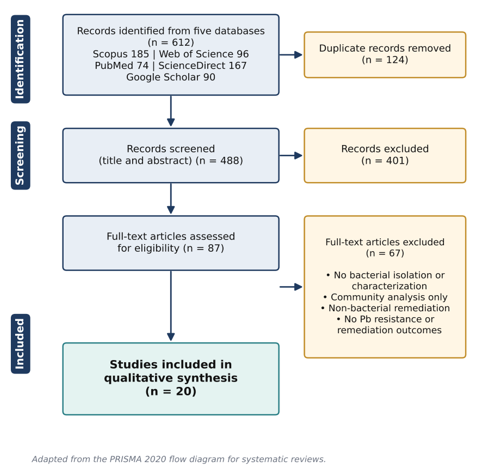
Lead (Pb) is a persistent, non-biodegradable pollutant that accumulates in soils and enters food chains, threatening ecosystems and human health. Indigenous bacteria from lead-polluted sites have evolved ways of tolerating and detoxifying the metal, making them attractive agents for sustainable remediation. We conducted a systematic review following PRISMA 2020 guidelines to synthesize empirical studies published between January 2023 and June 2026 on the isolation, characterization, and bioremediation potential of lead-resistant bacteria. Scopus, Web of Science, PubMed, ScienceDirect, and Google Scholar were searched, and 20 of 612 records met the inclusion criteria. Fifteen studies were from Asia, four from Nigeria, and one from Chile. Bacillus was the most frequently named genus, followed by Pseudomonas, Kocuria, Mesobacillus, Sphingobium, and Lysinibacillus. Lead tolerance and removal were attributed to biosorption, intracellular bioaccumulation, biomineralization, extracellular sequestration, biosurfactant production, antioxidative defence, and active efflux. Thirteen studies relied on morphological and biochemical identification alone, whereas seven reported molecular characterization, including 16S rRNA gene sequencing. Almost all work was laboratory-based, and field validation was largely absent. Indigenous lead-resistant bacteria, particularly Bacillus and Pseudomonas, are promising candidates for lead remediation, but the evidence is limited by non-standardized methods, thin molecular characterization, geographic imbalance, and a lack of field trials. Future work should prioritize standardized reporting, routine genome-based identification, biosafety screening, microbial consortia, and field-scale studies in under-represented regions such as Africa
References
Aguad, H., Aguayo, P., Valenzuela, C., Padilla, C., Smith, C. T., Yañez, F., and Campos, V. L. (2026). Lead (Pb) bioremediation by Sphingobium sp. RO-01 strain isolated from gold mine tailings, Atacama Desert, Chile. World Journal of Microbiology and Biotechnology, 42(8):422. https://doi.org/10.1007/s11274-026-05148-w.
Al-Heety, L. F. (2026). Bioremediation of lead, cadmium and zinc in industrially contaminated soils of the Al-Ma'amal area, Baghdad, Iraq, using indigenous Pseudomonas and Bacillus isolates. Al-Turath Journal for Biology, 2(2): 34–42. https://doi.org/10.63964/atjb.2026.2.4.
Arasu, A., Ramesh, S., Rajendar, M., and Venkataraman, S. (2025). Biosorption of lead (Pb) by Pb-resistant microorganisms isolated from e-waste dump yard – a strategy for microbiological bioremediation. Microbiology and Biotechnology Letters, 53(4), 602–614. https://doi.org/10.48022/mbl.2508.08017
Badamasi, A., and Salisu, B. (2025). Characterization of heavy metal-tolerant bacteria from dumpsites in Katsina Metropolis and their bioremediation potential. UMYU Scientifica, 4(2), 417–428. https://doi.org/10.56919/usci.2542.044.
Danwanzam, A. A., Farouq, A. A., Fardami, A. Y., Ahmed, J. M., Kaka, K. G., Adamu, A., … Ibrahim, U. B. (2025). Screening of hydrocarbon-degrading bacteria isolated from petroleum-contaminated soil and their potential for bioremediation of lead (Pb) contaminated soil. Integral Research, 2(8), 165–192. https://doi.org/10.57067/.
Ehis-Eriakha, C. B., Momodu Oshiomane, E. O., Akharaiyi, F. C., and Akemu, S. E. (2025). Evaluation of the genetic structure and functionality of selected lead-resistant bacteria toward lead bioremediation. Journal of Hazardous, Toxic, and Radioactive Waste, 29(4), 04025025. https://doi.org/10.1061/JHTRBP.HZENG-1471.
Faisal, S., Ahmad, G., Nawaz, S., Rahman, Z. U., Asad, M. T., Khan, A., … Ullah, S. (2025). Isolation and screening of the heavy metals, antibiotics resistant and acidophilic profile of bacterial strains from lead acid batteries repairing and recycling units. Advancements in Life Sciences, 12(2), 451–459. https://doi.org/10.62940/als.v12i2.3376.
Harun, F. A., Yusuf, M. R., Usman, S., Shehu, D., Babagana, K., Sufyanu, A. J., … Yakasai, H. M. (2023). Bioremediation of lead contaminated environment by Bacillus cereus strain BUK_BCH_BTE2: Isolation and characterization of the bacterium. Case Studies in Chemical and Environmental Engineering, 8, 100540. https://doi.org/10.1016/j.cscee.2023.100540
Heidari, P., Bagheriyeh, N., and Soltanian, H. (2025). Bioremediation potential of Kocuria rosea PH1 and Mesobacillus persicus DH1 for lead (Pb(II)) removal from contaminated environments. Bioremediation Journal, 1–10. https://doi.org/10.1010/10889868.2025.2536639.
Idrees, M., Ali, S., Rehman, A., Hussain, S. Z., and Bukhari, D. A. (2023). Uptake of lead by bacteria isolated from industrial effluents and their potential use in bioremediation of wastewater. Saudi Journal of Biological Sciences, 30(8), 103740. https://doi.org/10.1016/j.sjbs.2023.103740
Joseph, O. J., and Ogunjobi, A. A. (2025). Plant growth-promoting properties of metal-tolerant bacteria isolated from battery wastes dumpsites. Environmental Analysis Health and Toxicology, 40(4), e2025028. https://doi.org/10.5620/eaht.2025028
Joshi, G., Raul, D., Harini, V., Jha, D. K., Dharani, G., and Ramakrishnan, B. (2026). A silver lining in the sea: Molecular insight and analytical validation of marine bacteria in lead bioremediation. Journal of Hazardous Materials Advances, 101406. https://doi.org/10.1016/j.hazadv.2026.101406.
Kaushal, P., and Pati, A. M. (2024). Bacillus altitudinis mediated lead bioremediation for enhanced growth of rice seedlings. Current Microbiology, 81(12), 410. https://doi.org/10.1007/s00284-024-03934-z.
Kumar, K., and Singh, D. (2025). Isolation, characterization and optimization of lead resistant bacteria and possible application in bioremediation. Indian Journal of Microbiology, 65(2), 1105–1120. https://doi.org/10.1007/s12088-025-01472-1.
Li, S., Zhang, X., Ma, S., Sun, Y., Wu, H., Zhao, M., … Lei, Y. (2026). Bacillus cereus LSP29 isolated from soil of the mining area can tolerate lead stress through antioxidation, adsorption, mineralization and molecular regulation. Ecotoxicology and Environmental Safety, 309, 119715. https://doi.org/10.1016j.ecoenv.2026.119715.
Mahmud, S., Akter, A., Ali, M. F., Ali, M. R., Khanam, R., Tabassum, F., … Mohiuddin, A. K. M. (2026). Bioremediation potential of lead and cadmium tolerant bacteria isolated from industrial (tannery) effluents. Journal of Genetic Engineering and Biotechnology, 24(3), 100723. https://doi.org/10.1016/j.jgeb.2026.100723.
Pal, P., Pramanik, K., Ghosh, S. K., Mondal, S., Mondal, T., Soren, T., and Maiti, T. K. (2024). Molecular and eco-physiological responses of soil-borne lead (Pb²⁺)-resistant bacteria for bioremediation and plant growth promotion under lead stress. Microbiological Research, 287, 127831. https://doi.org/10.1016/j.jclepro.2023.140508.
Pertiwi, B. L. S., Ustiatik, R., and Nuraini, Y. (2024). Lead (Pb)-resistant bacteria improve Brassica chinensis biomass and reduce Pb concentration in Pb-contaminated soil. Journal of Tropical Biodiversity and Biotechnology, 9(1), 1. https://doi.org/10.22146/jtbb.86174.
Purwasena, I. A., Astuti, D. I., Kristyanto, J. F., and Lestari, F. A. (2026). Potential of Bacillus licheniformis F16 biosurfactant for lead (Pb) bioremediation in soil using soil washing method. Bioremediation Journal, 1–18. https://doi.org/10.1080/10889868.2026.2699765.
Sevak, P., Pushkar, B., and Mazumdar, S. (2025). Comprehensive analysis of Mithi River water quality: Pollution assessment, and lead bioremediation by indigenous bacteria. World Journal of Microbiology and Biotechnology, 41(10), 350. https://doi.org/10.1007/s11274-025-04589-z.
Tahir, U., Zameer, M., Ali, Q., Rafique, A., Ali, S. M., Arif, M. U., … Ali, D. (2023). Toxicity assessment of heavy metal (Pb) and its bioremediation by potential bacterial isolates. Environmental Monitoring and Assessment, 195(9), 1047. https://doi.org/10.1007/s10661-023-11632-9.
Wang, T., Yao, J., Yuan, Z., Zhao, Y., Wang, F., and Chen, H. (2018). Isolation of lead-resistant Arthrobacter strain GQ-9 and its biosorption mechanism. Environmental Science and Pollution Research, 25(4), 3527–3538. https://doi.org/10.1007/s11356-017-0694-7.
World Health Organization. (2025). Exposure to lead: A major public health concern. Preventing disease through healthy environments. World Health Organization. https://www.who.int/publications/i/item/9789240112384
Yadav, S., Kajala, R., Rajpurohit, D., Upadhyay, S. K., Kumar, P., Singh, A., and Jain, D. (2025). Role of newly isolated plant growth-promoting lead-tolerant bacteria in lead bio-remediation and plant growth performance under lead stress. Annals of Microbiology, 75(1), 27. https://doi.org/10.1186/s13213-025-01822-w
Zhang, J., Noor, Z. Z., Baharuddin, N. H., Setu, S. A., Hamzah, M. A. A. M., and Zakaria, Z. A. (2024). Uptake of lead, cadmium and copper by heavy metal-resistant Pseudomonas aeruginosa strain DR7 isolated from soil. World Journal of Microbiology and Biotechnology, 40(12), 387. https://doi.org/10.1007/s11274-024-04194-6.
Downloads
Published
Issue
Section
Categories
License
Copyright (c) 2026 Sikirat Enebere Abdulhakeem, Ibrahim Khalil, Gbenga Olorunshola Alege

This work is licensed under a Creative Commons Attribution 4.0 International License.


