
Utilization of Sargassum Natans in Sand Crete Block Production for Sustainable Walling Solutions
DOI:
https://doi.org/10.33003/fjs-2026-1024-6494Keywords:
Compressive strength, Efflorescence, Sargassum natans, Sandcreteblock, Sustainable walling, Thermal conductivityAbstract
Seaweeds are a diverse and abundant group of marine algae that offer a promising sustainable alternative to conventional cementitious materials, which are increasingly associated with high environmental impact.
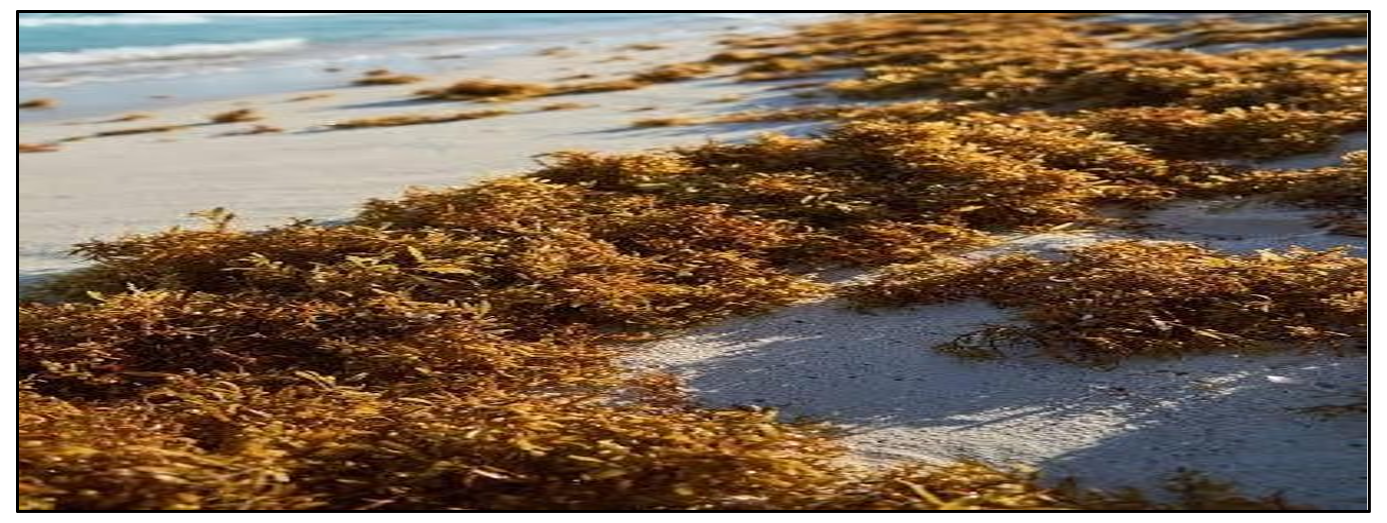
This study investigated the feasibility of incorporating locally sourced Sargassumnatans powder into cement–sandcrete blocks as a bio-based additive for sustainable walling. Seaweed collected at Eleko Beach, Lagos State, Nigeria, was washed, sun-dried, oven-dried, pulverized, and sieved before incorporation at 0% (control), 5%, and 7.5% by mass of cement in a 1:5 cement-to-sand mix.
Specimens were produced in 230 × 110 × 80 mm moulds and evaluated using material characterization, sieve analysis, specific gravity, compressive-strength testing at 7, 14, and 28 days, water absorption, thermal screening, efflorescence observation, and a stakeholder perception survey (n = 55). This study evaluates the physical, chemical, mechanical, and thermal properties of seaweed-based (Sargassum natans) sandcrete blocks to support more environmentally friendly and cost-effective construction practices. Locally sourced Sargassum natans was processed into powder and incorporated as a cement additive at 5% and 7.5% by weight. Laboratory tests—including chemical composition analysis and microstructure using (optical microscopy and SEM-EDX), sieve analysis, specific gravity, compressive strength, water absorption, and thermal conductivity—were carried out in line with relevant BS and AASHTO standards. Results showed that Sargassum natans contains substantial amounts of SiO₂ (41.6%) and CaO (29.9%), indicating pozzolanic potential. The mix with 5% additive achieved at 28-days compressive strength of 8.22 N/mm², closely matching the 7.5% mix (7.08 N/mm²) and satisfying the Nigerian Industrial Standard (NIS 87:2000) for load-bearing blocks.
References
Abowei,J.F.N.,&Tawari,C.C.(2011).A review of the biology, culture, exploitation and utilization potentials of seaweed resources: Case study in Nigeria. Research Journal of Applied Sciences, Engineering and Technology, 3(4), 290–303.
Afolayan, J.O., Ijimdia,S.T.,& Oriola,F.O.P.(2017).Effect of water–cement ratio on the compressive strength of sandcrete block blended with sawdust ash. International Journal of Development Research, 7(9), 14923–14928.
Alejo,A.O.(2020).Comparison of strength of sandcrete blocks produced with fine aggregate from different sources. Nigerian Journal of Technology, 39(2), 332–337.
Anderson,J.,& Moncaster,A.(2020).Embodied carbon of concrete in buildings,Part1:Analysis of published EPD. Buildings and Cities, 1(1), 198–217.
Ashik, K., Thajudheen, A. B., Husna, P., Amal, N. M., & Abraham, R. (2022). Study on strength of concrete prepared by replacing cement with seaweed powder. International Journal of Advances in Engineering and Management, 4(9), 838–842.
Asim,M.,Shahzad,A., Khan,R.,& Hussain,R.(2021).Sustainable materials in construction: A review of recent developments. Journal of Cleaner Production, 285, 124805. https://doi.org/10.1016/j.jclepro.2020.124805
ASTM International.(2018).ASTMC67:Standard test methods for sampling and testing brick and structural clay tile. ASTM International.
Baloch,M.A., Abdullah,A.M.,& Shaikh, S.A.(2023).Potential of bio-based materials in eco-friendly construction: A review. Construction and Building Materials, 360, 129556. https://doi.org/10.1016/j.conbuildmat.2022.129556
BritishStandardsInstitution.(2011).BSEN772:Methodsoftestformasonryunits.BSI.
Geissdoerfer,M.,Savaget,P.,Bocken,N.M.P.,&Hultink,E.J.(2017).Thecirculareconomy—A new sustainability paradigm? Journal of Cleaner Production, 143, 757–768.
Holdt,S.L.,& Kraan,S.(2011).Bioactive compounds in seaweed: Functional food applications and legislation. Journal of Applied Phycology,23(3),543–597.
International Organization for Standardization.(1991).ISO8302:Thermal insulation—Determination of steady-state thermal resistance and related properties. ISO.
MacMonagail,M.,Cornish,L.,Morrison,L.,Araújo,R.,&Critchley,A.T.(2017).Sustainable harvesting of wild seaweed resources. European Journal of Phycology, 52(4), 371–390.
Ross,F.W.R.,et. al.(2023).Potential role of seaweeds in climate change mitigation. Science of the Total Environment, 885, 163699.
Scardifield, K., Mclean, N.,Kuzhiumparambil, U., Ralph, P. J., Neveux, N., Isaac, G., & Schork, T. (2024). Bio masonry products from macroalgae: A design-driven approach to developing biomaterials for carbon storage. Journal of Applied Phycology, 36(2), 935–950.
Stanislas,T.T., Bilba,K., Potiron,C.O.,& Arsène,M.-A.(2024).Effect of desalination of Sargassumalgaeonits potential use as a stabilizer in sustainable earth-based bricks. Algal Research, 82, 103625.
WCED (World Commission on Environment and Development).(1987).Our common future. Oxford University Press.
Downloads
Published
Issue
Section
Categories
License
Copyright (c) 2026 Fabinu Ayodeji Viavoh, Ameh

This work is licensed under a Creative Commons Attribution 4.0 International License.


