In Vitro Antimicrobial Activity and In Vivo Wound-Healing Potential of Hydro-Ethanol Plant Extract of Euphorbia Hirta in Wistar Rats with Staphylococcus Aureus-Infected Wounds
DOI:
https://doi.org/10.33003/fjs-2026-1024-6497Keywords:
Wound healing, Staphylococcus aureus, Bacteria wound infection, Euphorbia hirta, Bacteria countAbstract
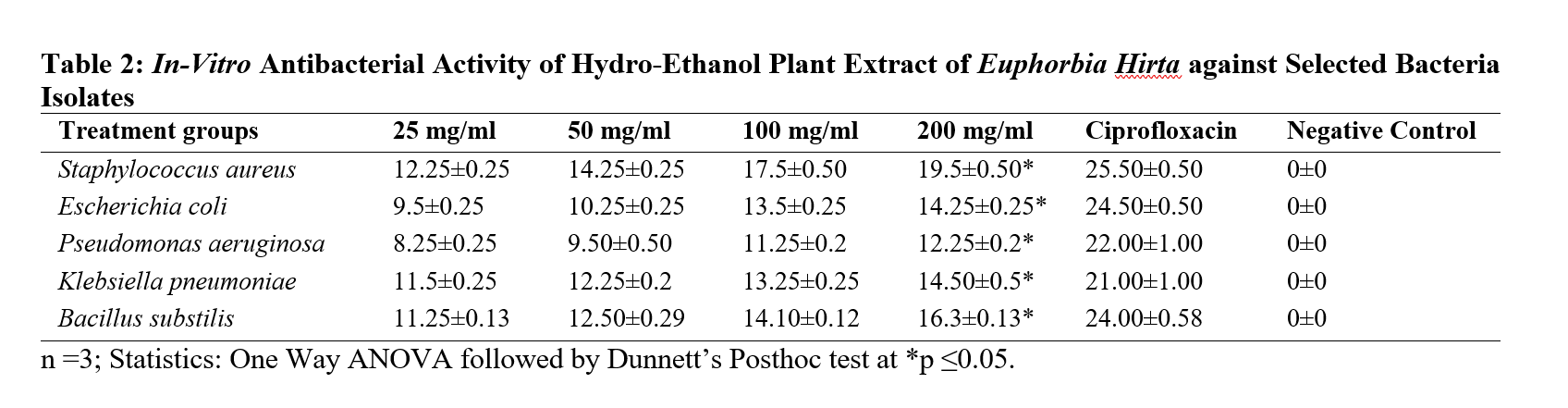
Euphorbia hirta is a medicinal-plant widely recognized in traditional-medicine and has demonstrated considerable potential in the treatment of infections and wounds. This study focused on evaluating the in-vitro antimicrobial-activity and wound-healing potential of a hydro-ethanol plant extract of Euphorbia hirta in Staphylococcus aureus-infected wounds in Wistar-rats. Preliminary-phytochemical screening of the extract was performed using standard-procedures. The acute-toxicity of the extract was also evaluated using Locke’s-method. The antimicrobial-activity was assessed in-vitro against selected bacterial and fungal-isolates using the agar-well diffusion-technique. For the wound-healing experiment, 30 Wistar-rats were randomly assigned to five-groups of six-rats each. A wound measuring 5mm was created on the dorsal thoracic-region of each rat after disinfection. The wounds were inoculated with Staphylococcus-aureus (1×10⁵CFU/mL) and left for 48hours to establish infection. The rats were then treated with graded oral-doses of E. hirta extract (150, 300 and 600mg/kg) with topical-formulations of 0.5, 1.0 and 1.5g (group 1-3), clindamycin (50mg/kg orally) with 0.1% w/w gentamicin topically (group 4) and vaseline as the topical-control (group 5). Wound-contraction was monitored from day-1 through day-21. Bacterial-samples were collected from the wound sites before treatment and on day-17 to determine bacterial-load. Phytochemical-screening revealed several biologically-active constituents. The acute-toxicity study produced an LD50 above 5000mg/kg. E. hirta demonstrated concentration-dependent antimicrobial-activity against the tested bacterial and fungal-isolates in the in-vitro-study. In the wound-healing study, treatment with the extract significantly reduced bacterial-load and enhanced wound-contraction. The findings indicate that Euphorbia hirta possesses significant antimicrobial and wound-healing properties and may have potential applications in the management of bacterial wound-infections.
References
Aderinola, A. A., Ejiofor, J. I., Ogunjimi, L. O., Murtala, A. A., Oladapo, O. E. & Oladoja, F. A. (2025). Lecaniodiscus cupanioides leaf extract attenuates Plasmodium berghei-induced malaria infection in albino mice via modulation of serum biochemical and hematological markers. Pharmacological Research-Natural Products, 7, 100257. Doi: https://doi.org/10.1016/j.prenap.2025.100257.
Ajayi, I. A., Odejobi, B. S., Ifedi, E. N., Raji, A. A., & Ajayi, O. O. (2026). Phytochemical composition and wound healing activity of Azadirachta indica seed extract in wistar rats. Journal of Chemical Society of Nigeria, 51(2). https://doi.org/10.4314/jcsn.v51i2.13.
Al-Aboody, M. S., & Mickymaray, S. (2020). Anti-fungal efficacy and mechanisms of flavonoids. Antibiotics, 9(2), 45. https://doi.org/10.3390/antibiotics9020045.
Anju, V.T., Busi, S., Mohan, M.S.,& Dyavaiah, M. (2023). Bacterial infections: Types and pathophysiology. In Antibiotics-Therapeutic Spectrum and Limitations Chapter 2. Pp.21-38. Academic Press. ISBN 9780323953887. https://doi.org/10.1016/B978-0-323-95388-7.00004-8.
Arbad S., Ullah, H., Alzahrani, K. J., Alsharif, K. F., Alzahrani, F. M., Abuderman, A., & Zeng, Z. (2026). Methanolic plant extracts: emerging biotherapeutic alternatives for animal wound infection control. Frontiers in Veterinary Science, 13, 1812558. https://doi.org/10.3389/fvets.2026.1812558.
Ashiq, A., Das, S. C., Biswas, S., Akter, R., Masum, M. A., & Bedoura, S. (2025). Accelerating wound healing: Unveiling a synergistic neem-chitosan composite for rapid tissue regeneration. Next Research, 2(3), 100541. ISSN 3050-4759. https://doi.org/10.1016/j.nexres.2025.100541.
Atanasov, A. G., Zotchev, S. B., Dirsch, V. M., & Supuran, C. T. (2021). Natural products in drug discovery: advances and opportunities. Nature reviews Drug discovery, 20(3), 200-216. https://doi.org/10.1038/s41573-020-00114-z.
Azeem, K., Irfan, I., Shakir, M., Rawat, D. S., & Abid, M. (2024). Therapeutic potential of phytochemicals and their derivatives as antifungal candidates: recent discovery and development. In: Manzoor, N. (eds) Advances in Antifungal Drug Development. Springer, Singapore. https://doi.org/10.1007/978-981-97-5165-5_19.
Bessa, G. (2023). Bacterial Infections. In: Rangel Bonamigo, R. (eds) Dermatology in Public Health Environments. Springer, Cham. Pp.183-202. https://doi.org/10.1007/978-3-031-13505-7_9.
Borges, A., Saavedra, M., & Simoes, M. (2015). Insights on antimicrobial resistance, biofilms and the use of phytochemicals as new antimicrobial agents. Current Medicinal Chemistry, 22(21), 2590-2614. https://doi.org/10.2174/0929867322666150530210522
Cong, N. D., Van Thu, N., Thanh, D. V., Yen, NTH., Yen, TH., Ha, HTT., & Thao, NTP. (2026). Study of Antibacterial Activity of Extract of Large-Leaf Milky Grass (Euphorbia hirta L.). TNU Journal of Science and Technology, 231 (13), 484-490.
Godin, B., Touitou, E., Rubinstein, E., & Athamna, A. M. (2005). A New approach for treatment of deep skin infections by an Ethosomal antibiotic preparation: An in-vivo study. Journal of Antimicrobial Chemotherapy, 55: 989-994. https://doi.org/10.1093/jac/dki125
Goyal, M., Sharma, R., and Verma, P. (2024). Recent advances in pharmacological studies on Euphorbiaceae medicinal plants. Industrial Crops and Products, 210, 118102.
Guo, S. A., & DiPietro, L. A. (2010). Factors affecting wound healing. Journal of Dental Research, 89(3), 219-229. https://doi.org/10.1177/0022034509359125
Hedrich H. H., & Bullock, G. (2006). The Laboratory Mouse: The Handbook of Experimental Animals. Elsevier Academic press, UK. pp. 463-492.
Jangir, R. K., Singh, J., & Haider, F. (2026). In vitro and in vivo Antimicrobial Activity of Azadirachta indica (Neem) Nanoformulations against Multidrug-Resistant Bacterial Strains Isolated from Indian Hospital Settings: Implications for Wound Healing in Tropical Climates. CME Journal Geriatric Medicine, 18(2), 202-207. https://doi.org/10.61336/cmejgm/2026-02-2.
Kumari, S., Sharma, T. K., & Kumar, V. B. (2026). Ethnobotanical, Phytochemical and Pharmacological Importance of Selected Members of Euphorbiaceae: A Review. Journal of Scientific Research and Technology, 4(5): 22-36. . ISSN: 2583-8660. www.jsrtjournal.com.
Lewnard, J. A., Charani, E., Gleason, A., Hsu, L. Y., Khan, W. A., Karkey, A., & Laxminarayan, R. (2024). Burden of bacterial antimicrobial resistance in low-income and middle-income countries avertible by existing interventions: an evidence review and modelling analysis. The Lancet, 403(10442), 2439-2454. http://doi.org/10.1016/s0140-6736%2824%2900862-6.
Lorke, D. (1983). A New Approach to Practical Acute Toxicity Testing, PMID: 6667118, Arch. Toxicol. 54 275–287. https://doi.org/10.1007/BF01234480.
Malone, M., & Schultz, G. (2022). Challenges in the diagnosis and management of wound infection. British journal of dermatology, 187(2), 159-166. https://doi.org/10.1111/bjd.21612
Monk, E. J., Jones, T. P., Bongomin, F., Kibone, W., Nsubuga, Y., Ssewante, N., & van Zandvoort, K. (2024). Antimicrobial resistance in bacterial wound, skin, soft tissue and surgical site infections in Central, Eastern, Southern and Western Africa: a systematic review and meta-analysis. PLOS global public health, 5(5), e0004608. https://doi.org/10.1371/journal.pgph.0004608
Murray, C. J., Ikuta, K. S., Sharara, F., Swetschinski, L., Aguilar, G. R., Gray, A., & Tasak, N. (2022). Global burden of bacterial antimicrobial resistance in 2019: a systematic analysis. The lancet, 399(10325), 629-655. https://doi.org/10.1016/s140-6736(21)02724-0.
Mukerjee, M. (1997). Trends in animal research. Scientific American, 276(2), 86-93. https://www.jstor.org/stable/24993615.
Mwalongo, O., Kisula, L., Credo, D., & Sauli, E. (2025). Phytochemical composition, toxicity, and in vivo antimicrobial properties of Euphorbia hirta and Plectranthus barbatus ethanolic extracts’ polyherbal formulation. Natural Product Communications, 20(10), 1934578X251388330. https://doi.org/10.1177/1934578X251388330
Perez C., Paul M., & Bazerque P. (1990). An antibiotic assay by the agar-well diffusion method. ActaBiol. Med. Exp. 15: 113-115.
Pieniążek, J. M., Padkowska, A., Dobosz, M., Arciszewska, K., Buczkowski, J., Miazga, M., & Mataczyńska, A. (2024). Overview of the Main Bacterial Infections in Humans. Quality in Sport, 23, 54786-54786. https://doi.org/10.12775/QS.2024.23.54786.
Prodinger, C., Lechner, A., Hintersteininger, A., Kern, J. M., Meißnitzer, M., Meyersburg, D., & Laimer, M. (2025). Complicated and deep bacterial skin and soft tissue infections. JDDG: Journal der Deutschen Dermatologischen Gesellschaft, 23(3), 357-375. https://doi.org/10.1111/ddg.15493
Salehi, B., Iriti, M., Vitalini, S., Antolak, H., Pawlikowska, E., Kręgiel, D., & Seca, A. M. (2019). Euphorbia-derived natural products with potential for use in health maintenance. Biomolecules, 9(8), 337. https://doi.org/10.3390/biom9080337
Shuwa, F. A. A., Yakubu, M., & Sani, A. M. (2026). Phytochemical analysis and antibacterial activities of aqueous and ethanolic leaf and stem extracts of Euphorbia hirta on some clinical isolates. Science World Journal, 21(2), 698-702. https://doi.org/10.4314/swj.v21i2.34.
Soni, J., Sinha, S., & Pandey, R. (2024). Understanding bacterial pathogenicity: a closer look at the journey of harmful microbes. Frontiers in Microbiology, 15, 1370818. https://doi.org/10.3389/fmicb.2024.1370818.
Touaitia, R., Mairi, A., Ibrahim, N. A., Basher, N. S., Idres, T., & Touati, A. (2025). Staphylococcus aureus: A review of the pathogenesis and virulence mechanisms. Antibiotics, 14(5): 470. https://doi.org/10.3390/antibiotics14050470.
Trease G.E & Evans W.C (1983). Pharmacognosy. 1st edition. Ahmadu Bello University press, Zaria, Nigeria. pp188-198.
Uberoi, A., McCready-Vangi, A., & Grice, E. A. (2024). The wound microbiota: microbial mechanisms of impaired wound healing and infection. Nature Reviews Microbiology, 22(8), 507-521. https://doi.org/10.1038/s41579-024-01035-z
Downloads
Published
Issue
Section
Categories
License
Copyright (c) 2026 Adeyinka Aderonke Aderinola, Luqman Ogunjimi, Emmanuel Irokosu, Muinat Adeyanju, Owolabi Sikiru

This work is licensed under a Creative Commons Attribution 4.0 International License.