
Dietary Supplementation of Tumeric (Curcuma longa) Powder On Heamatological and Biochemical Indices of Clarias gariepinus Juveniles
DOI:
https://doi.org/10.33003/fjs-2026-1023-6502Keywords:
Immune Response, Turmeric Powder, Phytogenic Additive, Haematology, Serum BiochemistryAbstract
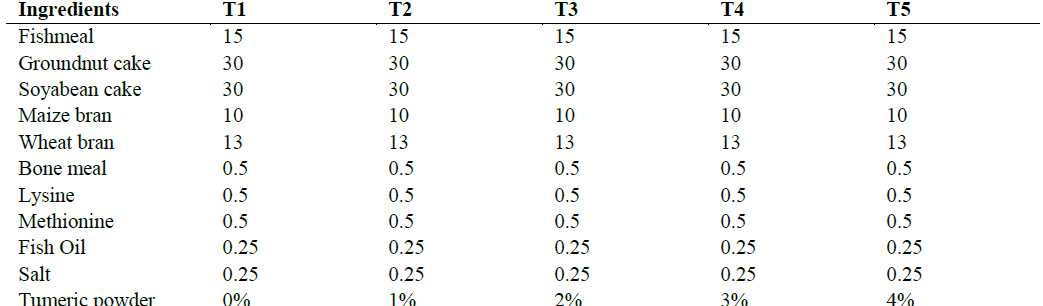
Dietary supplementation of fish feed with phytogenic feed additives in aquaculture has been shown to enhance aquaculture production by improving immune function and mitigating physiological dysfunctions associated with fish health. As a result, phytogenic additives contribute to better growth performance, increased disease resistance, and overall fish welfare, making them a promising natural alternative to synthetic feed additives. A three-month feeding trial was conducted to investigate the effects varied concentrations of turmeric (Curcuma longa) powder on the haematological and biochemical indices of Clarias gariepinus juveniles. A total of 150 juveniles of uniform weight were randomly assigned to five dietary treatments containing 0, 1, 2, 3, and 4% turmeric powder in two replicates. At the end of the experiment, blood samples were collected for haematological and serum biochemical analyses. Results obtained revealed that dietary turmeric supplementation significantly (P<0.05) increased white blood cell count, haemoglobin concentration, mean corpuscular volume, and mean corpuscular haemoglobin compared with the control. Red blood cell count and haematocrit were not significantly affected (P>0.05). There was significant reduction in cholesterol, serum glutamic pyruvic transaminase (GPT/ALT), and serum glutamic oxaloacetic transaminase (GOT/AST) activities in turmeric-fed fish. Total protein and alkaline phosphatase were not significantly influenced by the treatments. Conclusively, this result demonstrates that turmeric powder positively enhanced the physiological status and health of C. gariepinus juveniles with no adverse effects. Dietary inclusion of 1–2% turmeric powder is recommended as an effective natural feed additive for African catfish production
References
Abdel-Latif, H. M. R., Abdel-Tawwab, M., Khafaga, A. F., and Dawood, M. A. O. (2020). Dietary phytogenic feed additives in aquaculture: Recent advances in improving fish health and production. Aquaculture Research, 51(8), 3153–3167.
Abdel-Latif, H. M. R., Abdel-Tawwab, M., Khafaga, A. F., and Dawood, M. A. O. (2020). Dietary phytogenic feed additives in aquaculture: Current applications and prospects. Aquaculture International, 28, 187–210.
Abdel-Tawwab, M., Adeshina, I., Jenyo-Oni, A., Ajani, E. K., and Emikpe, B. O. (2018). Growth, physiological, antioxidant and immune responses of African catfish fed diets supplemented with herbal extracts. Fish Physiology and Biochemistry, 44, 1029–1040.
Acar, Ü., Kesbiç, O. S., Yılmaz, S., Gültepe, N., and Türker, A. (2015). Evaluation of the effects of dietary herbal extracts on haematological and immune parameters of fish. Aquaculture International, 23, 221–232.
Adamu, Y. K., Dauda, A. B. and Tiamiyu, L. O. (2023). Climate variability and fisheries production in Nasarawa State, Nigeria: A ten-year assessment. Journal of Climate Change and Sustainability, 8(2), 112-124.
Adewole, H. A. (2021). Growth performance and feed utilization of Clarias gariepinus juveniles fed diets containing varying levels of herbal additives. African Journal of Aquatic Science, 46(1), 97-105.
Ahmadifar, E., Sheikhzadeh, N., Roshanaei, K., Dargahi, N., & Faggio, C. (2019). Can dietary ginger (Zingiber officinale) alter biochemical and immunological parameters and gene expression related to growth, immunity and antioxidant system in zebrafish (Danio rerio)?. Aquaculture, 507, 341-348.
Ajima, M.N.O., Ogo, O.A., Audu, B. S. and Ugwoegbu, K.C. (2015). Chronic diclofenac (DCF) exposure alters both enzymatic and haematological profile of African catfish, Clarias gariepinus. Drug and Chemical Toxicology, 38(4), 383-390.
Ajima, M.N.O., Pandey, P.K., Kumar, K., Poojary, N. and Gora, A.H. (2019). Verapamil caused biochemical alteration, DNA damage and expression of hepatic stress-related gene biomarkers in Nile tilapia, Oreochromis niloticus. Comparative Clinical Pathology, 29 (1), 135-144.
Allain, C.C. Poon, L.S, Chan, C.S.G. Richmond, W. and Fu, P.C (1974), Enzymatic determination of total serum cholesterol. Clinical Chemistry, 20, 470-475.
APHA (American Public Health Association) (2021). Standard Methods for the Examination of Water and Wastewater (24th ed.). American Public Health Association, Washington, DC.
Atter, A., Taye, N. Osei Tutu, C., Asiedu, B.K., Acheampong, R. Ofori, H. et al. (2026). Nutritional Composition of African Cat fish (Clarias gariepinus) in Ghana: Effects of culture conditions, feed and processing. Aquaculture, Fish and Fisheries, 6(4): e70303.https:///doi.org/10.1002/aff2.70303.
Awad, E., and Awaad, A. (2017). Role of medicinal plants on growth performance and immune status in fish. Fish & Shellfish Immunology, 67, 40–54.
Blaxhall, P.C. and Dalsely, K.W. (1973). Routine hematological methods for use with fish blood. Journal of Fish Biology, 5,771-781.
Bradford, M.M. (1976). Rapid and sensitive method for quantitation of microgram quantities of protein utilizing principle of protein dye binding. Annals of Biochemistry, 72,248-254.
Catacutan, M.R. (2002). Formulation of aquafeeds in. O.M. Millamena, R.M. Coloso, and F.P. Pascual (Eds), Nutrition in Tropical Aquaculture Essentials of Fish Nutrition, Feed and Feeding of Tropical Aquatic Species (pp.99-123).
Cooper, G.R. and McDaniel, V. (1970). Estimation of biochemical parameters. In: McDonald RP, ed. Standard Methods of Clinical Chemistry. New York: Academic Press, 162.
Coulombe, J.J. and Favreau, L. (1963). A new simple semi micro method for colorimetric determination of urea. Clinical Chemistry, 9, 102-108.
Dawood, M. A. O., Koshio, S., Abdel-Daim, M. M., and Van Doan, H. (2019). Probiotic and phytogenic feed additives in aquaculture: Roles in fish health and performance. Aquaculture, 500, 72–86.
Dawood, M. A. O., Magouz, F. I., Mansour, M., Saleh, A. A., and Fadl, S. E. (2020). Dietary herbal supplementation improves liver function and antioxidant status in cultured fish. Aquaculture Research, 51, 2417–2430.
Deepa, G., Ayesha, S. and Nishitha, K. (2022). Comparative evaluation of different drying methods on curcuminoid retention and antioxidant activity of turmeric rhizomes. Journal of Food Processing and Preservation, 46(4), e16321.
Dewi, C.O., Manalu, W., Ekastuti, D.R. and Sudrajat A.O. (2018). The Role of Turmeric Powder Supplementation in improving Liver Performances to Support the Production of Siam Catfish (Pangasianodon hypophthalmus). Omni Akuatika, 14 (1), 44~53,
Essey, O.A., Lowky, O.H. and Brock, M.J. (1946). A method for the rapid determination of alkaline phosphatase with five cubic millimetres of serum. Journal of Biology and Chemistry, 164:321-329.
FAO (Food and Agriculture Organization). (2024). FAOSTAT Database on Turmeric Production. Rome, Italy: FAO.
Fawole, F. J., Adeoye, A. A. and Tiamiyu, L. O. (2022). Dietary turmeric supplementation improves growth, antioxidant status, and disease resistance in African catfish (Clarias gariepinus). Aquaculture Reports, 24, 101138.
Gabriel, U. U., Akinrotimi, O. A., Bekibele, D. O., Onunkwo, D. N., & Anyanwu, P. E. (2015). Haematological responses of African catfish (Clarias gariepinus) fed diets containing Moringa oleifera leaf meal. Journal of Aquaculture Research & Development, 6, 311.
Henry, J.B. (1974). Clinical Diagnosis and Management, 17* ed. W.B. Saunders, Philadelphia.
Hewlings, S.J. and Kalman, D.S. (2023). Curcumin: An updated review of its molecular mechanisms and therapeutic applications. Foods, 12(1), 122.
Houston, A.H. (1997) Review: Are the classical haematological variables acceptable indicators of fish? Transaction of American Fisheries Society, 126,879-894.
Hrubec, T. C., Cardinale, J. L., & Smith, S. A. (2000). Hematology and plasma chemistry reference intervals for cultured tilapia (Oreochromis hybrid). Veterinary Clinical Pathology, 29(1), 7–12.
Ibrahim, M. A., Abdel-Hamid, N. M. and Mahmoud, O. M. (2024). Phytogenic feed additives in aquafeeds: A review on the potentials of turmeric (Curcuma longa) for sustainable aquaculture. Reviews in Aquaculture, 16(1), 267-285.
Iheanacho, S.C., Ogbu, M., Ude, E., Ayotunde, E., and Ogueji, E. (2018). Growth, haematology and immuno-modulatory potential of ginger (Zingiber officinale) supplemented diets in Clarias gariepinus Juvenile (Burchell, 1822). Aquaculture Studies, 18(5), 41-49.
Inanan B.E. Acar U. and Inanan, T. (2021). Effects of dietary Ferula elaeochytris root powder concentrations on haematology, serum biochemical parameters, spermatozoa parameters, and oxidative status in tissues of males goldfish (Carassius auratus). Aquaculture, 544, 737087,
Inanan, B.E. and Acar, U. (2019). Evaluation of sugar beet leave extracts in goldfish (Carassius auratus) diets: Effects on blood and semen parameters Acta Aquatica Turcica, 15(4), 458-468.
Joshi, R., Kaur, S., and Kansal, R. (2024). Genetic diversity assessment of elite turmeric (Curcuma longa L.) germplasm using phenotypic and SSR markers. Industrial
Mooraki, N., Batmany, Y., Zoriehzahram S.J. and Kakoolaki, S.H. (2019). Evaluating the effect of using turmeric (Curcuma longa) on growth performance and hematological parameters of the ornamental fish, Green Terror (Andinocara rivulatus). Journal of Survey in Fisheries Sciences, 5(2), 37-47.
Nelson, D.A. and Morris, M.W. (1989). Basic methodology, hematology and coagulation, Part IV. In: Nelson DA, Henry JB, eds. Clinical diagnosis and management by laboratory methods, 17th ed. Philadelphia (PA): W.B. Saunders, 578-625.
Nwose, F.O, Wachi, F.O and Ekelemu, J.K. (2026). Dietary turmeric enhancing physiological resilience of African Cat Fish (Clarias gariepinus) following Aeromonas hydrophila challenge: An integrated physiological assessment FUDMA Journal of Sciences 10(19), 185-197. https://doi.org/0.33003/fjs-2026-1019-5857
Olaniyi, C., Atoyebi, M.O., Obafunmiso, H.T., & Salaam, K.A. (2020). Effect of ginger (Zingiber officinale) in the nutrition of African catfishA cholesterol reducer and fertility enhancer. International Journal of Aquatic Fish Science, 6(2), 24-28.
Reitman, S. and Frankel, S. (1957). Acolorimetric method for the determination of serum glutamic oxalo acetic and glutamic pyruvic transaminase. American Journal of Clinical Pathology, 766,28-56,
Reverter, M., Bontemps, N., Lecchini, D., Banaigs, B., and Sasal, P. (2014). Use of plant extracts in fish aquaculture as an alternative to chemotherapy: Current status and future perspectives. Aquaculture, 433, 50–61.
Reverter, M., Tapissier-Bontemps, N., Lecchini, D., Banaigs, B. and Sasal, P. (2021). Biological and ecological roles of external fish mucus: A review. Fishes, 6(4), 66.
Rusia, V. and Sood, K. (1992). Routine hematological tests. tn: Mukeriee KL, ed Medical laboratory technology. New Detti Tata McGrawhill, 252-258
Saeidi, A.M.R., Adel, M, Caipang, C.M.A., and Oawood, M.A.O. (2017). Immunological responses and disease resistance of rainbow trout (Oncorhynchus mykiss) juveniles following dietary administration of stinging nettle (Lirtice dronca), Fish Shellfish Immunology, 71230-238.
Shalaby, A.M., Khattab, Y.A. and Abdel -Rahman, A.M. (2006). Effects of garlic (A/lium sativum) and chloramphenicol on growth performance, physiological parameters and survival of Nile tilapia. Journal of Venomous Animal Toxins including Tropical Diseases, 12(2), 172-201.
Sivaram, V., Babu, M. M., Immanuel, G., Murugadass, S., Citarasu, T., & Marian, M. P. (2004). Growth and immune response of fish fed herbal diets. Aquaculture, 238, 285–295.
Van Hai, N. (2015). The use of medicinal plants as immunostimulants in aquaculture: A review. Aquaculture, 446, 88–96.
Wong, K. E., Ngai, S.C., and Chan, K.G. (2024). Advanced nanoformulations of curcumin: Enhancing bioavailability and therapeutic efficacy. International Journal of Nanomedicine, 19, 563-585.
Xia, S.L. Ge, X.P., Liu, B., Xie, J., Miao, L.H., Ren M.C,, Zhou Q.L. Zhang W.X., Jiang X.J. Chen R.L. and Pan l.K. (2015). Effects of Supplemented Dietary Curcumin on Growth and Non-Specific immune Responses in Juvenile Wuchang Bream (Megalobrama amblycephala). The Israeli Journal of Aquaculture, 67, 1174
Downloads
Published
Issue
Section
Categories
License
Copyright (c) 2026 Lawee Aliyu Yusuf, Ataya Josiah Osu, Agbason Nelson Anzaku, Bala Babangida Manta, Suswam Oraluter

This work is licensed under a Creative Commons Attribution 4.0 International License.


