
Effect of Vitamin-Mineral Fortification on The Nutritional Composition and Sensory Acceptability of a Locally Formulated Maize-Based Ready-to-use Therapeutic Food for Children with Severe Acute Malnutrition
DOI:
https://doi.org/10.33003/fjs-2026-1023-6510Keywords:
Ready-to-Use Therapeutic Food, Maize-Based, Acute malnutrition, Vitamin-mineral fortification, Nutritional CompositionAbstract
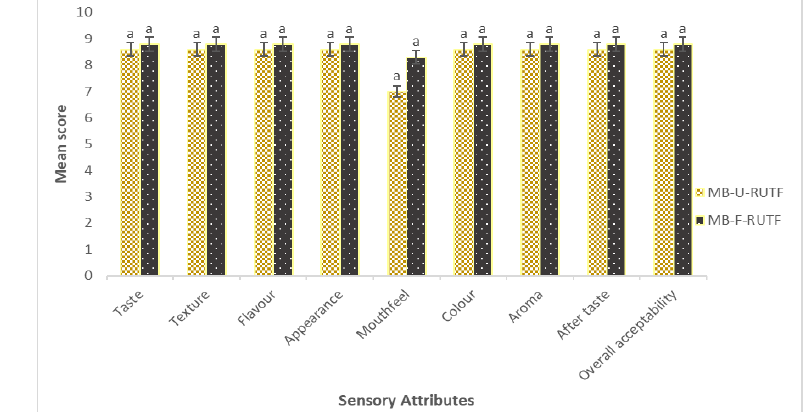
Ready-to-use therapeutic food (RUTF) plays an important role in the community-based management of severe acute malnutrition (SAM). However, reliance on commercially produced and imported RUTF can limit its affordability and availability in low-resource settings. This study developed and evaluated maize-based RUTFs (MB-RUTFs) from locally available ingredients and examined the effect of vitamin-mineral fortification on their nutritional composition and sensory acceptability. Two formulations were produced: an unfortified formulation (MB-U-RUTF) and a vitamin-mineral premix-fortified formulation (MB-F-RUTF). Proximate composition, mineral and vitamin contents, amino acid profile, and sensory acceptability were determined using standard analytical procedures. Data were analyzed using an independent-samples t-test, with significance set at P < 0.05. Energy content ranged from 581.17 to 586.03 kcal/100g, while moisture content ranged from 2.12 to 2.24%. Protein and lipid contents ranged from 10.12 to 11.55 and 45.02 to 47.17 g/100g, respectively. Fortification significantly increased most mineral and vitamin concentrations, including potassium (35.98-1,373.68 mg/100g), calcium (3.98-344.73 mg/100g), iron (3.10-4.86 mg/100g), zinc (0.19-12.75 mg/100g), vitamin A (0.052-0.607 mg/100g), vitamin E (0.34-2.91 mg/100g), and folic acid (1.62-141.67 µg/100g) (P < 0.05). Most amino acids were also higher in the fortified formulation. Both formulations received high sensory acceptability scores, with no significant differences in the sensory attributes assessed (P > 0.05). The findings show that locally available ingredients can be used to produce acceptable maize-based RUTF. Vitamin-mineral fortification improved the micronutrient composition without compromising sensory acceptability. However, further formulation optimization is needed to meet all recommended RUTF nutrient specifications
References
Abdul-kader, T.R. (2025). Amino Acids: Metabolism, Functions, and Their Role in Health and Disease Management. OBAT: Jurnal Riset Ilmu Farmasi dan Kesehatan. 3, 35-57. https://doi.org/10.61132/obat.v3i4.1432
Amegovu, K.A., Peter, U.K., and Timothy, C. (2018). Nutrients and anti-nutrient profile of a local formula from sorghum, peanut, honey, and garlic (Metu-2) for treatment of severe acute malnutrition. Journal of food Research, 7(2): 26-38. https://doi.org/10.5539/jfr.v7n2p25
AOAC International. (2000). Official methods of analysis of AOAC INTERNATIONAL (17th ed.). AOAC International.
AOAC International. (2019). Official methods of analysis of AOAC INTERNATIONAL (21st ed.). AOAC International.
Ashish, S., Vibhawari, D., Jayashri, P., Dipty, J., and Kavita, S. (2022). Mapping of Local Therapeutic Foods (LTF) and Micronutrients (MN); their logistics in community-based management of Severe Malnutrition (SAM, SUW) as a benchmark in tribal Melghat, Maharashtra. Arch Food Nutr Sci, 6: 026-034. https://doi.org/10.29328/journal.afns.1001034
Banda T., Chawanda K., Tsuchida W., and Kathumba S. (2021). Report of a Pilot Program Using a Milk-Free Ready-to-Use Therapeutic Food Made From Soya, Maize, and Sorghum to Treat Severe Acute Malnutrition. Food and Nutrition Bulletin, 42(1):91-103.
Bharaniidharan, J., and Reshmi, S. K. (2019). Locally Prepared RUTF for MAM: A Controlled Trail Department of Biotechnology, Sri Ramakrishna College of Arts and Science, Coimbatore, Tamil Nadu-641006, India. International Journal of Scientific Research and Review, 8(6),807.
Choudhury N., Ahmed T., Hossain I., Islam M.M., Sarker S.A., Zeilani M., et al. (2018). Ready‐to‐use therapeutic food made from locally available food ingredients is well accepted by children having severe acute malnutrition in Bangladesh. Food and Nutrition Bulletin, 39(1):116‐26.
Church, D.D., Hirsch, K.R., Park, S., Kim, I.Y., Gwin, J.A., Pasiakos, S.M., Wolfe, R.R., and Ferrando, A.A. (2020). Essential amino acids and protein synthesis: Insights into maximizing the muscle and whole-body response to feeding. Nutrients, 12(12), 3717. https://doi.org/10.3390/nu12123717
Clark H., Coll-Seck A.M., Banerjee A., et al. (2020). A future for the world’s children? A WHO–UNICEF–Lancet Commission. Lancet. 2020;395(10224):605–658. 10.1016/S0140-6736(19)32540-1
de Freitas Floriano, R., Gräbin, K., Cassanta Rossi, R., Dietrich Ferreira, C., and Ziegler, V. (2020). Impact of roasting conditions on the quality and acceptance of the peanut paste. Journal of Texture Studies, 51(5), 841–848.
Dipasquale, V., Cucinotta, U., and Romano, C. (2020). Acute Malnutrition in Children: Pathophysiology, Clinical Effects and Treatment. Nutrients, 12(8), 2413. https://doi.org/10.3390/nu12082413
Drammeh W., Hamid N.A., and Rohana A.J. (2019). Determinants of household food insecurity and its association with child malnutrition in sub-Saharan Africa: A review of the literature. Curr Res Nutr Food Sci. 2019;7(3):610–623. 10.12944/CRNFSJ.7.3.02
Edafioghor, L.O., Ibeanu, V.N., Onodugo, N.G., and Okorie, I. (2025). Formulation and nutritional evaluation of ready-to-use therapeutic food using locally available food ingredients. World Nutrition, 16(1), 21–26. https://doi.org/10.26596/wn.202516121-26
Federal Ministry of Health and Social Welfare [Nigeria], National Population Commission (NPC) [Nigeria], and ICF. (2024). Nigeria demographic and health survey 2023–24: Key indicators report.
Food and Agricultural Organization (FAO), World Health Organization (WHO). (2022). Guidelines for ready-to-use therapeutic foods. Codex Alimentarius Guideline No. CXG 95-2022. Codex Alimentarius Commission. Rome. https://doi.org/10.4060/cc4593en
Food and Agricultural Organization. (2003). Food Energy - Methods of Analysis and Conversion Factors. Rome: FAO; 2003.
Gopalakrishnan, L., Doriya, K., and Kumar, D. S. (2016). Moringa oleifera: A review on nutritive importance and its medicinal application. Food Science and Human Wellness, 5, 49–56
Heudi, O., Kilinc, T., and Fontannaz, P. (2005). Separation of water-soluble vitamins by reversed-phase high-performance liquid chromatography with UV detection in multivitamin premixes. Journal of Chromatography A, 1071(1–2), 173–177.
Holeček M. (2022). Serine Metabolism in Health and Disease and as a Conditionally Essential Amino Acid. Nutrients, 14(9), 1987. https://doi.org/10.3390/nu14091987
Ibarra-Herrera, C. C., Acosta-Estrada, B., Chuck-Hernández, C., Serrano-Sandoval, S. N., Guardado-Félix, D., and Pérez-Carrillo, E. (2020). Nutritional content of edible grasshopper (Sphenarium purpurascens) fed on alfalfa (Medicago sativa) and maize (Zea mays). CyTA – Journal of Food, 18(1), 257–263. https://doi.org/10.1080/19476337.2020.1746833
Ijarotimi, O.S., and Keshinro, O.O. (2012). Effect of thermal processing on biochemical composition, antinutritional factors and functional properties of beniseed (Sesamum indicum) flour. American Journal of Biochemistry and Molecular Biology, 2(3), 175–182. https://doi.org/10.3923/ajbmb.2012.175.182
Institute of Medicine. (1998) Dietary Reference Intakes for Thiamin, Riboflavin, Niacin, Vitamin B6, Folate, Vitamin B12, Pantothenic Acid, Biotin, and Choline. Washington (DC): National Academies Press.
Ishaq, R.A., Adegbegi, A.J., Okere, S.O., and Anyanwu, G.O. (2025). Evaluation of locally produced ready-to-use therapeutic food (RUTF) for prevention of childhood malnutrition. Tropical Journal of Phytochemistry and Pharmaceutical Sciences, 4(3), 136–140. https://doi.org/10.26538/tjpps/v4i3.5
Jibril, A.B. (2017). Nutritional evaluation of a potential ready-to-use therapeutic food (RUTF) formulated from sesame, wheat and soybean blends (Master’s thesis). Ahmadu Bello University, Zaria, Nigeria. https://kubanni.abu.edu.ng/items/2014722c-b57e-4266-871f-0e5c0977bce4/full
Kabir, M.I., Ove, T.A., Kamal, M.M., Karim, S., Hasan, S.M. K., Haque, M.R., and Akhter, M.J. (2022). Production and evaluation of quality characteristics of edible fish powder from tilapia (Oreochromis mossambicus) and silver carp (Hypophthalmichthys molitrix). Journal of Food Quality, 2022, Article 2530533, 1–11. https://doi.org/10.1155/2022/2530533
Kienen, V., Costa, W.F., Visentainer, J.V., Souza, N.E., and Oliveira, C.C. (2008). Development of a green chromatographic method for determination of fat-soluble vitamins in food and pharmaceutical supplement. Talanta, 75(1), 141–146. https://doi.org/10.1016/j.talanta.2007.10.043
Life, J.K.S., Abasiekong, B., and Nweke, A. (2020). Production and comparative quality evaluation of Chin-Chin snacks from maize, soybean, and orange-fleshed sweet potato flour blends. FUDMA Journal of Sciences, 4(2), 300–307.
Manary, M.J. (2006). Local production and provision of ready-to-use therapeutic food (RUTF) spread for the treatment of severe childhood malnutrition. Food and Nutrition Bulletin, 27(3 Suppl), S83–S89. https://doi.org/10.1177/15648265060273S305
Nga, T.T., Nguyen, M., Mathisen, R., Hoa, D.T., Minh, N.H., Berger, J., and Wieringa, F.T. (2013). Acceptability and impact on anthropometry of a locally developed ready-to-use therapeutic food in pre-school children in Vietnam. Nutrition Journal, 12(1), Article 120. https://doi.org/10.1186/1475-2891-12-120
O'Keefe, S.J., (2019). The association between dietary Fibre deciency and high-income lifestyle-associated diseases: burkitt's hypothesis revisited. Lancet Gastroenterol. Hepatol. 4 (12), 984–996.
Oner, M.E., and Tan, A. (2026). Effect of Processing Parameters on Physicochemical, Rheological and Sensory Properties of Sesame Paste . Turkish Journal of Agriculture - Food Science and Technology, 14(6), 1708–1716. https://doi.org/10.24925/turjaf.v14i6.1708-1716.8742.
Sa’eedu, A.M., Saidu, G.M., and Haruna, H. (2025). Development and evaluation of locally formulated ready-to-use therapeutic foods (RUTFs) for treating acute malnutrition in children aged 6–59 months in Nasarawa State, Nigeria. FUDMA Journal of Sciences, 9(12), 247–253. https://doi.org/10.33003/fjs-2025-0912-4214
Saini, R.K., Sivanesan, I., and Keum, Y.S. (2016). Phytochemicals of Moringa oleifera leaves and their nutritional, therapeutic, and industrial significance – A review. Journal of Food Science and Technology, 53(9), 1–12
Sandeep, S., and Mona, V. (2014). Nutritional rehabilitation using energy dense local food as ready to use therapeutic food in hospitalized malnourished children: Case for primary prevention at grass root levels. J. Med. Trop. 2014; 16(1): 22-26.
Schoonees_A, Lombard_MJ, Musekiwa_A, Nel_E, Volmink_J., (2019). Ready-to-use therapeutic food (RUTF) for home-based nutritional rehabilitation of severe acute malnutrition in children from six months to five years of age. Cochrane Database of Systematic Reviews 2019, Issue 5. Art. No.: CD009000.
Sosanya, M.E., Nweke O.G., and Ifitezue L.C. (2018). Formulation and Evaluation of Ready-To-Use Therapeutic Foods Using Locally Available Ingredients in Bauchi, Nigeria 8(1): 1-10, 2018; Article no. EJNFS.2018.001 ISSN: 2347-564.
United Nations Children’s Fund (UNICEF), World Health Organization (WHO), and World Bank Group. (2020). Levels and trends in child malnutrition: Key findings of the 2020 edition of the Joint Child Malnutrition Estimates.
United Nations Children’s Fund. (2026). Nutrition. UNICEF Nigeria. https://www.unicef.org/nigeria/nutrition. Accessed 23rd September, 2026
Walker, M. C., and van der Donk, W. A. (2016). The many roles of glutamate in metabolism. Journal of industrial microbiology and biotechnology, 43(2-3), 419–430. https://doi.org/10.1007/s10295-015-1665-y
World Health Organization, WHO (2013). Guideline: Updates on the management of severe acute malnutrition in infants and children. Geneva.
World Vision International. (2018, February 6). Community-based management of acute malnutrition. https://www.wvi.org/nutrition/publication/community-based-management-acute-malnutrition
Yangilar, F. (2013). The application of dietary fibre in food industry: Structural features, effects on health and definition, obtaining and analysis of dietary fibre: A review. Journal of Food and Nutrition Research, 1(3), 13–23. https://doi.org/10.12691/jfnr-1-3-1
Downloads
Published
Issue
Section
Categories
License
Copyright (c) 2026 Auwal Sa'eedu Magaji, Aliyu Saleh Muhammad, Tsoho, Haruna Bala, Abubakar Hafizu, Jibril Mustafa Muhammad, Muhammad Amina Sa’id, Ishaq Daha Umar, Muhammad, Nura Yakubu, Rabiu, Zainab Muhammad, Bashar, Jafaru Bashar, Babagana, Kamaluddeen, Abubakar, Salisu Maiwada, Aisha Muhammad

This work is licensed under a Creative Commons Attribution 4.0 International License.


