
Development and Characterization of Modified Starches from Selected Tropical Crops for Potential Application as Sustainable Corrosion Inhibitors
DOI:
https://doi.org/10.33003/fjs-2026-1024-6536Keywords:
Modified starch, Hydroxypropylation, Cross-linking, Dual modification, Tropical tubersAbstract
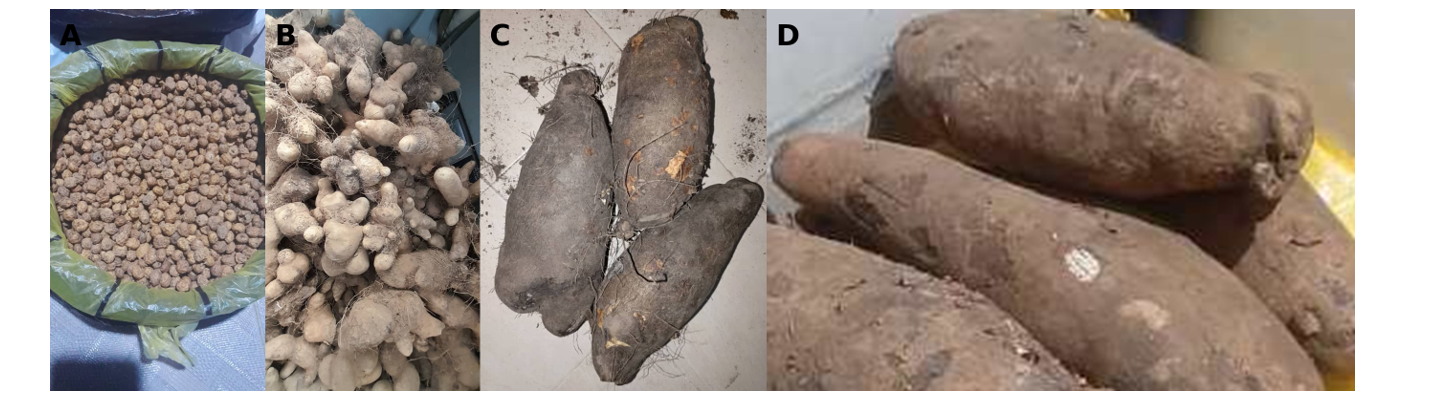
The chemical modification of starch offers opportunities to develop renewable biopolymers for industrial applications, including corrosion protection. This study investigated the effects of hydroxypropylation, phosphate cross-linking, and sequential dual modification on the physicochemical, functional, and structural properties of starches isolated from tigernut (Cyperus esculentus), water yam (Dioscorea alata), and trifoliate yam (Dioscorea dumetorum). The starches were characterized using proximate analysis, functional property assessment, Rapid Visco Analysis (RVA), Fourier-transform infrared spectroscopy (FTIR), X-ray diffraction (XRD), scanning electron microscopy coupled with energy-dispersive X-ray spectroscopy (SEM–EDS), and differential scanning calorimetry (DSC). Chemical modification significantly (p < 0.05) affected starch properties. Cross-linked starches exhibited lower moisture contents (12.12–12.43%) and higher apparent amylose contents (up to 29.45%) than their hydroxypropylated counterparts. FTIR analysis indicated chemical changes associated with modification while confirming retention of the starch backbone. XRD patterns showed preservation of the native crystalline polymorphs, with relative crystallinity ranging from 23.1 to 33.9%. SEM observations revealed changes in granule morphology, including increased aggregation following cross-linking and dual modification, while EDS detected phosphorus in phosphate-treated starches. DSC and RVA analyses demonstrated modification-dependent changes in thermal and pasting properties. Overall, the three modification approaches altered starch composition, molecular organization, and functional behaviour without disrupting the fundamental polysaccharide structure. These findings demonstrate the potential of underutilized tropical starches as renewable functional materials and provide a basis for evaluating their corrosion-inhibition performance.
References
Ashmawy, A.M. and M. Mostfa, Study of eco-friendly corrosion inhibition for mild steel in acidic environment. Egyptian Journal of Chemistry, 2021. 64(3): p. 1285-1291.
El-Housseiny, S., et al., Eco-friendly corrosion inhibitor for mild steel in acidic media. Int. J. Corros. Scale Inhib, 2022. 11(4): p. 1516-1538.
Furtado, L.B. and R. Nascimento, Plant extracts as green corrosion inhibitors, in Sustainable corrosion inhibitors II: synthesis, design, and practical applications. 2021, ACS Publications. p. 19-77.
Ahmed, M.A., S. Amin, and A.A. Mohamed, Current and emerging trends of inorganic, organic and eco-friendly corrosion inhibitors. RSC advances, 2024. 14(43): p. 31877-31920.
Verma, C., et al., Principles and theories of green chemistry for corrosion science and engineering: design and application. Green Chemistry, 2024. 26(8): p. 4270-4357.
Salim, A., et al., Environmentally friendly green inhibitors used for corrosion inhibition of oil pipeline. Int. J. Corros. Scale Inhib, 2026. 15(3): p. 27-57.
Gamage, A., et al., Environmental properties and applications of biodegradable starch-based nanocomposites. Polymers, 2022. 14(21): p. 4578.
Korniy, S., et al., Eco-friendly metal corrosion inhibitors based on natural polymers (A review). Materials Science, 2023. 58(5): p. 567-578.
Awoyale, R.B., et al., Harnessing the Industrial Potential of Starch Derived From Selected Tuber Crops for the Pharmaceutical Industry: A Review. Starch‐Stärke, 2026. 78(1): p. e70151.
He, R., et al., Starch modification with molecular transformation, physicochemical characteristics, and industrial usability: A state-of-the-art review. Polymers, 2023. 15(13): p. 2935.
Amaraweera, S.M., et al., Development of starch-based materials using current modification techniques and their applications: A review. Molecules, 2021. 26(22): p. 6880.
Wang, H., et al., Functional and physicochemical properties of flours and starches from different tuber crops. International journal of biological macromolecules, 2020. 148: p. 324-332.
Ogunbiyi, B.I., S. Akano, and M.B. Yahaya, PHYSICAL, CHEMICAL AND FUNCTIONAL PROPERTIES OF FLOUR AND STARCH FROM TWO TIGERNUT (Cyperus esculentus) VARIETIES. FUDMA JOURNAL OF SCIENCES, 2026. 10(4): p. 148-154.
Wu, Y., et al., Tiger nut (Cyperus esculentus) starch: extraction, composition, structure, properties, modification and uses. Sustainable Food Technology, 2024. 2(3): p. 635-651.
Azima, F., N. Nazir, and H. Efendi. Characteristics of physico-chemical and functional properties of starch extracts from tubers. in Journal of Physics: Conference Series. 2020. IOP Publishing.
Talha, M., Biomacromolecules as green corrosion inhibitors: a review based on mild steel corrosion in acidic media. Corrosion Reviews, 2025. 43(4): p. 409-428.
Awoyale, R.B., et al., Comparative Structural and Functional Characterization of Underutilized Tropical Tuber Starches: Implications for Pharmaceutical Excipient Development. Starch‐Stärke, 2026. 78(10): p. e70311.
Ishiwu, C., et al., Physiochemical properties of cocoyam starch extracted in two media. International Letters of Natural Sciences, 2017. 64.
Olatidoye, O., D. Adenoye, and B. Idemudia, Influence of chemical modification on some properties of starches from tiger nut (Cyperus esculentus) and cocoyam (Xanthosoma sagittifolium) as a potential biomaterial. Int. Res. J. Biol. Sci, 2019. 1: p. 13-24.
Woggum, T., P. Sirivongpaisal, and T. Wittaya, Characteristics and properties of hydroxypropylated rice starch based biodegradable films. Food Hydrocolloids, 2015. 50: p. 54-64.
Lawal, O.S., Composition, physicochemical properties and retrogradation characteristics of native, oxidised, acetylated and acid-thinned new cocoyam (Xanthosoma sagittifolium) starch. Food chemistry, 2004. 87(2): p. 205-218.
Gunaratne, A., S. Ranaweera, and H. Corke, Thermal, pasting, and gelling properties of wheat and potato starches in the presence of sucrose, glucose, glycerol, and hydroxypropyl β-cyclodextrin. Carbohydrate polymers, 2007. 70(1): p. 112-122.
Chandra, S., S. Singh, and D. Kumari, Evaluation of functional properties of composite flours and sensorial attributes of composite flour biscuits. Journal of food science and technology, 2015. 52(6): p. 3681-3688.
Xiang, G., et al., The influence of temperature changes on the rice starch structure and digestive characteristics: One and two-step annealing. Foods, 2022. 11(22): p. 3641.
Karmakar, B., R. Chakraborty, and S. Roy, Assessment of yield and characterization of starch extracted using different methods from the corms of some aroids in North Bengal region of India. Discover Food, 2025. 5(1): p. 290.
Okekunle, M.O., et al., Physicochemical, morphological and thermal properties of oxidized starches from Lima bean (Phaseolus lunatus). Scientific African, 2020. 8: p. e00432.
Amoo, A.R.N., W.-M.F. Dufie, and O. Ibok, Physicochemical and pasting properties of starch extracted from four yam varieties. Journal of Food and Nutrition Sciences, 2014. 2(6): p. 262-269.
Yadav, S., et al., Characterisation of finger millet (Eleusine coracana) starch isolated by conventional and ultrasound-assisted starch isolation methods. International Journal of Food Science and Technology, 2024. 59(8): p. 5710-5720.
Olayinka, F., et al., Effect of chemical modifications on thermal, rheological and morphological properties of yellow sorghum starch. Journal of food science and technology, 2015. 52(12): p. 8364-8370.
Punia Bangar, S., et al., Recent advancements in cross-linked starches for food applications-a review. International journal of food properties, 2024. 27(1): p. 411-430.
Kibar, E.A.A., et al., Determination of Physicochemical and Functional Properties of Cross‐Linked, Hydroxypropylated, and Dual Modified Corn Starch and Investigation of Its Use as Gelling Agent in Soft Confectionery. Starch‐Stärke, 2024. 76(7-8): p. 2300036.
Lagunes‐Delgado, C., E. Agama‐Acevedo, and L.A. Bello‐Pérez, Dual starch modifications to expand its end‐uses: A review. Starch‐Stärke, 2024. 76(11-12): p. 2300153.
Mehfooz, T., et al., Characterization of hydroxypropylated-distarch phosphate barley starch and its impact on rheological and sensory properties of soup. International journal of biological macromolecules, 2020. 144: p. 410-418.
Chen, P., et al., Comparison of the structure and properties of hydroxypropylated acid-hydrolysed maize starches with different amylose/amylopectin contents. Food Hydrocolloids, 2021. 110: p. 106134.
Chandak, A., et al., Effects of cross-linking on physicochemical and film properties of lotus (Nelumbo nucifera G.) Seed Starch. Foods, 2022. 11(19): p. 3069.
Mehfooz, T., et al., Morphological, functional and thermal characteristics of hydroxypropylated-crosslinked barley starches. Journal of Food Measurement and Characterization, 2021. 15(1): p. 237-246.
Deng, S., X. Li, and G. Du, An efficient corrosion inhibitor of cassava starch graft copolymer for aluminum in phosphoric acid. Chinese Journal of Chemical Engineering, 2021. 37: p. 222-231.
Chen, M., et al., An investigation of modified dialdehyde starch as a highly efficient green corrosion inhibitor for carbon steel in 1 M HCl medium: Synthesis, experimental and theoretical studies. Industrial Crops and Products, 2024. 215: p. 118534.
Fu, Z., et al., Developments in hydroxypropylation of starch: A review. Starch‐Stärke, 2019. 71(1-2): p. 1800167.
Park, M.H. and M. Kim, Physicochemical properties of hydroxypropylated apios starches. Preventive Nutrition and Food Science, 2020. 25(3): p. 286.
Kumar, Y., S. Singh, and D. Saxena, A comprehensive review on methods, mechanisms, properties, and emerging applications of crosslinked starches. International Journal of Biological Macromolecules, 2025. 306: p. 141526.
Zhang, R.-Y., et al., Effects of different isolation methods on the structure and functional properties of starch from tiger nut (Cyperus esculentus L.) meal. LWT, 2024. 196: p. 115853.
Bahrami, M., et al., Cross-linked starch as media for crystal Violet elimination from water: modeling batch adsorption with fuzzy regression. Molecules, 2024. 29(16): p. 3894.
Kittipongpatana, O.S. and N. Kittipongpatana, Physicochemical and functional properties of modified KJ CMU-107 rice starches as pharmaceutical excipients. Polymers, 2022. 14(7): p. 1298.
Rashwan, A.K., et al., Plant starch extraction, modification, and green applications: A review. Environmental Chemistry Letters, 2024. 22(5): p. 2483-2530.
Tong, C., et al., Toward an understanding of potato starch structure, function, biosynthesis, and applications. Food Frontiers, 2023. 4(3): p. 980-1000.
Yan, X., et al., Characterisation of starch nanoparticles prepared by cross-linking and nanoprecipitation. International Journal of Food Science and Technology, 2025. 60(2): p. vvaf025.
Singh, J., L. Kaur, and O. McCarthy, Factors influencing the physico-chemical, morphological, thermal and rheological properties of some chemically modified starches for food applications—A review. Food hydrocolloids, 2007. 21(1): p. 1-22.
Arawande, J.O. and A.O. Ashogbon, Isolation and characterization of starch obtained from cocoyam cultivated at Akungba Akoko, Ondo State, Nigeria. Nutri. and Food Sci. Int. J, 2019. 8(2): p. 1-6.
Ashogbon, A.O. and E.T. Akintayo, Recent trend in the physical and chemical modification of starches from different botanical sources: A review. Starch‐Stärke, 2014. 66(1-2): p. 41-57.
Lahrour, S., et al., Glycerin-grafted starch as corrosion inhibitor of C-Mn steel in 1 M HCl solution. Applied Sciences, 2019. 9(21): p. 4684.
Quadri, T.W., et al., Grafted Starch Used as Sustainable Corrosion Inhibitors. Grafted Biopolymers as Corrosion Inhibitors: Safety, Sustainability, and Efficiency, 2023: p. 313-335.
Núñez-Bretón, L.C., et al., Recent developments of multiple functionalization of starches: A review of physical, chemical, and enzymatic modifications and their industrial applications. Journal of Food Measurement and Characterization, 2026. 20(6): p. 9527-9555.
Kumari, B. and N. Sit, Comprehensive review on single and dual modification of starch: Methods, properties and applications. International Journal of Biological Macromolecules, 2023. 253: p. 126952.
Paramitasari, D., et al., Hydroxypropylation for functional enhancement of sago starch: The effects of low propylene oxide concentration using response surface methodology. Journal of Agriculture and Food Research, 2024. 15: p. 100933.
Wattanachant, S., et al., Effect of crosslinking reagents and hydroxypropylation levels on dual-modified sago starch properties. Food Chemistry, 2003. 80(4): p. 463-471.
Ashogbon, A.O., Dual modification of various starches: Synthesis, properties and applications. Food chemistry, 2021. 342: p. 128325.
Downloads
Published
Issue
Section
Categories
License
Copyright (c) 2026 Rosemary Bassey Awoyale, Ezekiel Adewole, Oluwafemi Temitayo Ogunmodede, Funmilayo Deborah Adewumi, Abiodun Ayodele Ojo, Omolara Abosede Peters, Adeolu Abiodun Awoyale

This work is licensed under a Creative Commons Attribution 4.0 International License.


