
Self-Reported Preoperative Skin Preparation Practices and Perceived Surgical Site Infection among Nursing Staff in the Female Surgical Ward, Murtala Muhammad Specialist Hospital, Kano, Nigeria
DOI:
https://doi.org/10.33003/Keywords:
Preoperative skin preparation, Surgical site infection, Hair removal, Antiseptics, Nursing, NigeriaAbstract
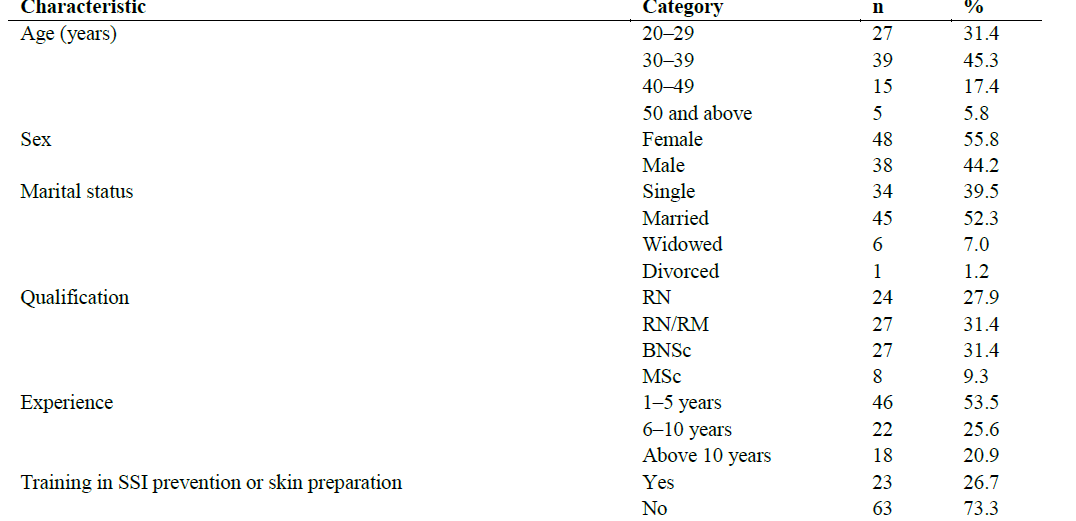
Surgical site infection (SSI) is a common healthcare-associated infection, and preoperative skin preparation is an important preventive measure. This study aimed to assess preoperative skin preparation practices, guideline compliance, perceived barriers and reported SSI occurrence among nursing staff in the female surgical ward of Murtala Muhammad Specialist Hospital, Kano. A descriptive cross-sectional survey was conducted using a structured questionnaire. Of 92 questionnaires distributed, 86 (93.5%) were analysed using SPSS version 25. Descriptive and inferential statistics were applied at p < 0.05. Razor shaving was the predominant hair-removal method (97.7%), while alcohol was the most commonly reported antiseptic (82.6%). Most hair removal occurred the night before surgery (67.4%). Most respondents (73.3%) had no previous SSI prevention training. Agreement with guideline-related practices ranged from 55.8% to 70.9%. Major barriers included inadequate supplies (95.3%), staff shortages (89.5%) and inadequate training (79.1%). Overall, 91.9% reported observing SSI frequently or very frequently. Compliance scores correlated weakly and negatively with reported SSI frequency (ρ = −0.219, p = 0.043). Previously trained respondents had significantly higher compliance scores (p = 0.009). Gaps existed between reported practices and recommended guidelines. Training, adequate supplies, standardised protocols and supervision are recommended to improve compliance. Patient-level SSI surveillance is necessary to establish actual SSI occurrence
References
Ademuyiwa, A. O., Adisa, A. O., Bach, S., Bhangu, A., Harrison, E., Ingabire, J. A., Haque, P. D., Ismail, L., Glasbey, J., Ghosh, D., & others. (2022). Alcoholic chlorhexidine skin preparation or triclosan-coated sutures to reduce surgical site infection: a systematic review and meta-analysis of high-quality randomised controlled trials. The Lancet Infectious Diseases, 22(8), 1242–1251.
Alamri, N. A., Alharthi, R. H., Alzhrani, A. M., & Marta, O. E. (2025). The Role of Institutional Integration Between Health Administration and Health Education in Enhancing Patient Experience and Improving the Quality of Healthcare Services. The Review of Diabetic Studies, 553–575.
Brown, A., & Oliveira, O. (2026). Risk Factors and Prevention Strategies for Surgical Site Infections.
Collaborative, N. S. R. (2026). Surgical site infections after abdominal surgeries: a prospective multicentre study in 53 Nigerian hospitals. BMJ Global Health, 11(6), e021423.
DaCanal, H. (2025). Impact of Preoperative Hair Removal on Surgical Site Infection Rates. Carlow University.
Drugeon, B., Mihala, G., Schults, J., Bigaud, B., Guenezan, J., Batiot, G., Barker, N., Marjanovic, N., Buetti, N., & Mimoz, O. (2026). Chlorhexidine vs povidone-iodine and incidence of catheter-related infections: a systematic review and meta-analysis. JAMA Network Open, 9(2), e2558954.
Krejcie, R. V., & Morgan, D. W. (1970). Determining sample size for research activities. Educational and Psychological Measurement, 30(3), 607–610.
Mele, T. S., Kaafarani, H. M. A., Guidry, C. A., Loor, M. M., Machado-Aranda, D., Mendoza, A. E., Morris-Stiff, G., Rattan, R., Schubl, S. D., Barie, P. S., & others. (2021). Surgical Infection Society Research Priorities: A narrative review of fourteen years of progress. Surgical Infections, 22(5), 568–582.
Mortada, H., Abu Alqam, R., AlNojaidi, T. F., Alshammari, A. J., Khider, M., Albarrak, M., Alrobaiea, S., & Alalola, R. (2024). Preventing and managing operating room fires in plastic surgery: A review of incidence, risk factors, and recommendations with case experiences. Journal of Burn Care & Research, 45(4), 887–894.
Niyomugabo, A., Mukeshimana, M., Collins, A., & Chironda, G. (2024). Exploring facilitators and barriers to healthcare professionals’ use of clinical guidelines to prevent surgical site infection in Rwandan hospitals. International Journal of Africa Nursing Sciences, 21, 100792.
Okomo, U., Fitzgerald, F., Feasey, N., Mehtar, S., & Dramowski, A. (2026). Infection prevention and control in low-and middle-income countries: policy, practice, and implementation challenges in sub-Saharan Africa. Clinical Microbiology Reviews, 39(2), e00142--22.
Quon, S., Park, J., Wong, S., & Zheng, K. (2025). The Impact of Accelerated Drying on Alcohol-Based Antiseptic Efficacy: A Scoping Review. Hospital Practices and Research, 10(4), 747–753.
Rezaei, A. R., Zienkiewicz, D., & Rezaei, A. R. (2025). Surgical site infections: a comprehensive review. Journal of Trauma and Injury, 38(2), 71.
Saxena, A., Panda, K., & Bhoi, S. K. (2024). Impact of preoperative hair removal on surgical site infection in elective abdominal surgery. Student’s Journal of Health Research Africa, 5(6), 5.
Surani, S. (2025). Timeliness and Appropriateness of Surgical Antibiotic Prophylaxis: A Systematic Review. Journal of Health, Wellness and Community Research, e595--e595.
Tura, T. S., & Ayalew, T. L. (2026). Knowledge and practice of surgical site infection prevention and associated factors among nurses working in public hospitals of Sodo town, Wolaita Zone, Southern Ethiopia. Scientific Reports, 16(1), 13362.
Witwit, W. A. M., Murtadha, I. H., & Abdulsaheb, R. A. (2026). Evaluation of Infection Control Practices in the Operating Theater. Journal Of Medical Sciences, 5(4), 1–10.
Yang, Q., Sun, J., Yang, Z., Rastogi, S., Liu, Y., & Zhao, B. (2024). Evaluation of the efficacy of chlorhexidine-alcohol vs. aqueous/alcoholic iodine solutions for the prevention of surgical site infections: a systematic review and meta-analysis. International Journal of Surgery (London, England), 110(11), 7353.
Downloads
Published
Issue
Section
Categories
License
Copyright (c) 2026 Ashiru Muhammad, Idris Abdulrashid, Zahra’u Abdullahi Bebeji

This work is licensed under a Creative Commons Attribution 4.0 International License.


