
Fabrication and Photovoltaic Performance of Dye-sensitized Solar Cells Using Cornstalk-Derived Carbon/TiO2 Composite Photoanodes
DOI:
https://doi.org/10.33003/fjs-2026-1023-6541Keywords:
TiO2 nanocomposite, dye-sensitized solar cells, electron mobility, and photoanode materialAbstract
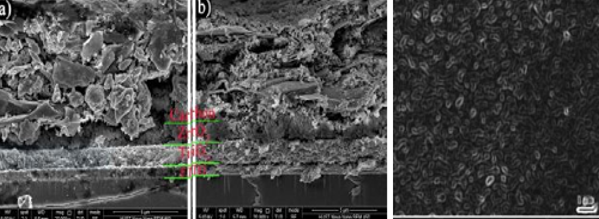
Dye-sensitised solar cells (DSSCs) offer a promising approach to sustainable photovoltaic energy conversion because of their relatively low fabrication costs and potential for environmentally compatible production. However, their performance is strongly influenced by the structural and physicochemical properties of the photoanode. This study investigates the incorporation of cornstalk-derived carbon materials into titanium dioxide (TiO₂) to develop a sustainable binary nanocomposite photoanode for DSSC applications. We obtained the carbon materials by thermally treating pulverised cornstalk at 400 °C for 24 h under a nitrogen flow, then integrating them with TiO₂ and depositing them onto fluorine-doped tin oxide substrates. The resulting materials were characterised using scanning electron microscopy (SEM), X-ray diffraction (XRD), UV–Visible spectroscopy, and current–voltage (J–V) and power–voltage (P–V) measurements. The reported photovoltaic results indicated power conversion efficiencies of 6.3% and 2.6 % for carbon/TiO₂ and pristine TiO₂-based DSSCs, respectively, corresponding to an apparent 2.4-fold enhancement following carbon incorporation. The improved performance was accompanied by increased short-circuit current density and modified photoanode morphology. These findings highlight the potential of agricultural-waste-derived carbon materials for developing sustainable DSSC photoanodes. However, the reported photovoltaic efficiencies require further experimental validation through calibrated irradiance measurements and consistency checks of the photovoltaic parameters
References
Almedhem, A. M. (2024). Overview of the factors influencing the efficiency of PV solar cells. Scholars Journal of Engineering and Technology,12(11),337–341. https://doi.org/10.36347/sjet.2024.v12i11.003
Arifin, N. M., Noor, E. E., Mohamad, F., Mohamad, N., &Muzni, N. H. (2024). Enhancing the properties of nanostructure TiO₂ thin film via calcination temperature for solar cell application. Energies, 17(14), Article 3415. https://doi.org/10.3390/en17143415
Asif, F. C., & Saha, G. C. (2023). Graphene-like carbon structure synthesis from biomass pyrolysis: A critical review on feedstock–process–properties relationship, Catalyst, 9 (1), Article31. https://doi.org/10.3390/c9010031
Chen, C. C., Nguyen, V. S., Chiu, H. C., Chen, Y. D., Wu, T. C. (2022). Anthracene-bridged sensitizers for dye-sensitized solar cells with 37% efficiency under dim light. Advanced Energy Materials, 12(20), Article 2270080.
Colmenares, J. C., Varma, R. S., & Lisowski, P. (2016). Sustainable hybrid photocatalysts: Titania immobilized on carbon materials derived from renewable and biodegradable resources. Green Chemistry, 18, 5736–5750. https://doi.org/10.1039/C6GC02477G
Danladi, E., & Gyuk, P. M. (2019). High-efficiency dye-sensitized solar cells by excitation of localized surface plasmon resonance of AgNPs. Science World Journal, 14(2).
Danladi, E., Onimisi, M. Y., Garba, S., & Tasiu, J. (2020). 9.05% HTM-free perovskite solar cell with negligible hysteresis by introducing silver nanoparticles encapsulated with P4VP polymer. SN Applied Sciences, 2, Article 1769. https://doi.org/10.1007/s42452-020-03597-y
Devadiga, D., Selvakumar, M., Shetty, P., & Santosh, M. S. (2021). Dye-sensitized solar cell for indoor applications: A mini-review. Journal of Electronic Materials, 50, 3187–3206. https://doi.org/10.1007/s11664-021-08854-3
Dhonde, M., Sahu, K., Das, M., Yadav, A., Ghosh, P., & Murty, V. V. S. (2022). Review—Recent advancements in dye-sensitized solar cells: From photoelectrode to counter electrode. Journal of The Electrochemical Society, 169(6), Article 066507. https://doi.org/10.1149/1945-7111/ac741f
Dragonetti, C., & Colombo, A. (2021). Recent advances in dye-sensitized solar cells. Molecules, 26, Article 2461.
Eli, D., Ibeh, G. J., Ige, O. O., Owolabi, J. A., Ugbe, R. U., Sherifdeen, B. O., ... Ali, H. (2019). Silver nanoparticles as nano antenna for TiO₂ activation and its application in DSSC for enhanced performance. Journal of Theoretical and Applied Physics. [Journal and page details require confirmation].
Fallah, M., & Maleki, I. (2020). Enhancing the efficiency of dye-sensitized solar cell by increasing the light trapping and decreasing the electron-hole recombination rate due to Ag@TiO₂ core-shell photoanode structure. Materials Research Express, 7, Article 1–12. https://doi.org/10.1088/2053-1591/ab5c8a
Francis, O., & Ikenna, A. (2021). Review of dye-sensitized solar cell (DSSCs) development. Natural Science, 13(12), 496–509. https://doi.org/10.4236/ns.2021.1312043
Gomesh, N., Ragunathan, S., Daud, Z., Tajarudin, H. A., Ong, S. Q., & Ramli, S. (2020). Effect of dye-sensitized solar cell fabricated with different thickness of rutile-anatase TiO₂ electrode on the electrical performance. IOP Conference Series: Earth and Environmental Science, 616, Article 012023. https://doi.org/10.1088/1755-1315/616/1/012023
González-Verjan, B., Trujillo-Navarrete, B., & Félix-Navarro, R. (2020). Effect of TiO₂ particle and pore size on DSSC efficiency. Materials for Renewable and Sustainable Energy, 9, Article 13. https://doi.org/10.1007/s40243-020-00173-7
Ji, J. M., Zhou, H., Eom, Y. K., Kim, C. H., & Kim, H. K. (2020). 14.2% efficiency dye-sensitized solar cells by co-sensitizing novel thieno[3,2-b]indole-based organic dyes with a promising porphyrin sensitizer. Advanced Energy Materials, 10(15), Article 2000124. https://doi.org/10.1002/aenm.202000124
Joshy, D., Narendranath, S. B., Ismail, Y. A., &Periyat, P. (2022). Recent progress in one-dimensional TiO₂ nanomaterials as photoanodes in dye-sensitized solar cells. Nanoscale Advances, 4(24), 5202–5232. https://doi.org/10.1039/D2NA00437B
Kabir, D., Forhad, T., Ghann, W., Richards, B., Rahman, M. M., Uddin, M. N. (2021). Dye-sensitized solar cell with plasmonic gold nanoparticles modified photoanode. Nano-Structures & Nano-Objects, 26, Article 100698.
Lana, G. M., Bello, I. T., Adedokun, O. M., Adenigba, V. O., Jubu, P. R., Adedokun, O., ... Awodugba, A. O. (2024). One-dimensional TiO₂ nanocomposite-based photoanode for dye-sensitized solar cells: A review. Solar Energy, 279, Article 112850. https://doi.org/10.1016/j.solener.2024.112850
Liu, S. X., Chen, X. Y., & Chen, X. (2007). A TiO₂/AC composite photocatalyst with high activity and easy separation prepared by a hydrothermal method. Journal of Hazardous Materials, 143(1–2), 257–263. https://doi.org/10.1016/j.jhazmat.2006.09.026
Nwosu, O. U. (2025). Renewable energy transitions in Nigeria: Pathways to a low-carbon future amidst fossil-fuel dependence. Research Journal of Pure Science and Technology, 8(9), 25–34. https://doi.org/10.56201/rjpst.vol.8.no9.2025.pg25.34
Okoye, I. F., Nwokoye, A. O. C., & Ahmad, G. (2021). Power voltage characteristics of fabricated DSSC incorporating multiple organic dyes as photosensitizer. Energy and Power Engineering, 13(6), 221–235. https://doi.org/10.4236/epe.2021.136015
Paneru, R., Kang, X., Budhathoki, S., Chen, Z., Yang, Q., Tjeng, S. T.,Fan, M. (2025). Enhancement effect of biomass-derived carbon quantum dots (CQDs) on the performance of dye-sensitized solar cells (DSSCs). Journal of Environmental Sciences, 154, 590–601. https://doi.org/10.1016/j.jes.2024.10.001
Qu, Z., Ma, F., Zhao, Y., Chu, X., Yu, S., & You, J. (2021). Updated progresses in perovskite solar cells. Chinese Physics Letters, 38(10), Article 107801. https://doi.org/10.1088/0256-307X/38/10/107801
Sathyajothi, S., Jayavel, R., &Dhanemozhi, A. C. (2017). The fabrication of natural dye-sensitized solar cell (DSSC) based on TiO₂ using henna and beetroot dye extracts. Materials Today: Proceedings, 4, 668–676. https://doi.org/10.1016/j.matpr.2017.01.071
Selvapriya, R., Abhijith, T., Ragavendran, V., Sasirekha, V., Reddy, V. S., Pearce, J. M., & Mayandi, J. (2022). Impact of coupled plasmonic effect with multishaped silver nanoparticles on efficiency of dye-sensitized solar cells. Journal of Alloys and Compounds, 894, Article 162339. https://doi.org/10.1016/j.jallcom.2021.162339
Sharma, K., Sharma, V., & Sharma, S. S. (2018). Dye-sensitized solar cells: Fundamentals and current status. Nanoscale Research Letters, 13, Article 381. https://doi.org/10.1186/s11671-018-2760-6
Sibinski, M., Jakubowska, M., Znajdek, K., Sloma, M., & Guzowski, B. (2011). Carbon nanotube transparent conductive layers for solar cells applications. Optica Applicata, 41(2), 375–381.
Singh, V. P., & Rawat, R. (2023). The scope of dye-sensitized solar cells for future applications. Renewable energy advances,73(3).
Smith, A. R., Ghamari, M., Velusamy, S., & Sundaram, S. (2024). Thin-film technologies for sustainable building-integrated photovoltaics. Energies, 17(24), Article 6363. https://doi.org/10.3390/en17246363
Soltani, H., Bahiraei, H., Ghasemi, S., & Hashempour, M. (2025). Rate capability and electrolyte concentration: Tuning MnO₂ supercapacitor electrodes through electrodeposition parameters. Heliyon, 11(1), Article e41427. https://doi.org/10.1016/j.heliyon.2024.e41427
Svora, P., Ecorchard, P., Pližingrová, E., Komárková, B., SvorováPawełkowicz, S., Murafa, N., ... Bezdička, P. (2020). Influence of inorganic bases on the structure of titanium dioxide-based microsheets. ACS Omega, 5(37), 23703–23717. https://doi.org/10.1021/acsomega.0c02570
Tsai, J. K., Hsu, W. D., Wu, T. C., Meen, T. H., & Chong, W. J. (2013). Effect of compressed TiO₂ nanoparticle thin film thickness on the performance of dye-sensitized solar cells. Nanoscale Research Letters, 8, Article 459. https://doi.org/10.1186/1556-276X-8-459
Wang, B., Liu, B., Ji, X. X., & Ma, M. G. (2018). Synthesis, characterization, and photocatalytic properties of bamboo charcoal/TiO₂ composites using four sizes powder. Materials, 11(5), Article 670. https://doi.org/10.3390/ma11050670
Wei, L., Chen, S., Yang, Y., Dong, Y., Song, W., & Fan, R. (2016). Reduced graphene oxide modified TiO₂ semiconductor materials for dye-sensitized solar cells. RSC Advances, 6, 100866–100875. https://doi.org/10.1039/C6RA22112B
Yoo, J. J., Seo, G., Chua, M. R., Park, T. G., Lu, Y., Rotermund, F., ... Seo, J. (2021). Efficient perovskite solar cells via improved carrier management. Nature, 590(7847), 587–593.
Downloads
Published
Issue
Section
Categories
License
Copyright (c) 2026 Yakubu Ogirima Ibrahim, Lawal Joseph Adeiza, Fasasi Teslim Ayinde, OmonileFunsho Jacob, Yahaya Muhammad Kabir, Ugwuanyi Sabastien, Ojo Adeku, Ismaila Isa Rikoto

This work is licensed under a Creative Commons Attribution 4.0 International License.


