
Mathematical Analysis of transmission dynamics of root rot disease in beans (Phaseolus vulgaris) cultivation
DOI:
https://doi.org/10.33003/fjs-2026-1023-6548Keywords:
Root rot, Beans (Phaseolus vulgaris), Compartmental model, Basic reproduction number, Sensitivity analysis, Differential Transformation MethodAbstract
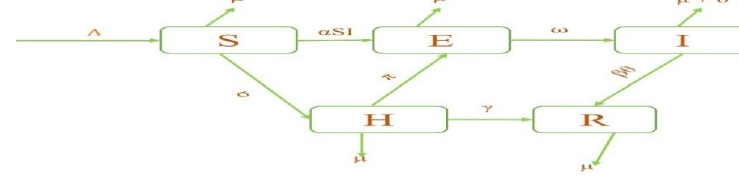
Root rot disease remains one of the most significant constraints to beans (Phaseolus vulgaris) production, causing substantial yield loss in continuously cropped or poorly drained fields, yet its management has continued to rely on general agronomic recommendations rather than a rigorous quantitative framework for its transmission dynamics. This study formulates a deterministic system of nonlinear ordinary differential equations describing the transmission dynamics of root rot disease in beans cultivation, partitioning the plant population into five mutually exclusive compartments: Susceptible, Healthy, Exposed, Infected, and Recovered. The solutions are shown to be positive and bounded. The basic reproduction number, R0, is derived by the Next Generation Matrix method; for the assumed baseline parameters R0 = 6.31, placing the simulated scenario in the endemic regime. The model is solved with the Differential Transformation Method (DTM) and simulated using Maple 2021, which was used to compared the fifth-order DTM series with a fourth-order Runge–Kutta solution. The simulation shows an agreement close to 97% over the first week and reduce subsequently over the weeks especially for susceptible and exposed plants. The study suggests that protection-based interventions, such as resistant varieties, seed treatment and soil management, represent a potentially effective intervention strategy for disease elimination.
References
Abdurrahman, N. O., & Ibrahim, M. O. (2024). Recycling of Municipal Solid Waste: A Deterministic Approach. The Pacific Journal of Science and Technology, 25(2), 55-63.
Ahmad, M. Z., Alsarayreh, D., Alsarayreh, A., & Qaralleh, I. (2017). Differential Transformation Method (DTM) for Solving SIS and SI Epidemic Models. Sains Malaysiana, 46(10), 2007–2017. https://doi.org/10.17576/jsm-2017-4610-40
Akogwu, B. (2022). The solution of a mathematical model for Covid-19 transmission and vaccination in Nigeria by using a differential transformation method. Fudma journal of sciences, 6(5), 50–56. https://doi.org/10.33003/fjs-2022-0605-1089
Harir, A., Melliani, S., El Harfi, H., & Chadli, L. S. (2020). Variational Iteration Method and Differential Transformation Method for Solving the SEIR Epidemic Model. International Journal of Differential Equations, 2020, 1–7. https://doi.org/10.1155/2020/3521936
Helmy, K. G., & Abu-Hussien, S. H. (2024). Root Rot Management in Common Bean (Phaseolus vulgaris L.) Through Integrated Biocontrol Strategies using Metabolites from Trichoderma harzianum, Serratia marcescens, and Vermicompost Tea. Microbial Ecology, 87(1), 94. https://doi.org/10.1007/s00248-024-02400-4
Irvin, M. J., Chilvers, M. I., Wright, E. M., Jacobs, J. L., Hoyos‐Villegas, V., & Gomez, F. E. (2025). Response of Elite Dry Bean ( Phaseolus vulgaris ) Genotypes to Fusarium oxysporum and Rhizoctonia solani Root Rot. Plant Pathology, 74(9), 2682–2696. https://doi.org/10.1111/ppa.70038
Jacobs, J. L., Kelly, J. D., Wright, E. M., Varner, G., & Chilvers, M. I. (2019). Determining the Soilborne Pathogens Associated with Root Rot Disease Complex of Dry Bean in Michigan. Plant Health Progress, 20(2), 122–127. https://doi.org/10.1094/PHP-11-18-0076-S
Jittamai, P., Chanlawong, N., Atisattapong, W., Anlamlert, W., & Buensanteai, N. (2021). Reproduction number and sensitivity analysis of cassava mosaic disease spread for policy design. Mathematical Biosciences and Engineering, 18(5), 5069–5093. https://doi.org/10.3934/mbe.2021258
Macedo, R., Sales, L. P., Yoshida, F., Silva-Abud, L. L., & Lobo, M. (2017). Potential worldwide distribution of Fusarium dry root rot in common beans based on the optimal environment for disease occurrence. PLOS ONE, 12(11), e0187770. https://doi.org/10.1371/journal.pone.0187770
Nakakawa, J., Mugisha, J. Y. T., Shaw, M. W., & Karamura, E. (2016). A mathematical model for the dynamics of banana Xanthomonas wilt with vertical transmission and inflorescence infection. Journal of Biological Systems, 24(01), 147–165. https://doi.org/10.1142/S021833901650008X
Odetunde, O. (2021). Error estimation for Differential Transform Method (DTM)solution of non-linear SIQRM biological model. Journal of Fundamental and Applied Sciences, 13(3), 1327–1339. https://doi.org/10.4314/jfas.v13i3.12
Uebersax, M. A., Cichy, K. A., Gomez, F. E., Porch, T. G., Heitholt, J., Osorno, J. M., Kamfwa, K., Snapp, S. S., & Bales, S. (2023). Dry beans (Phaseolus Vulgaris) as a vital component of sustainable agriculture and food security: A review. Legume Science, 5(1), e155. https://doi.org/10.1002/leg3.155
Van Den Driessche, P., & Watmough, J. (2002). Reproduction numbers and sub-threshold endemic equilibria for compartmental models of disease transmission. Mathematical Biosciences, 180(1–2), 29–48. https://doi.org/10.1016/S0025-5564(02)00108-6
Downloads
Published
Issue
Section
Categories
License
Copyright (c) 2026 Nurat Olamide Abdurrahman, Azeez Aderibigbe Adebayo, Solomon Ayomide Jude, Samuel Abu Somma

This work is licensed under a Creative Commons Attribution 4.0 International License.


