
Hydroclimatic Variability and Near-Surface Soil Moisture Trends at Six Locations in South-South Nigeria, 2000–2025
DOI:
https://doi.org/10.33003/fjs-2026-1023-6549Keywords:
South-South Nigeria, Hydroclimatic Variability, ERA5, Precipitation, Air Temperature, Soil Moisture, Mann–Kendall test, Theil–Sen estimator, Serial DependenceAbstract
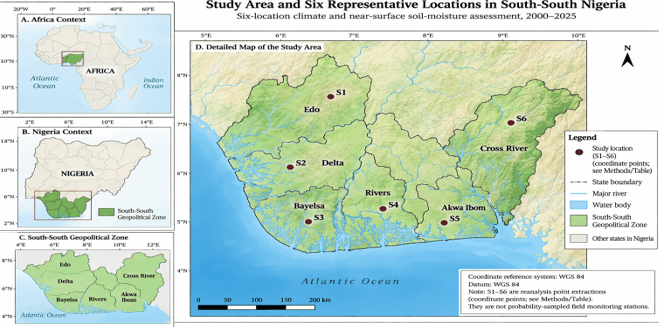
In this study the monthly and annual 2-m air temperature, precipitation and 0–7 cm volumetric soil moisture were validated for six selected coordinate locations within Akwa Ibom, Bayelsa, Cross River, Delta, Edo and Rivers states in the South-South Nigeria from January 2000 to December 2025. The 1,872 location-month records were retrieved from the Open-Meteo Historical Weather API, with the model ERA5 option. Annual temperature and soil moisture were the mean of the monthly values and annual precipitation was the sum of the monthly totals. Theil–Sen slopes and tie-adjusted Mann–Kendall tests were used, and alternative serial-dependence methods explored as sensitivity analyses. The temperature increased at a rate of 0.0480 °C year⁻¹ (conventional p = 1.22 × 10⁻⁷) as summarised by the equal weight composite; this is not an area weighted regional estimate and is simply a summary of the six sampled locations. The slope of annual precipitation was positive but not significant (2.85 mm year -1, p = 0.724).The soil-moisture slope was negative −0.000636 m³ m−3 year−1 and significantly negative at conventional Mann–Kendall significance level (p = 0.038) and mixed indications for dependence sensitive procedures. The maximum values of mean temperature (28.40 °C) occurred in February while the maximum values of precipitation (342.33 mm month⁻¹) and shallow soil moisture (0.4666 m³ m⁻³) occurred in September. Results show a strong warming signal, no evidence for a monotonic annual precipitation signal, and soil moisture in shallow soils with varying degrees of signal depending on the method used.
References
Abubakar, M. L., Ahmed, M. S., Ashiru, U.-K. A., Ahmed, M., Mohammed, R. Z., & Abdussalam, A. F. (2025). Assessment of spatiotemporal rainfall variability over the Niger Delta region, Nigeria: Implications for water resource management. Hydrological Sciences Journal, 70(10), 1571–1584. https://doi.org/10.1080/02626667.2025.2496279
Akinbobola, A., Lawal, K. A., & Ologunorisa, T. E. (2023). Spatiotemporal variability of rainfall as an evidence of changing climate over the Nigerian Niger Delta. Ghana Journal of Geography, 15(2), 212–238. https://doi.org/10.4314/gjg.v15i2.9
Animashaun, I. M., Oguntunde, P. G., Olubanjo, O. O., & Akinwumiju, A. S. (2023). Analysis of variations and trends of temperature over Niger central hydrological area, Nigeria, 1911–2015. Physics and Chemistry of the Earth, Parts A/B/C, 131, Article 103445. https://doi.org/10.1016/j.pce.2023.103445
Ayanlade, A., & Howard, M. T. (2019). Land surface temperature and heat fluxes over three cities in Niger Delta. Journal of African Earth Sciences, 151, 54–66. https://doi.org/10.1016/j.jafrearsci.2018.11.027
Edokpa, D. A. (2020). Variability in the long-term trends of rainfall and temperature over southern Nigeria. Journal of Geography, Meteorology and Environment, 3(1), 15–41.
Galvincio, J. D., de Queiroga Miranda, R., & da Luz, G. G. (2024). Use of soil moisture as an indicator of climate change in the SUPer system. Hydrology, 11(5), Article 65. https://doi.org/10.3390/hydrology11050065
Gbode, I. E., Babalola, T. E., Diro, G. T., & Intsiful, J. D. (2023). Assessment of ERA5 and ERA-Interim in reproducing mean and extreme climates over West Africa. Advances in Atmospheric Sciences, 40(4), 570–586. https://doi.org/10.1007/s00376-022-2161-8
Hamed, K. H., & Rao, A. R. (1998). A modified Mann–Kendall trend test for autocorrelated data. Journal of Hydrology, 204(1–4), 182–196. https://doi.org/10.1016/S0022-1694(97)00125-X
Hassan, I., Kalin, R. M., Aladejana, J. A., & White, C. J. (2020). Potential impacts of climate change on extreme weather events in the Niger Delta part of Nigeria. Hydrology, 7(1), Article 19. https://doi.org/10.3390/hydrology7010019
Idisi, B. E., Deekor, T. N., & Lawal, O. (2024a). Climate variability and soil moisture dynamics in the South-South region of Nigeria. International Journal of Advanced Academic Research, 10(11), 1–18. https://doi.org/10.5281/zenodo.14193268
Idisi, B. E., Ogbereyivwe, O., & Ogbevire, E. (2025a). Hydroclimatic drivers of soil moisture decline in South-South Nigeria: Implications for sustainable agriculture. Frontiers in Sustainable Science and Technology, 2(2), 68–85. https://doi.org/10.69930/fsst.v2i2.560
Idisi, B. E., Essaghah, A. E. A., & Lawal, O. (2025b). Temporal trends in soil moisture and their linkages to precipitation and temperature variability in South-South Nigeria. Nigeria Journal of Oil, Gas and Engineering Technology Research, 3(1), 88–122. https://nijoget.org/img/zuma.pdf
Kendall, M. G. (1975). Rank correlation methods (4th ed.). Charles Griffin.
Lal, P., Singh, G., Das, N. N., Colliander, A., & Entekhabi, D. (2022). Assessment of ERA5-Land volumetric soil water layer product using in situ and SMAP soil moisture observations. IEEE Geoscience and Remote Sensing Letters, 19, 1–5. https://doi.org/10.1109/LGRS.2022.3223985
Mann, H. B. (1945). Nonparametric tests against trend. Econometrica, 13(3), 245–259. https://doi.org/10.2307/1907187
Oguntunde, P. G., Lischeid, G., Abiodun, B. J., & Dietrich, O. (2017). Analysis of long-term dry and wet conditions over Nigeria. International Journal of Climatology, 37(9), 3577–3586. https://doi.org/10.1002/joc.4938
Olisa, C. O., Akinloye, K. F., Idisi, E. B., & Eludoyin, O. S. (2023). Comparative assessment of physicochemical properties of soil in different ecological zones of Western Niger Delta, Nigeria. Scholarly Journal of Science and Technology Research & Development, 2(6), 1–19. https://www.ijaar.org/articles/sjstrd/v2n6/sjstrd262.pdf
Open-Meteo. (n.d.). Historical weather API documentation. https://open-meteo.com/en/docs/historical-weather-api
Peiro, Y., Volpe, E., Ciabatta, L., & Cattoni, E. (2024). High-resolution precipitation and soil moisture data integration for landslide susceptibility mapping. Geosciences, 14(12), Article 330. https://doi.org/10.3390/geosciences14120330
Salami, A. W., Mohammed, A. A., Abdulmalik, Z. H., & Olanlokun, O. K. (2014). Trend analysis of hydro-meteorological variables using the Mann–Kendall trend test: Application to the Niger River and the Benue sub-basins in Nigeria. International Journal of Technology, 5(2), 100–110. https://doi.org/10.14716/ijtech.v5i2.406
Sen, P. K. (1968). Estimates of the regression coefficient based on Kendall’s tau. Journal of the American Statistical Association, 63(324), 1379–1389. https://doi.org/10.1080/01621459.1968.10480934
Thamaga, K. H., Dube, T., & Shoko, C. (2022). Advances in satellite remote sensing of the wetland ecosystems in Sub-Saharan Africa. Geocarto International, 37(20), 5891–5913. https://doi.org/10.1080/10106049.2021.1926552
Xi, X., Zhuang, Q., Kim, S., & Gentine, P. (2023). Evaluating the effects of precipitation and evapotranspiration on soil moisture variability within CMIP5 using SMAP and ERA5 data. Water Resources Research, 59(5), Article e2022WR034225. https://doi.org/10.1029/2022WR034225
Yue, S., & Wang, C. Y. (2004). The Mann–Kendall test modified by effective sample size to detect trend in serially correlated hydrological series. Water Resources Management, 18, 201–218. https://doi.org/10.1023/B:WARM.0000043140.61082.60
Downloads
Published
Issue
Section
Categories
License
Copyright (c) 2026 Benjamin Evi Idisi, Asiafa James Oscar, Agwor Nicholas Emamezi, Amara Ethel Uzor-Totty

This work is licensed under a Creative Commons Attribution 4.0 International License.


