
Multiscale Structural and Microstructural Characterization of Bract Derived ZnO Relating XRD Coherent Domains to Micrometer Scale Secondary Structures
DOI:
https://doi.org/10.33003/fjs-2026-1023-6557Keywords:
ZnO, Bougainvillea spectabilis, X-ray diffraction, Scherrer coherent domain, secondary structure, FTIRAbstract
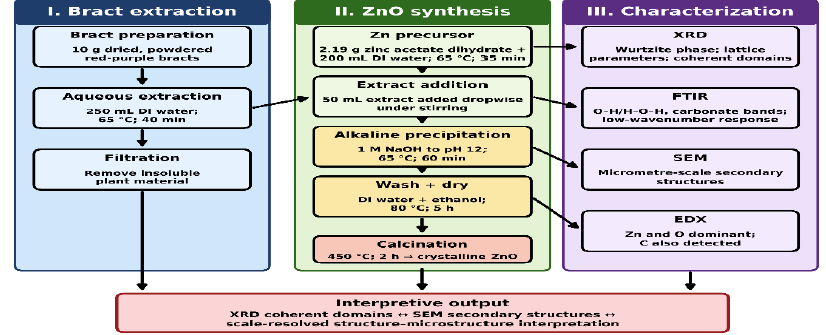
The synthesis of zinc oxide (ZnO) with the help of plants can be dependent on the precursor chemistry, the content of the extract, and post-precipitation treatment. Complementary studies of crystal structure, diffraction-coherent domain length, secondary morphology, vibrational response, and elemental composition were used to analyze ZnO powder synthesized using an aqueous extract of red-purple Bougainvillea spectabilis bracts. Dried bracts (10 g) were extracted with deionized water (250 mL) at 65°C for 40 min. The extract (50 mL) was added to an aqueous solution of zinc acetate dihydrate at 65°C, and the pH was adjusted to 12 with 1 M NaOH. The precipitate was aged for 60 min, dried at 80°C for 5 h and calcined at 450°C for 2 h. The XRD reflections matched hexagonal wurtzite ZnO with lattice parameters a = 3.237 Å and c = 5.186 Å. Doublet-resolved profile fitting gave Scherrer estimates for seven reflections of 8.7 to 12.3 nm (mean 10.34 nm; sample standard deviation 1.52 nm; coefficient of variation 14.7%). These are apparent coherent-domain estimates, not particle sizes. SEM revealed compact, irregular micrometer-scale secondary structures. FTIR indicated O-H/H-O-H contributions, carbonate/carboxylate-type bands, and a terminal low wavenumber absorption with an unresolved band center. EDX of one analyzed area revealed Zn and O as the main elements and carbon; its ZnO ratio is not quantitatively reliable. The results indicate that XRD coherent-domain length and SEM-visible secondary structures represent different structural scales; the available data do not establish primary-particle size, defect concentration, oxidation state, or functional performance
References
Borysiewicz, M. A. (2019). ZnO as a functional material, a review. Crystals, 9(10), 505. https://doi.org/10.3390/cryst9100505
Chen, M., Wang, X., Yu, Y. H., Pei, Z. L., Bai, X. D., Sun, C., Huang, R. F., & Wen, L. S. (2000). X-ray photoelectron spectroscopy and auger electron spectroscopy studies of Al-doped ZnO films. Applied Surface Science, 158(1–2), 134–140. https://doi.org/10.1016/S0169-4332(99)00601-7
Chowdhury, N. R., Pritha, N., Sajid, S., Mesbah, M. B., Islam, M. E., Hakim, M., Mobarak, M. B., & Chowdhury, F. (2026). Plant-mediated green synthesis of ZnO nanoparticles utilizing Garcinia cowa leaf extract: Structural, bioactive, and in silico molecular docking insights. Next Materials, 10, 101575. https://doi.org/10.1016/j.nxmate.2025.101575
Dwivedi, A., Umar, H. M., Ahmed, G., Vaswani, J., & Aamir, M. (2026). Moringa oleifera leaf extract-assisted precipitation synthesis of Co–Cu–Zn spinel nanoferrites: Structural, optical, magnetic, and cytotoxic evaluation. Journal of Alloys and Compounds Communications, Article 100300. https://doi.org/10.1016/j.jacomc.2026.100300
Dong, L., Liu, Y. C., Tong, Y. H., Xiao, Z. Y., Zhang, J. Y., Lu, Y. M., Shen, D. Z., & Fan, X. W. (2005). Preparation of ZnO colloids by aggregation of the nanocrystal subunits. Journal of Colloid and Interface Science, 283, 380–384. https://doi.org/10.1016/j.jcis.2004.09.044
Girish, K. M., Lavanya, R., Surendra, B. S., Gurushantha, K., Sharada, T., & Prashantha, S. C. (2026). Eco-friendly synthesis of ZnO nanoparticles using Bougainvillea and Syzygium cumini extracts: Structural, optical, and photocatalytic insights. ChemistrySelect, 11, e73427. https://doi.org/10.1002/slct.73427
Goldstein, J. I., Newbury, D. E., Michael, J. R., Ritchie, N. W. M., Scott, J. H. J., & Joy, D. C. (2018). Scanning electron microscopy and X-ray microanalysis (4th ed.). Springer. https://doi.org/10.1007/978-1-4939-6676-9
Holder, C. F., & Schaak, R. E. (2019). Tutorial on powder X-ray diffraction for characterizing nanoscale materials. ACS Nano, 13(7), 7359–7365. https://doi.org/10.1021/acsnano.9b05157
Komalakshi, K. V., Kamble, A. A., Barretto, D. A., Divakar, M. S., & Chalannavar, R. K. (2025). Plant-mediated ZnO nanoparticles using Allophylus concanicus: Synthesis, characterization, and in vitro biological evaluation. Nano-Structures & Nano-Objects, 43, 101524. https://doi.org/10.1016/j.nanoso.2025.101524
Langford, J. I., & Wilson, A. J. C. (1978). Scherrer after sixty years: A survey and some new results in the determination of crystallite size. Journal of Applied Crystallography, 11(2), 102–113. https://doi.org/10.1107/S0021889878012844
McGehee, R., & Renault, J. (1972). The use of standard deviation of X-ray diffraction lines as a measure of broadening in the Scherrer equation: A curve fitting method. Journal of Applied Crystallography, 5, 365–370. https://doi.org/10.1107/S002188987200977X
Mohammadi, F. M., & Ghasemi, N. (2018). Influence of temperature and concentration on biosynthesis and characterization of zinc oxide nanoparticles using cherry extract. Journal of Nanostructure in Chemistry, 8, 93–102. https://doi.org/10.1007/s40097-018-0257-6
Morkoç, H., & Özgür, Ü. (2009). Zinc oxide: Fundamentals, materials and device technology. Wiley-VCH. https://doi.org/10.1002/9783527623945
Mutukwa, D., Taziwa, R. T., & Khotseng, L. (2024). A review of plant-mediated ZnO nanoparticles for photodegradation and antibacterial applications. Nanomaterials, 14(14), 1182. https://doi.org/10.3390/nano14141182
Nakamoto, K. (2009). Infrared and Raman spectra of inorganic and coordination compounds, Part A: Theory and applications in inorganic chemistry (6th ed.). Wiley. https://doi.org/10.1002/9780470405840
Nanthakumar, J., Palanisamy, Y., Palanisamy, S., Karuppusamy, M., Raja, R., Abbas, M., Alagarsamy, A., & Rahman, M. Z. (2025). Eco-friendly synthesis of ZnO nanoparticles using Delonix elata extract with enhanced antibacterial activity. RSC Advances, 15, 39305–39313. https://doi.org/10.1039/D5RA05208D
Nichols, G., Byard, S., Bloxham, M. J., Botterill, J., Dawson, N. J., Dennis, A., Diart, V., North, N. C., & Sherwood, J. D. (2002). A review of the terms agglomerate and aggregate with a recommendation for nomenclature used in powder and particle characterization. Journal of Pharmaceutical Sciences, 91(10), 2103–2109. https://doi.org/10.1002/jps.10191
Nouri-Mashiran, M., Taghavi, L., Fataei, E., Ebrahimzadeh-Rajaei, G., & Ramezani, M. (2022). Green synthesis of ZnO nanoparticles and comparison of 2,4-dinitrophenol removal efficiency using photocatalytic, sonocatalytic, and adsorption processes. Main Group Chemistry, 21, 559–575. https://doi.org/10.3233/MGC-210152
Ogwuegbu, M. C., Olatunde, O. C., Pfukwa, T. M., Mthiyane, D. M. N., Fawole, O. A., & Onwudiwe, D. C. (2025). Green synthesis, characterization and antimicrobial activity of ZnO and Co-doped ZnO nanoparticles obtained using aqueous extracts of Platycladus orientalis leaves. Discover Materials, 5(1), 55. https://doi.org/10.1007/s43939-025-00230-w
Osman, A. I., Zhang, Y., Farghali, M., Rashwan, A. K., Eltaweil, A. S., Abd El-Monaem, E. M., Mohamed, I. M. A., Badr, M. M., Ihara, I., Rooney, D. W., & Yap, P.-S. (2024). Synthesis of green nanoparticles for energy, biomedical, environmental, agricultural, and food applications: A review. Environmental Chemistry Letters, 22(2), 841–887. https://doi.org/10.1007/s10311-023-01682-3
Özgür, Ü., Alivov, Y. I., Liu, C., Teke, A., Reshchikov, M. A., Doğan, S., Avrutin, V., Cho, S.-J., & Morkoç, H. (2005). A comprehensive review of ZnO materials and devices. Journal of Applied Physics, 98(4), 041301. https://doi.org/10.1063/1.1992666
Raha, S., & Ahmaruzzaman, M. (2022). ZnO nanostructured materials and their potential applications: Progress, challenges and perspectives. Nanoscale Advances, 4, 1868–1925. https://doi.org/10.1039/D1NA00880C
Ravi, P., & Babu, S. (2025). Recent development in plant-mediated zinc oxide nanoparticles with biomedical applications. Chemical Physics Impact, 10, 100870. https://doi.org/10.1016/j.chphi.2025.100870
Sekrafi, T., Echabaane, M., Ly, A., Debliquy, M., Dridi, C., & Lahem, D. (2026). Green synthesis of ZnO nanoparticles using Retama raetam leaf extract for VOC sensing applications. Chemosensors, 14(2), 42. https://doi.org/10.3390/chemosensors14020042
Senapati, U. S., Chauhan, P., Kalita, H., Das, A., Saikia, J., Goswami, M., Deka, H., & Barman, T. (2025). Green synthesis, characterization and bioactivity of zinc oxide nanoparticles: Experimental and computational approaches. Next Nanotechnology, 7, 100194. https://doi.org/10.1016/j.nxnano.2025.100194
Shukla, M., Narain, S., Kumar, A., & Dikshit, A. (2026). Zinc oxide nanoparticles: A plant-mediated synthesis, characterizations and their functional applications. Nano Trends, 13, 100184. https://doi.org/10.1016/j.nwnano.2026.100184
Umar, H. M., Sumaila, J. L., & Zangina, T. (2026). Comparative structural, optical, morphological and elemental characterization of jujube-mediated silver and zinc oxide nanoparticles. FUDMA Journal of Sciences, 10(19), 219–229. https://doi.org/10.33003/fjs-2026-1019-6073
Umar, H. M., Zangina, T., Sumaila, J. L., Vasamsetti, T., & Dwivedi, A. (2026). From Ziziphus jujuba leaves to nanoparticles: Green synthesis and characterization of Ag and ZnO nanostructures. International Journal of Scientific Research and Technology, 3(10), 695–704. https://doi.org/10.5281/zenodo.23279649
Umar, H. M., Zangina, T., Sumaila, J. L., Dwivedi, A., & Aamir, M. (2026). Green synthesis of silver and zinc oxide nanoparticles using Ziziphus jujuba: Mechanisms, characterization, applications, and future perspectives. Journal of Materials Science: Materials in Energy, 2, 9. https://doi.org/10.1007/s44308-026-00021-6
Vanheusden, K., Warren, W. L., Seager, C. H., Tallant, D. R., Voigt, J. A., & Gnade, B. E. (1996). Mechanisms behind green photoluminescence in ZnO phosphor powders. Journal of Applied Physics, 79(10), 7983–7990. https://doi.org/10.1063/1.362349
Veg, E., Raza, A., Rai, S., Bansal, P., Sharma, S., Mishra, N., Gupta, R., Mishra, S., Joshi, S., Khan, A. R., & Khan, T. (2025). Green synthesis of ZnO and α-Fe₂O₃ nanoparticles using Chinese fan palm leaf extract for their biological and photocatalytic activity evaluation. RSC Sustainability, 3, 5609–5631. https://doi.org/10.1039/D5SU00349K
Wahab, R., Kim, Y.-S., & Shin, H.-S. (2009). Synthesis, characterization and effect of pH variation on zinc oxide nanostructures. Materials Transactions, 50, 2092–2097. https://doi.org/10.2320/matertrans.M2009099
Downloads
Published
Issue
Section
Categories
License
Copyright (c) 2026 Huzaifa Ali Saleh, Akhilesh Dwivedi, Hamza Mustapha Umar, Ibrahim Abba Ibrahim, Maryam Ibrahim

This work is licensed under a Creative Commons Attribution 4.0 International License.


