
Phytochemical Screening, Spectrophotometric Quantification and GC-MS Profiling of Jatropha Curcas Leaf Extract
DOI:
https://doi.org/10.33003/fjs-2026-1024-6566Keywords:
Jatropha Curcas, Phytochemical Screening, Spectrophotometry, GC-MS, Phenols, Flavonoids, Medicinal PlantsAbstract
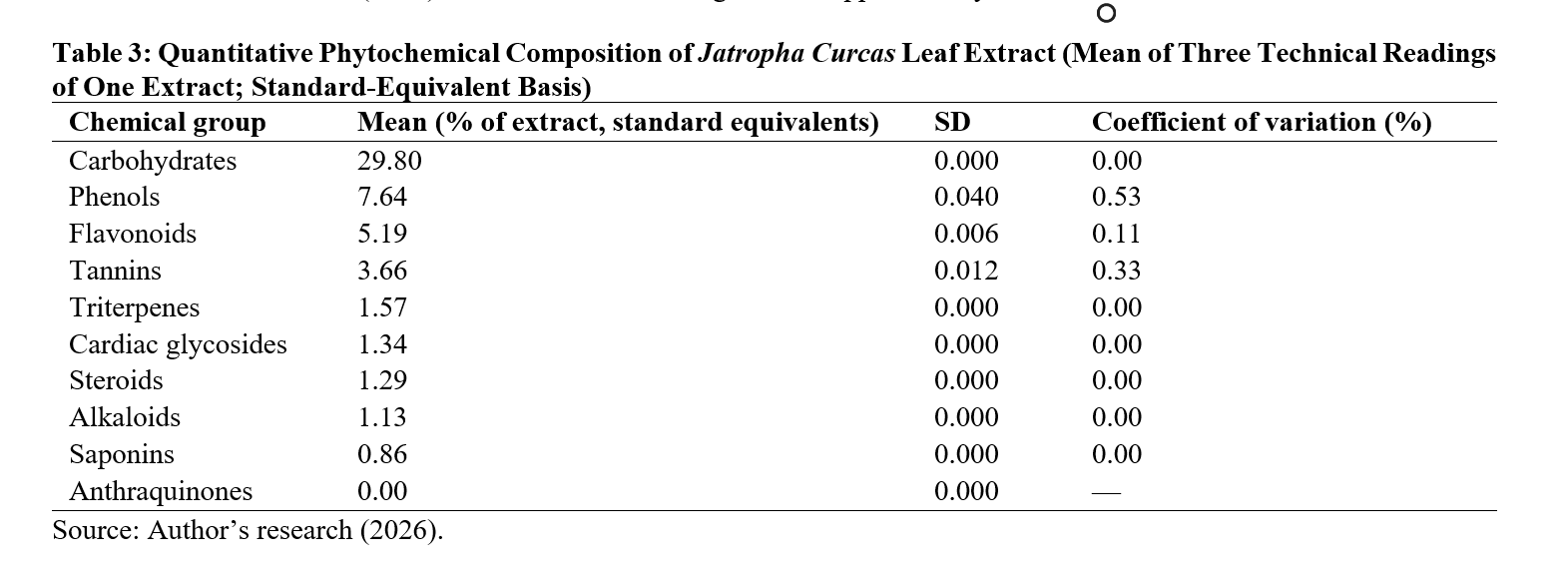
Jatropha curcas is used in traditional medicine across Africa and Asia, including for liver complaints, but the chemical make-up of its leaves is still not fully described. This preliminary study profiled the chemical groups in a single aqueous leaf extract of J. curcas using colour tests, spectrophotometry and gas chromatography–mass spectrometry (GC-MS). Leaves collected in Kaduna State, Nigeria, were dried, powdered and cold-macerated in water, and the extract was screened for ten groups of plant chemicals. Each group was then measured in three technical readings of the same extract, so the values describe this extract only and do not show how much the chemistry varies between plants or batches. Nine of the ten groups were present, and only anthraquinones were absent. Expressed as standard equivalents, carbohydrates were the highest (29.80%), followed by phenols (7.64%), flavonoids (5.19%) and tannins (3.66%), while triterpenes, cardiac glycosides, steroids, alkaloids and saponins were each below 2%. GC-MS assigned seven compounds that the literature associates with antioxidant, anti-inflammatory or liver-related activities, the largest peaks being D-limonene (4.26% of the total peak area) and pentadecanoic acid (1.53%); these identities were not confirmed with reference standards, and the seven peaks together made up only 8.81% of the total peak area. No biological activity was tested, so the results give a chemical starting point for, but no evidence of, liver protection. Independent samples, confirmation of the compounds and biological testing are needed.
References
Abdelgadir, H. A., & Van Staden, J. (2013). Ethnobotany, ethnopharmacology and toxicity of Jatropha curcas L. (Euphorbiaceae): A review. South African Journal of Botany, 88, 204–218. https://doi.org/10.1016/j.sajb.2013.07.021
Abd-ElGawad, A. M., Elgamal, A. M., El-Amier, Y. A., Mohamed, T. A., El Gendy, A. E.-N. G., & Elshamy, A. I. (2021). Chemical composition, allelopathic, antioxidant, and anti-inflammatory activities of sesquiterpenes rich essential oil of Cleome amblyocarpa Barratte & Murb. Plants, 10(7), Article 1294. https://doi.org/10.3390/plants10071294
Abdollahi, M., Asle-Rousta, M., & Mahmazi, S. (2024). Protective effect of 1,8-cineole (eucalyptol) against lead-induced liver injury by ameliorating oxidative stress and inflammation and modulating TLR4/MyD88/NF-κB signaling. Iranian Journal of Basic Medical Sciences, 27(10), 1293–1299. https://doi.org/10.22038/ijbms.2024.78448.16964
Ahmad, S. B., Rehman, M. U., Fatima, B., Ahmad, B., Hussain, I., Ahmad, S. P., Farooq, A., Muzamil, S., Razzaq, R., Rashid, S. M., Bhat, S. A., & Mir, M. U. R. (2018). Antifibrotic effects of D-limonene (5(1-methyl-4-[1-methylethenyl]) cyclohexane) in CCl4 induced liver toxicity in Wistar rats. Environmental Toxicology, 33(3), 361–369. https://doi.org/10.1002/tox.22523
Ainsworth, E. A., & Gillespie, K. M. (2007). Estimation of total phenolic content and other oxidation substrates in plant tissues using Folin–Ciocalteu reagent. Nature Protocols, 2(4), 875–877. https://doi.org/10.1038/nprot.2007.102
Asuk, A. A., Agiang, M. A., Dasofunjo, K., & Willie, A. J. (2015). The biomedical significance of the phytochemical, proximate and mineral compositions of the leaf, stem bark and root of Jatropha curcas. Asian Pacific Journal of Tropical Biomedicine, 5(8), 650–657. https://doi.org/10.1016/j.apjtb.2015.05.015
Atif, M., Malik, M. N. H., Alsahli, T. G., Ali, M., Younis, W., Alharbi, K. S., Alzare, S. I., Alsuwayt, B., Maqbool, T., Anjum, I., Jahan, S., Alanzi, A. R., Solre, G. F. B., & Bilal, H. M. (2025). p-Cymene inhibits pro-fibrotic and inflammatory mediators to prevent hepatic dysfunction. Open Life Sciences, 20(1), Article 20221054. https://doi.org/10.1515/biol-2022-1054
Brain, K. R., & Turner, T. D. (1975). The practical evaluation of phytopharmaceuticals. Wright-Scientechnica.
DuBois, M., Gilles, K. A., Hamilton, J. K., Rebers, P. A., & Smith, F. (1956). Colorimetric method for determination of sugars and related substances. Analytical Chemistry, 28(3), 350–356. https://doi.org/10.1021/ac60111a017
Evans, W. C. (2009). Trease and Evans’ pharmacognosy (16th ed.). Saunders Elsevier.
Harborne, J. B. (1973). Phytochemical methods: A guide to modern techniques of plant analysis. Chapman and Hall.
Harborne, J. B. (1998). Phytochemical methods: A guide to modern techniques of plant analysis (3rd ed.). Chapman & Hall.
Huang, Q.-H., Wu, X., Chen, X.-H., Wu, J.-Z., Su, Z.-R., Liang, J.-L., Li, Y.-C., Lai, X.-P., Chen, J.-N., & Liu, Y.-H. (2018). Patchouli oil isolated from the leaves of Pogostemon cablin ameliorates ethanol-induced acute liver injury in rats via inhibition of oxidative stress and lipid accumulation. RSC Advances, 8(43), 24399–24410. https://doi.org/10.1039/c8ra02422g
Jaeschke, H., McGill, M. R., Williams, C. D., & Ramachandran, A. (2011). Current issues with acetaminophen hepatotoxicity—A clinically relevant model to test the efficacy of natural products. Life Sciences, 88(17–18), 737–745. https://doi.org/10.1016/j.lfs.2011.01.025
Kokate, C. K., Purohit, A. P., & Gokhale, S. B. (2009). Pharmacognosy. Nirali Prakashan.
Krishnan, S., Ding, Y., Saedi, N., Choi, M., Sridharan, G. V., Sherr, D. H., Yarmush, M. L., Alaniz, R. C., Jayaraman, A., & Lee, K. (2018). Gut microbiota-derived tryptophan metabolites modulate inflammatory response in hepatocytes and macrophages. Cell Reports, 23(4), 1099–1111. https://doi.org/10.1016/j.celrep.2018.03.109
Li, Q., He, D., & He, Y. (2024). Study on the protective effect of flavonoids extracted from Jatropha curcas leaves against radiation damage in mice. Heliyon, 10(21), Article e39403. https://doi.org/10.1016/j.heliyon.2024.e39403
Mahmoud, A. M., Hussein, O. E., Hozayen, W. G., & Bin-Jumah, M. (2020). Amelioration of oxidative stress and liver injury by natural antioxidants. Journal of Advanced Research, 24, 1–12. https://doi.org/10.1016/j.jare.2020.03.009
Mahmud, R., Uddin, M. F., Hossain, I., Rahman, A., Bishwas, R. K., Lipy, E. P., Hayatullah, & Saha, K. (2025). Phytochemical screening of plant extracts and GC-MS analysis of the n-hexane extracts of stems and roots of Jatropha curcas growing in Bangladesh. Journal of Pharmacognosy and Phytochemistry, 14(3), 349–355. https://doi.org/10.22271/phyto.2025.v14.i3e.15385
Makkar, H. P. S., Siddhuraju, P., & Becker, K. (2007). Plant secondary metabolites. Humana Press.
Marinova, D., Ribarova, F., & Atanassova, M. (2005). Total phenolics and total flavonoids in Bulgarian fruits and vegetables. Journal of the University of Chemical Technology and Metallurgy, 40(3), 255–260.
Oyetayo, V. O., & Temenu, O. E. (2023). Comparative study on the phytochemical, antistaphylococcal and antioxidant properties of the stem bark of Jatropha curcas L. and Jatropha gossypifolia L. SQU Journal for Science, 28(1), 17–24. https://doi.org/10.53539/squjs.vol28iss1pp17-24
Papalia, T., Barreca, D., & Panuccio, M. R. (2017). Assessment of antioxidant and cytoprotective potential of Jatropha (Jatropha curcas) grown in Southern Italy. International Journal of Molecular Sciences, 18(3), Article 660. https://doi.org/10.3390/ijms18030660
Sabandar, C. W., Ahmat, N., Jaafar, F. M., & Sahidin, I. (2013). Medicinal property, phytochemistry and pharmacology of several Jatropha species (Euphorbiaceae): A review. Phytochemistry, 85, 7–29. https://doi.org/10.1016/j.phytochem.2012.10.009
Shamsa, F., Monsef, H., Ghamooshi, R., & Verdian-rizi, M. (2008). Spectrophotometric determination of total alkaloids in some Iranian medicinal plants. The Thai Journal of Pharmaceutical Sciences, 32(1), 17–20. https://doi.org/10.56808/3027-7922.2196
Sharief, M. N., Srinivasulu, A., & Uma Maheswara Rao, V. (2014). Estimation of alkaloids and total phenol in roots of Derris trifoliata L. and evaluation for antibacterial and antioxidant activity. Indian Journal of Applied Research, 4(5).
Sofowora, A. (1993). Medicinal plants and traditional medicine in Africa (2nd ed.). Spectrum Books.
Solich, P., Sedliaková, V., & Karlíček, R. (1992). Spectrophotometric determination of cardiac glycosides by flow-injection analysis. Analytica Chimica Acta, 269(2), 199–203.
Trease, G. E., & Evans, W. C. (1989). Pharmacognosy (13th ed.). Baillière Tindall.
Yoo, W., Gjuka, D., Stevenson, H. L., Song, X., Shen, H., Yoo, S. Y., Wang, J., Fallon, M., Ioannou, G. N., Harrison, S. A., & Beretta, L. (2017). Fatty acids in non-alcoholic steatohepatitis: Focus on pentadecanoic acid. PLoS ONE, 12(12), Article e0189965. https://doi.org/10.1371/journal.pone.0189965
Zhishen, J., Mengcheng, T., & Jianming, W. (1999). The determination of flavonoid contents in mulberry and their scavenging effects on superoxide radicals. Food Chemistry, 64(4), 555–559. https://doi.org/10.1016/S0308-8146(98)00102-2
Downloads
Published
Issue
Section
Categories
License
Copyright (c) 2026 Ahmed Tijani, Appah, Dan

This work is licensed under a Creative Commons Attribution 4.0 International License.