
Regularised Geoadditive Regression Modelling of Malaria Cases in the North-Western Region of Nigeria
DOI:
https://doi.org/10.33003/fjs-2026-1023-6574Keywords:
Malaria, Geoadditive regression, Spatial autocorrelation, Negative Binomial model, North-Western NigeriaAbstract
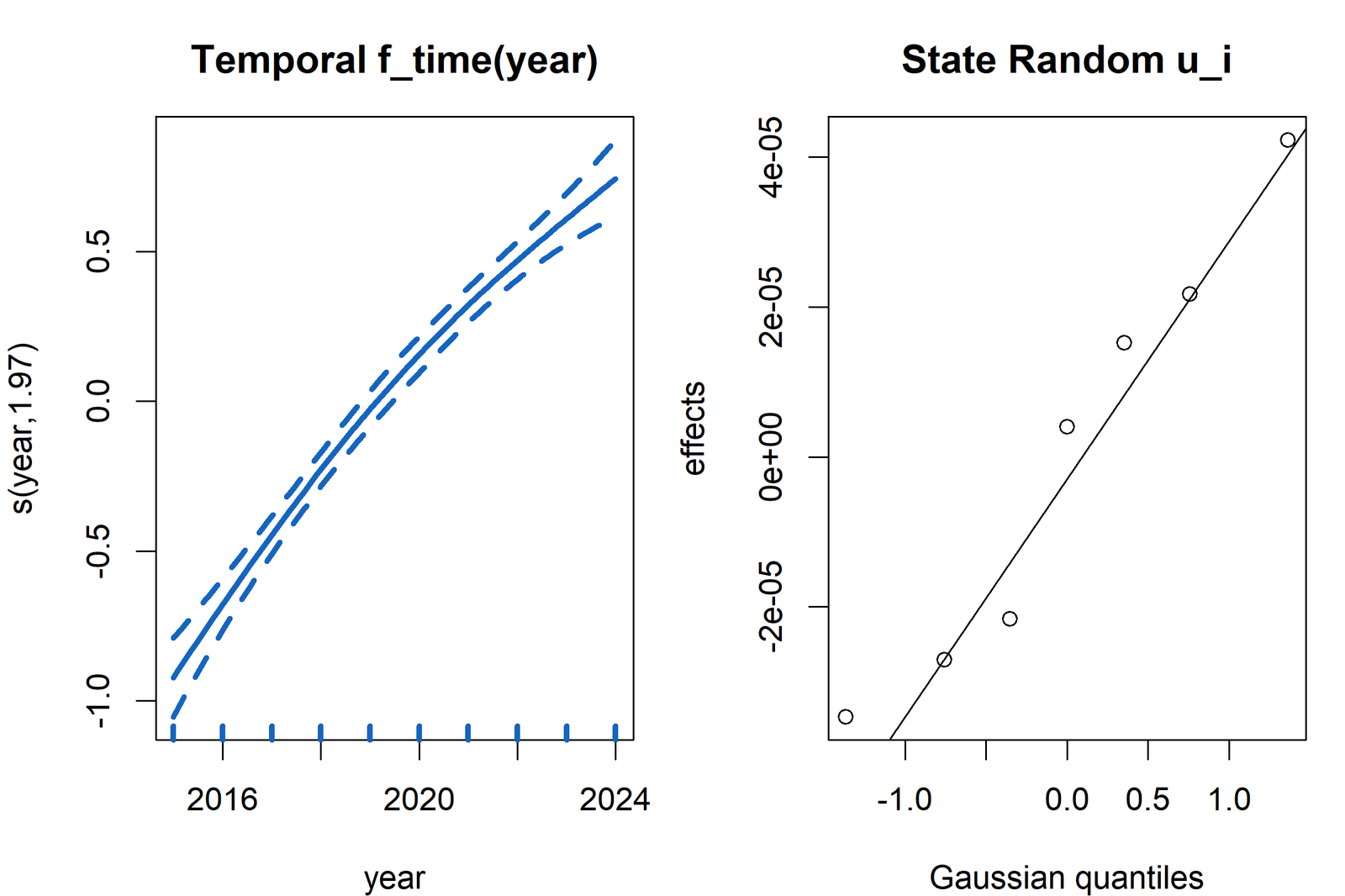
Malaria remains a major public health problem in Nigeria, particularly in the North-West. Environmental, spatial and temporal factors shape its distribution but are rarely modelled together, and conventional regression assumes linear effects and independent observations, risking biased estimates and missed hotspots. The aim of this study was to assess environmental and spatial risk factors of malaria in North-Western Nigeria using a Regularised Geoadditive Regression Model (RGRM). Secondary state-level data for 2015–2024 (70 state-year observations) came from DHIS2, remote-sensing platforms, WorldPop and national surveys. Confirmed cases were overdispersed, so Negative Binomial models fitted by restricted maximum likelihood progressed from a Generalised Additive Model to a Geoadditive Model then the RGRM, combining penalised splines, spatial and temporal terms, and shrinkage penalties. Global, yearly and local (LISA) Moran’s I statistics tested spatial autocorrelation, and state-level random intercepts identified residual spatial effects. Distance to water was the only significant linear predictor (incidence rate ratio = 0.9917, p < 0.001), and elevation was significant among the smooth terms (p = 0.005). The spatial surface and temporal trend were significant (p < 0.001), with expected cases rising about five-fold between 2015 and 2024. Cases were significantly clustered (Moran’s I = 0.1850, p = 0.033), with Kano, Katsina and Kaduna forming a high-burden core, whereas residuals showed no significant clustering (p = 0.657) or state-level effects. Malaria burden is spatially clustered, rising over time and strongly associated with proximity to water. Control programmes should therefore prioritise communities near water and coordinate surveillance across state borders
References
Abatzoglou, J. T., Dobrowski, S. Z., Parks, S. A., & Hegewisch, K. C. (2018). TerraClimate, a high-resolution global dataset of monthly climate and climatic water balance from 1958–2015. Scientific Data, 5, Article 170191. https://doi.org/10.1038/sdata.2017.191
Bakare, E. A., Olasupo, I. I., Imoudu, M., Abidemi, A., Daniel, D. O., Osikoya, S. A., Mogbojuri, O. A., Nwana, A. O., Oniyelu, D. O., Olorunfemi, R. D., Olagbami, O. S., Agboola, D. O., Ikediashi, S. I., Adedeji, A., Ikuseka, O., Fadairo, M., Odewale, O., Onwuka, I. G., Hansinon, A., … Ogban, G. I. (2026). Modelling the effect of long-lasting insecticidal nets on malaria transmission dynamics in Kebbi State, Nigeria. Infectious Disease Modelling, 11(3), 896–919. https://doi.org/10.1016/j.idm.2026.01.003
Bayode, T., & Siegmund, A. (2024). Identifying childhood malaria hotspots and risk factors in a Nigerian city using geostatistical modelling approach. Scientific Reports, 14, Article 5445. https://doi.org/10.1038/s41598-024-55003-x
Bhatt, S., Weiss, D. J., Cameron, E., Bisanzio, D., Mappin, B., Dalrymple, U., Battle, K. E., Moyes, C. L., Henry, A., Eckhoff, P. A., Wenger, E. A., Briët, O., Penny, M. A., Smith, T. A., Bennett, A., Yukich, J., Eisele, T. P., Griffin, J. T., Fergus, C. A., … Gething, P. W. (2015). The effect of malaria control on Plasmodium falciparum in Africa between 2000 and 2015. Nature, 526(7572), 207–211. https://doi.org/10.1038/nature15535
Bosson-Amedenu, S., Eyiah-Bediako, F., & Anafo, A. Y. (2026). Malaria incidence, severity and mortality in children under five in Ghana: Evidence from generalised additive models. BMC Public Health, 26, Article 653. https://doi.org/10.1186/s12889-025-25931-y
Cressie, N. A. C. (1993). Statistics for spatial data (Rev. ed.). Wiley. https://doi.org/10.1002/9781119115151
Dambazau, Z. B., Cyril-Egware, K., Charles, O., Eshikhena, G., Adegbite, G., Akoma, D., Ojielo, N., Gayawan, E., Gadanya, M., Nelson, E., Sikiru, N. A., & Kaduru, C. (2025). Malaria transmission dynamics and the impact of treatment interventions in Kano State, Nigeria: A compartmental model approach. PAMJ - One Health, 18, Article 11. https://doi.org/10.11604/pamj-oh.2025.18.11.48342
Dawaki, S., Al-Mekhlafi, H. M., Ithoi, I., Ibrahim, J., Atroosh, W. M., Abdulsalam, A. M., Sady, H., Elyana, F. N., Adamu, A. U., Yelwa, S. I., Ahmed, A., Al-Areeqi, M. A., Subramaniam, L. R., Nasr, N. A., & Lau, Y.L. (2016). Is Nigeria winning the battle against malaria? Prevalence, risk factors and KAP assessment among Hausa communities in Kano State. Malaria Journal, 15, Article 351. https://doi.org/10.1186/s12936-016-1394-3
Didan, K. (2021). MODIS/Terra vegetation indices 16-day L3 global 250m SIN grid V061 [Data set]. NASA EOSDIS Land Processes DAAC. https://doi.org/10.5067/MODIS/MOD13Q1.061
Eilers, P. H. C., & Marx, B. D. (1996). Flexible smoothing with B-splines and penalties. Statistical Science, 11(2), 89–121. https://doi.org/10.1214/ss/1038425655
Ekpa, D. E., Salubi, E. A., Olusola, J. A., & Akintade, D. (2023). Spatio-temporal analysis of environmental and climatic factors impacts on malaria morbidity in Ondo State, Nigeria. Heliyon, 9(3), Article e14005. https://doi.org/10.1016/j.heliyon.2023.e14005
Eshofonie, F., Johnson, O., & Gayawan, E. (2025). Co-morbidity of malaria and soil-transmitted helminths in Nigeria: A joint Bayesian modelling approach. Infectious Diseases of Poverty, 14, Article 28. https://doi.org/10.1186/s40249-025-01276-x
Farr, T. G., Rosen, P. A., Caro, E., Crippen, R., Duren, R., Hensley, S., Kobrick, M., Paller, M., Rodriguez, E., Roth, L., Seal, D., Shaffer, S., Shimada, J., Umland, J., Werner, M., Oskin, M., Burbank, D., & Alsdorf, D. (2007). The Shuttle Radar Topography Mission. Reviews of Geophysics, 45(2), Article RG2004. https://doi.org/10.1029/2005RG000183
Federal Ministry of Health and Social Welfare of Nigeria, National Population Commission, & ICF. (2025). Nigeria demographic and health survey 2024. https://www.health.gov.ng/wp-content/uploads/2025/10/NDHS-2024-Final-Report_Disseminated17102025.pdf
GADM. (2022). GADM database of global administrative areas (Version 4.1) [Data set]. https://gadm.org
Githeko, A. K., Lindsay, S. W., Confalonieri, U. E., & Patz, J. A. (2000). Climate change and vector-borne diseases: A regional analysis. Bulletin of the World Health Organization, 78(9), 1136–1147. https://iris.who.int/handle/10665/268220
Gorelick, N., Hancher, M., Dixon, M., Ilyushchenko, S., Thau, D., & Moore, R. (2017). Google Earth Engine: Planetary-scale geospatial analysis for everyone. Remote Sensing of Environment, 202, 18–27. https://doi.org/10.1016/j.rse.2017.06.031
Hastie, T. J., & Tibshirani, R. J. (1990). Generalized additive models. Chapman & Hall. https://www.routledge.com/p/book/9780412343902
Isiko, I., Nyegenye, S., Bett, D. K., Asingwire, J. M., Okoro, L. N., Emeribe, N. A., Koech, C. C., Ahgu, O., Bulus, N. G., Taremwa, K., & Mwesigwa, A. (2024). Factors associated with the risk of malaria among children: Analysis of 2021 Nigeria Malaria Indicator Survey. Malaria Journal, 23, Article 109. https://doi.org/10.1186/s12936-024-04939-6
Kammann, E. E., & Wand, M. P. (2003). Geoadditive models. Journal of the Royal Statistical Society: Series C (Applied Statistics), 52(1), 1–18. https://doi.org/10.1111/1467-9876.00385
McCullagh, P., & Nelder, J. A. (1989). Generalized linear models (2nd ed.). Chapman & Hall. https://www.routledge.com/p/book/9780412317606
Mordecai, E. A., Paaijmans, K. P., Johnson, L. R., Balzer, C., Ben‐Horin, T., de Moor, E., McNally, A., Pawar, S., Ryan, S. J., Smith, T. C., & Lafferty, K. D. (2013). Optimal temperature for malaria transmission is dramatically lower than previously predicted. Ecology Letters, 16(1), 22–30. https://doi.org/10.1111/ele.12015
Muñoz-Sabater, J., Dutra, E., Agustí-Panareda, A., Albergel, C., Arduini, G., Balsamo, G., Boussetta, S., Choulga, M., Harrigan, S., Hersbach, H., Martens, B., Miralles, D. G., Piles, M., Rodríguez-Fernández, N. J., Zsoter, E., Buontempo, C., & Thépaut, J.N. (2021). ERA5-Land: A state-of-the-art global reanalysis dataset for land applications. Earth System Science Data, 13(9), 4349–4383. https://doi.org/10.5194/essd-13-4349-2021
National Malaria Elimination Programme, National Population Commission, & ICF. (2022). Nigeria malaria indicator survey 2021 final report. https://dhsprogram.com/pubs/pdf/MIS41/MIS41.pdf
Nelder, J. A., & Wedderburn, R. W. M. (1972). Generalized linear models. Journal of the Royal Statistical Society: Series A (General), 135(3), 370–384. https://doi.org/10.2307/2344614
Odhiambo, J. N., Kalinda, C., Macharia, P. M., Snow, R. W., & Sartorius, B. (2020). Spatial and spatio-temporal methods for mapping malaria risk: A systematic review. BMJ Global Health, 5(10), Article e002919. https://doi.org/10.1136/bmjgh-2020-002919
Ogbuagada, S. O., Okolo, A., Torsen, E., & John, O. T. (2022). Multivariate time series analysis in modelling malaria cases in Jimeta metropolis of Adamawa State, Nigeria. FUDMA Journal of Sciences, 6(3), 62–69. https://doi.org/10.33003/fjs-2022-0603-970
Ogidan, O. C., Nzoputam, C. I., Barrow, A., & Ekholuenetale, M. (2025). Prevalence and determinants of insecticide-treated net ownership among women of reproductive age in Nigeria: A mixed-effect insight from the 2021 malaria indicator survey. Malaria Journal, 24, Article 75. https://doi.org/10.1186/s12936-025-05314-9
Ogunsakin, R. E., Babalola, B. T., Olusola, J. A., Joshua, A. O., & Okpeku, M. (2024). GIS-based spatiotemporal mapping of malaria prevalence and exploration of environmental inequalities. Parasitology Research, 123, Article 262. https://doi.org/10.1007/s00436-024-08276-0
Patz, J. A., Campbell-Lendrum, D., Holloway, T., & Foley, J. A. (2005). Impact of regional climate change on human health. Nature, 438(7066), 310–317. https://doi.org/10.1038/nature04188
R Core Team. (2024). R: A language and environment for statistical computing. R Foundation for Statistical Computing. https://www.R-project.org/
Roy, D. P., Wulder, M. A., Loveland, T. R., Woodcock, C. E., Allen, R. G., Anderson, M. C., Helder, D., Irons, J. R., Johnson, D. M., Kennedy, R., Scambos, T. A., Schaaf, C. B., Schott, J. R., Sheng, Y., Vermote, E. F., Belward, A. S., Bindschadler, R., Cohen, W. B., Gao, F., Zhu, Z. (2014). Landsat-8: Science and product vision for terrestrial global change research. Remote Sensing of Environment, 145, 154–172. https://doi.org/10.1016/j.rse.2014.02.001
Tatem, A. J., Gething, P. W., Smith, D. L., & Hay, S. I. (2013). Urbanization and the global malaria recession. Malaria Journal, 12, Article 133. https://doi.org/10.1186/1475-2875-12-133
Tibshirani, R. (1996). Regression shrinkage and selection via the lasso. Journal of the Royal Statistical Society: Series B (Methodological), 58(1), 267–288. https://doi.org/10.1111/j.2517-6161.1996.tb02080.x
Tobler, W. R. (1970). A computer movie simulating urban growth in the Detroit region. Economic Geography, 46(Suppl. 1), 234–240. https://doi.org/10.2307/143141
Ugwu, C. L. J., & Zewotir, T. (2020). Evaluating the effects of climate and environmental factors on under-5 children malaria spatial distribution using generalized additive models (GAMs). Journal of Epidemiology and Global Health, 10(4), 304–314. https://doi.org/10.2991/jegh.k.200814.001
Wood, S. N. (2011). Fast stable restricted maximum likelihood and marginal likelihood estimation of semiparametric generalized linear models. Journal of the Royal Statistical Society: Series B (Statistical Methodology), 73(1), 3–36. https://doi.org/10.1111/j.1467-9868.2010.00749.x
Wood, S. N. (2017). Generalized additive models: An introduction with R (2nd ed.). Chapman & Hall/CRC. https://doi.org/10.1201/9781315370279
World Health Organization. (2024). World malaria report 2024: Addressing inequity in the global malaria response. https://www.who.int/teams/global-malaria-programme/reports/world-malaria-report-2024
WorldPop. (n.d.). Open spatial demographic data and research. University of Southampton. Retrieved October 25, 2026, from https://www.worldpop.org/
Yakudima, I. I., Adamu, Y. M., Samat, N., Mohammed, M. U., Abdulkarim, I. I., & Hassan, N. I. (2024). Geospatial analysis of malaria prevalence among children under five years in Jigawa State, North West, Nigeria. African Journal of Biomedical Research, 27(2), 243–251. https://www.ajol.info/index.php/ajbr/article/view/278784
Yamana, T. K., & Eltahir, E. A. B. (2013). Incorporating the effects of humidity in a mechanistic model of Anopheles gambiae mosquito population dynamics in the Sahel region of Africa. Parasites & Vectors, 6, Article 235. https://doi.org/10.1186/1756-3305-6-235
Zanaga, D., Van De Kerchove, R., De Keersmaecker, W., Souverijns, N., Brockmann, C., Quast, R., Wevers, J., Grosu, A., Paccini, A., Vergnaud, S., Cartus, O., Santoro, M., Fritz, S., Georgieva, I., Lesiv, M., Carter, S., Herold, M., Li, L., Tsendbazar, N.-E., … Arino, O. (2021). ESA WorldCover 10 m 2020 v100 [Data set]. Zenodo. https://doi.org/10.5281/zenodo.5571936
Zhang, S., Amratia, P., Symons, T. L., Rumisha, S. F., Kang, S. Y., Connell, M., Uusiku, P., Katokele, S., Hamunyela, J., Ntusi, N., Soroses, W., Moyo, E., Lukubwe, O., Maponga, C., Lucero, D., Gething, P. W., & Cameron, E. (2024). High-resolution spatio-temporal risk mapping for malaria in Namibia: A comprehensive analysis. Malaria Journal, 23, Article 297. https://doi.org/10.1186/s12936-024-05103-w
Zou, H., & Hastie, T. (2005). Regularization and variable selection via the elastic net. Journal of the Royal Statistical Society: Series B (Statistical Methodology), 67(2), 301–320. https://doi.org/10.1111/j.1467-9868.2005.00503.x
Downloads
Published
Issue
Section
Categories
License
Copyright (c) 2026 Razinu Hamisu Ayuba, Saheed Olalenkan Jabaru

This work is licensed under a Creative Commons Attribution 4.0 International License.