
Machine Learning-Based Predictive Analytics of Customer Churn in E-Commerce Platforms
DOI:
https://doi.org/10.33003/fjs-2026-1024-6594Keywords:
Autoencoder, Customer churn, E-commerce, Machine learning, PCA, Random Forest, XGBoostAbstract
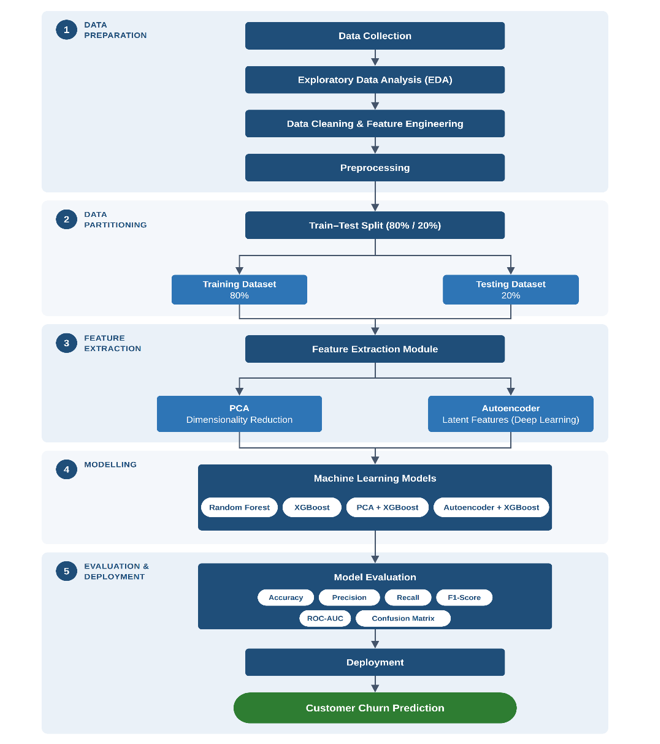
Customer churn is especially crippling for e-Commerce businesses, impacting bottom line, customer value and competitiveness. Machine learning has turned out to be useful in predicting behaviors in e-commerce, but there are limited empirical studies to support its use in Nigeria's socioeconomic and infrastructural environment with few studies conducted overseas. To analyse a machine learning predictive of customer churn in e-commerce, a dataset was obtained from jumia Nigeria (https://www.jumia.com.ng/churn.encoded/customer_value.ids). The number of Customer dataset used in this study was 30,000 with 80% for training and 20% for testing. The data was then preprocessed before further reducing the data using PCA, and then using autoencoders to extract key features. Four models were designed and tested: Random Forest (baseline), XGBoost (primary model), XGBoost with PCA features and XGBoost with Autoencoder features. The accuracy, precision, recall, F1-measure and ROC-AUC were used to evaluate the models' performances. The results indicate that the hybrid models have higher predictive accuracy while the model Autoencoder + XGBoost has better predictive accuracy than the other models due to its ability to represent more complex planar patterns. The study also provides ecommerce managers with a data-driven method to keep their own customers and suggests a hybrid feature extraction and ensemble learning could be a useful technique to make accurate future predictions of churn comprehensible and scalable. It also brings empirical evidence on the usage of machine learning applications in an African and Nigerian E-commerce environment.
References
Jordan M. I., and Mitchell T. M. (2015). Trends, perspectives and prospects. Science, 349(6245), 255–260. https://doi.org/10.1126/science.aaa8415
Maan J., and Maan H. (2023). Customer churn prediction model using explainable machine learning. arXiv. https://doi.org/10.48550/arXiv.2303.00960
Mirabdolbaghi S. M. S., Amiri B., and Pan W.-T. (2022). Model optimization analysis of customer churn prediction using machine learning algorithms with focus on feature reductions. Discrete Dynamics in Nature and Society, 2022, Article 5134356. https://doi.org/10.1155/2022/5134356
Ouf S., Mahmoud K. T., and Abdel-Fattah M. A. (2024). A proposed hybrid framework to improve the accuracy of customer churn prediction in telecom industry. Journal of Big Data, 11, Article 70. https://doi.org/10.1186/s40537-024-00922-9
Sagming M., Heymann R., and Visaya M. V. (2024). Using topological data analysis and machine learning to predict customer churn. Journal of Big Data, 11, Article 160. https://doi.org/10.1186/s40537-024-01020-6
Tanvir A.-A., Khandokar I. A., Islam A. K. M. M., Islam S., and Shatabda, S. (2023). A gradient boosting classifier for purchase intention prediction of online shoppers. Heliyon, 9(4), Article e15163. https://doi.org/10.1016/j.heliyon.2023.e15163
Verbeke W., Dejaeger K., Martens D., Hur J., and Baesens B. (2012). New insights into churn prediction in the telecommunication sector: A profit driven data mining approach. European Journal of Operational Research, 218(1), 211–229. https://doi.org/10.1016/j.ejor.2011.09.031
Downloads
Published
Issue
Section
Categories
License
Copyright (c) 2026 Usman-Hamza Fatima Enehezei, Bello Tope Mistura, Adeleke Abdulfattah Ejire, Olorukooba Abdullateef Adekunle, Abdulraheem Silifat Adaramaja, Alasinrin Olufadi Falilat, Issah Olawale Mustapha

This work is licensed under a Creative Commons Attribution 4.0 International License.