
Chemical Profiling of Phyllanthus Niruri L. Leaves by Phytochemical Screening and GC–MS Analysis
DOI:
https://doi.org/10.33003/Keywords:
Ethanol extract, GC-MS, Medicinal plants, NMR spectroscopy Phytochemical screening, Secondary metabolites, Traditional medicineAbstract
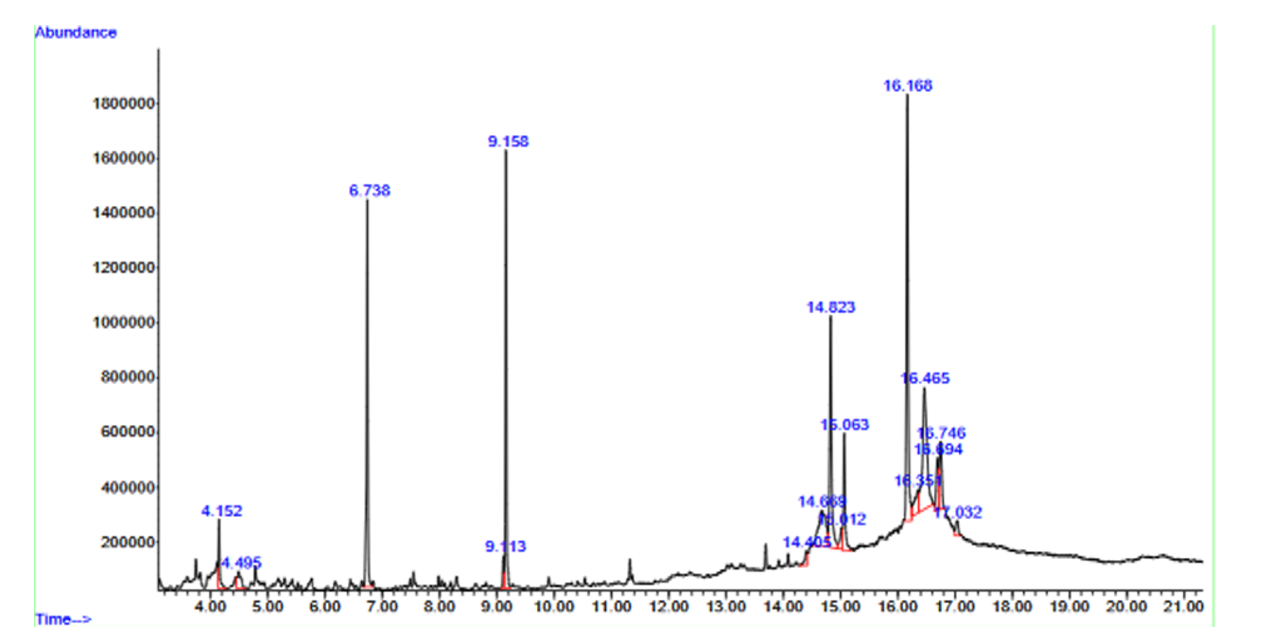
Phyllanthus niruri is a medicinal plant widely used in traditional medicine and is recognized for its diverse pharmacological properties. This study aimed to comprehensively profile the secondary metabolites present in the ethanol leaf extract of P. niruri using preliminary phytochemical screening and Gas Chromatography–Mass Spectrometry (GC-MS). Fresh leaves of P. niruri were collected, authenticated, air-dried, pulverized, and subjected to ethanol extraction. The resulting extract was evaluated qualitatively for major classes of secondary metabolites, including alkaloids, flavonoids, tannins, phenolics, saponins, terpenoids, steroids, glycosides, and other bioactive constituents. GC-MS analysis was employed to separate and identify volatile and semi-volatile compounds based on their retention times and mass spectral fragmentation patterns, while NMR spectroscopy was used to characterize the structural features of prominent metabolites present in the extract. The phytochemical screening indicated the presence of several biologically important secondary metabolites, with the chromatographic and spectroscopic analyses providing further evidence of the chemical complexity of the leaf extract. Flavonoids was heavily detected and had the highest phytoconstituent content (510.23 mg/100g). GC-MS detected 16 compounds with the most abundant being Phytol (19.12%). The identified constituents may contribute to the reported antioxidant, antimicrobial, anti-inflammatory, hepatoprotective, and other therapeutic activities. The combined application of phytochemical screening and GC-MS offers a comprehensive approach to profiling the chemical constituents of P. niruri leaves. The findings provide a scientific basis for further isolation, structural elucidation, pharmacological evaluation, and potential development of P. niruri-derived compounds for therapeutic applications.
References
Adebisi, J.A., Okunloye, N.A., Togun, V.A., Okwusidi, J. I. (2021). Phytochemical screening, proximate and mineral compositional analyses of Phyllanthus Niruri leaves. International Journal of Public Health, Pharmacy and Pharmacology, 6(2), 1–10.
Ahuchaogu, A. A., Nwaokoro, A. C., Nwaogwugwu, C. J., Bello, M. O., & Umoh, S. D. (2024). Phytochemical investigation of methanolic leaf extract of Phyllanthus niruri using fourier-transform infrared spectroscopy and gas chromatography-mass spectrometry. Scientia Africana, 23(1), 85–96. https://doi.org/10.4314/sa.v23i1.7
Araújo, O. F., Kristiani, E. B. E., Kasmiyati, S., & Nugroho, L. H. (2024). The Phytochemical and Biological Activities of Two Phyllanthus Species: Insights into Metabolit, Antioxidant and Antibacterial Activity. Biosaintifika, 16(3). https://doi.org/10.15294/biosaintifika.v16i3.13944
Chakravarthi, P. V., Murugesan, S., Arivuchelvan, A., Sukumar, K., Arulmozhi, A., & Jagadeeswaran, A. (2019). Identification of phytocompounds of phyllanthus niruri and characterization by gas chromatography and mass spectrometry analysis. Journal Of Veterinary Pharmacology And Toxicology, 18(2), 26-29.
Ekayoda, O., Kadiri, H. E., Apiamu, A., & Okpoghono, J. (2026). Phytochemicals and antioxidant indices of Persea americana and Telfairia occidentalis seeds formulated diets. Next Research, 7, 101437. https://doi.org/10.1016/j.nexres.2026.101437
Frolova, N., Orlova, A., Popova, V., Bilova, T., & Frolov, A. (2025). Gas Chromatography–Mass Spectrometry (GC-MS) in the Plant Metabolomics Toolbox: Sample Preparation and Instrumental Analysis. Biomolecules, 16(1), 16. https://doi.org/10.3390/biom16010016
Harborne, J. B. (1973). Methods of Plant Analysis. In Phytochemical Methods (pp. 1–32). Springer Netherlands. https://doi.org/10.1007/978-94-009-5921-7_1
Hasan, M., Safarianti, S., Ramadhani, A. F., Khilfi, S., Suryawati, S., & Husna, F. (2024). Bioactive Compounds and In Vitro Evaluation of Phyllanthus niruri Extract as Antioxidant and Antimicrobial Activities. Trends in Sciences, 21(2). https://doi.org/10.48048/tis.2024.7130
Ibobo, G. O., Okpoghono, J., & Onyesom, I. (2025). Impact of Phyllanthus amarus on fragmented DNA and antioxidant activity of rats exposed to sodium fluoride. Discover Toxicology, 2(1), 2. https://doi.org/10.1007/s44339-025-00017-x
Jomova, K., Alomar, S. Y., Valko, R., Liska, J., Nepovimova, E., Kuca, K., & Valko, M. (2025). Flavonoids and their role in oxidative stress, inflammation, and human diseases. Chemico-Biological Interactions, 413, 111489. https://doi.org/10.1016/j.cbi.2025.111489
Labu, Z. K., Karim, S., Afroz, M., Batul, U. K., Akther, L., Rahman, M. T., & Arifuzzaman, S. (2026). GC-MS based bioactive profiling of Phyllanthus niruri and its antibacterial potential through experimental and computational studies. PLOS One, 21(1), e0340866. https://doi.org/10.1371/journal.pone.0340866
Lee, J.-E., Jayakody, J., Kim, J.-I., Jeong, J.-W., Choi, K.-M., Kim, T.-S., Seo, C., Azimi, I., Hyun, J., & Ryu, B. (2024). The Influence of Solvent Choice on the Extraction of Bioactive Compounds from Asteraceae: A Comparative Review. Foods, 13(19), 3151. https://doi.org/10.3390/foods13193151
Mediani, A., Abas, F., Maulidiani, M., Khatib, A., Tan, C. P., Ismail, I. S., Shaari, K., & Ismail, A. (2017). Characterization of Metabolite Profile in Phyllanthus niruri and Correlation with Bioactivity Elucidated by Nuclear Magnetic Resonance Based Metabolomics. Molecules, 22(6), 902. https://doi.org/10.3390/molecules22060902
Meselhy, M. R., Abdel-Sattar, O. E., El-Mekkawy, S., EL-Desoky, A. M., Mohamed, S. O., Mohsen, S. M., Abdel-Sattar, E., & El-Halawany, A. (2020). Preparation of Lignan-Rich Extract from the Aerial Parts of Phyllanthus niruri Using Nonconventional Methods. Molecules, 25(5), 1179. https://doi.org/10.3390/molecules25051179
Ojeaburu, S. I., & Olasehinde, O. (2025). Phytochemical and Nutritional Evaluation of Phyllanthus niruri Leaves: Implications for Ethnomedicinal Use. Journal of Science Research and Reviews, 2(5), 57–64. https://doi.org/10.70882/josrar.2025.v2i5.121
Okom, S. U., Okpoghono, J., & Onyesom, I. (2025). In vivo antiplasmodial activity of alkaloids, flavonoids and ethanol extracts from stem and leaves of Phyllanthus amarus. Discover Applied Sciences, 7(4), 280. https://doi.org/10.1007/s42452-025-06769-w
Okpoghono, J., Acha, J. O., Okom, S. U., Dunkwu, C. C., & Onyesom, I. (2025). Protective outcomes of Zingiber officinale leaves ethanol extract on ovarian oxidative stress and hormonal functions in malaria mice. Food Chemistry Advances, 9, 101110. https://doi.org/10.1016/j.focha.2025.101110
Onakurhefe, P., Diakparomre, O., Njideaka, T. O., & Okpoghono, J. (2025). Antioxidant indices, essential and non-essential amino acids of Phyllanthus niruri leaves extracts. Results in Chemistry, 16. https://doi.org/10.1016/j.rechem.2025.102545
Park, J., Lee, J., Cho, C., Lee, D. K., Song, W., Choi, K., Choi, S. Y., & Yang, H. (2025). Mass Spectral Data of Primary and Secondary Metabolites Changes in Medicinal Plants by Solvent Polarity. Scientific Data, 12(1), 893. https://doi.org/10.1038/s41597-025-05262-8
Rani, P., & Pooja. (2025). Phyllanthus niruri: A Comprehensive Review of Its Botanical, Phytochemical, and Therapeutic Potential. Journal of Advances in Biology & Biotechnology, 28(8), 1688–1697. https://doi.org/10.9734/jabb/2025/v28i82839
Shoeb, M., Islam, M. N., & Nahar, N. (2022). Biological activity studies of the aerial parts of Phyllanthus niruri L. Current Research on Biosciences and Biotechnology, 4(1), 251–255. https://doi.org/10.5614/crbb.2022.4.1/U7GMG56E
Tiwana, G., Cock, I. E., & Cheesman, M. J. (2024). Phyllanthus niruri Linn.: Antibacterial Activity, Phytochemistry, and Enhanced Antibiotic Combinatorial Strategies. Antibiotics, 13(7), 654. https://doi.org/10.3390/antibiotics13070654
Sailaja, V., Madhu, M., & Neeraja, V. (2016). Quantitative phytochemical analysis of some medicinal plant seed by using various organic solvents. Journal of Pharmacognosy and Phytochemistry, 5(2), 30-34.
Downloads
Published
Issue
Section
Categories
License
Copyright (c) 2026 Thelma Ewere Konyeme, Josephine Ese Konyeme, Diagboya Paul Nkem, Adewale Babasola Daniel, MacDonald Idu

This work is licensed under a Creative Commons Attribution 4.0 International License.