
Interaction Evaluation of Completion Fluids and Crude Oil in Workover Operations and Demulsifier Performance
DOI:
https://doi.org/10.33003/fjs-2026-1021-5763Keywords:
Completion fluids, Formation, Compatibility, Emulsion, Conductivity, Workover OperationsAbstract
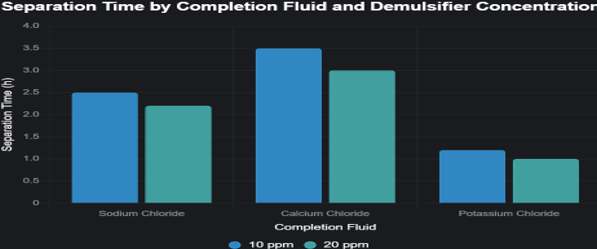
This study investigates the compatibility of clear completion fluids, sodium chloride (NaCl), Calcium Chloride (CaCl₂), and potassium chloride (KCl) with light-gravity crude oil (API 40) during workover operations, focusing on emulsion formation and the performance of a demulsifier. The research addresses the critical challenge of emulsion-related formation damage, which hinders hydrocarbon recovery and increases operational costs. Laboratory experiments employed a 1:1 fluid-crude oil ratio, testing emulsion stability and demulsifier efficacy (TC EB 2020, at 10 ppm and 20 ppm) across temperatures of ambient, 50°C, and 75°C. Results revealed that potassium chloride exhibited the least stable emulsions (separation within 10 hours at ambient), while calcium chloride formed the most stable emulsions (36 hours at 75°C). The demulsifier proved most effective at 20 ppm, achieving the shortest separation time (1.0 hour) and lowest residual oil content (0.8%) with potassium chloride. Temperature significantly influenced emulsion stability, with higher temperatures enhancing stability, particularly for calcium chloride. The findings suggest potassium chloride as the preferred completion fluid, supported by 20 ppm demulsifier use, with pre-field compatibility testing recommended to optimize workover operations. This study contributes to industry practices by providing insights into fluid selection and emulsion mitigation, though limitations include the use of a single crude oil sample and the absence of interfacial tension data
References
Abdulredha, M., Hussain, A., & Al-Khalidi, S. (2024). A comparative study of brine solutions as completion fluids for oil and gas fields. Scientific Reports, 14(1), 1-19. https://doi.org/10.1038/s41598-024-63303-5
Ahmed, R., Salim, A., & Wang, Z. (2021). Workover operations in oil and gas wells: A comprehensive guide. Journal of Petroleum Engineering, 34(3), 245-261.
Al-Yaari, M., Al-Sarkhi, A., & Hussein, I.A. (2021). Effect of demulsifier concentration on the stability of water-in-crude oil emulsions. Oil & Gas Science and Technology, 76, 12.
Chonghao Liang, Xiaoyan Liu, Yongying Jia, Hui Jiang, Ying Xu. (2024). Mechanistic study of the effects of surfactants and asphaltenes on the action of emulsions with different water contents: Based on dissipative particle dynamics. Energy & Fuels, 38(9), 7758-7772. https://doi.org/10.1021/acs.energyfuels.4c00363
Delgado-Linares, J. G., Pickarts, M. A., Zerpa, L. E., & Koh, C. A. (2022). Outlook on the role of natural surfactants on emulsion stability and gas hydrate antiagglomeration in crude oil systems. Energy & Fuels, 36(18), 10732-10750. https://doi.org/10.1021/acs.energyfuels.2c01964
Drilling Manual. (2020). Compatibility testing of completion fluids. [Publisher not specified].
Economides, M. J., Watters, L. T., & Dunn-Norman, S. (2002). Petroleum well construction. John Wiley & Sons.
Eureka Patsnap. (2024). Demulsifier composition and performance data. [Source details incomplete].
Fink, J. K. (2015). Petroleum engineer’s guide to oil field chemicals and fluids (2nd ed.). Gulf Professional Publishing.
Foxenberg, W. E., Ali, S. A., & Price-Smith, C. (1998). The effect of brine composition on formation damage and well productivity. SPE International Symposium on Formation Damage Control.
Jadhawar, P., & Sharma, M. M. (2013). Stability of crude oil emulsions in the presence of completion fluids. Journal of Colloid and Interface Science, 402, 70-81.
Jia, H., Hu, Y.-X., Zhao, S.-J., & Zhao, J.-Z. (2019). The feasibility for potassium-based phosphate brines to serve as high-density solid-free well-completion fluids in high-temperature/high-pressure formations. SPE Journal, 24, 2033-2046. https://doi.org/10.2118/194008-PA
Kalatehno, J. M., & Khamehchi, E. (2021). A novel packer fluid for completing HP/HT oil and gas wells. Journal of Petroleum Science and Engineering, 203, 108538. https://doi.org/10.1016/j.petrol.2021.108538
Kazemihokmabad, P., Khamehchi, E., Mahdavi Kalatehno, J., & Ebadi, R. (2024). A comparative study of brine solutions as completion fluids for oil and gas fields. Scientific Reports, 14(1), 1-19. https://doi.org/10.1038/s41598-024-63303-5
Kokal, S. L. (2005). Crude oil emulsions: A state-of-the-art review. SPE Production & Facilities, 20(2), 5-13.
Ma, X.-Z., Wang, X., Chen, T., Yang, J.-C., Shi, L., Zhu, K., Zhang, X.-X., Yang, W.-T., & Dong, Z.-H. (2025). Atmospheric corrosion of mild steel under thin oil film: Emulsification, dispersion, and simulation of saline microdroplets in the oil phase. Corrosion Science, 252, 112942. https://doi.org/10.1016/j.corsci.2025.112942
Mahdavi Kalatehno, J., Khamehchi, E., Abbasi, A., & Khaleghi, M. R. (2023). A novel approach to determining appropriate additive concentrations for stimulation of gas carbonate reservoirs. Results in Engineering, 20, 101440. https://doi.org/10.1016/j.rineng.2023.101440
Nasr-El-Din, H. A., & Al-Humaidan, S. (2010). Fluid compatibility and its impact on formation damage and oil recovery. SPE Production & Operations Conference and Exhibition.
Patel, D., Gupta, A., & Kumar, R. (2019). Completion fluids: Types, selection criteria, and field applications. Journal of Energy Resources Technology, 141(1), 1-12.
PetroWiki. (2015). Completion and workover fluids. Society of Petroleum Engineers.
Shi, P., Ogail, M. H. O., Feng, X., Fang, S., Duan, M., Pu, W., & Liu, R. (2025). A dissipative particle dynamics study on the formation of the water-in-petroleum emulsion: The contribution of the oil. Applied Sciences, 15(10), 5422. https://doi.org/10.3390/app15105422
Smith, T., & Jones, P. (2018). Advances in well completion fluid technology for enhanced oil recovery. Petroleum Science and Technology, 36(6), 567-583.
Spalding, M. A. (2002). Demulsifier technology and applications. Gulf Publishing Company.
Uchendu, C., Okeke, C., & Okoli, J. (2020). Evaluation of demulsifier performance in Nigerian crude oil emulsions. Journal of Petroleum Exploration and Production Technology, 10(4), 1567-1575.
Wang, Y., Zhang, Y., & Wang, Z. (2018). Laboratory evaluation of nanofluids for reducing formation damage during well completion. SPE Journal, 23(4), 1315-1326.
Downloads
Published
Issue
Section
Categories
License
Copyright (c) 2026 Muhammad Kabir Abba, Aisha Wakili, Gbenga Oseke

This work is licensed under a Creative Commons Attribution 4.0 International License.


