
Compatibility of Completion Fluids with Formation Water During Workover Operations
DOI:
https://doi.org/10.33003/fjs-2026-1023-6503Keywords:
Completion fluids, Formation water, Compatibility, Precipitation, Scaling, Workover Operations, BrinesAbstract
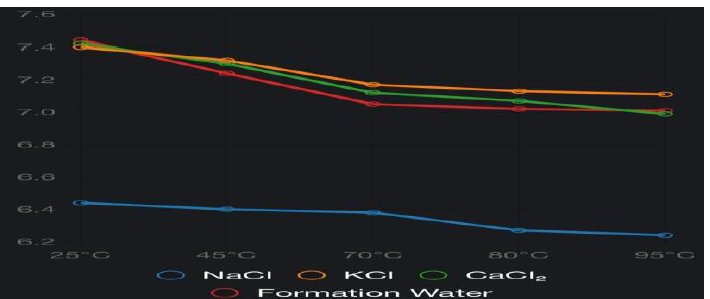
Workover operations play a vital role in extending the productive life of oil and gas wells. Completion fluids play a critical role in maintaining wellbore stability, minimizing formation damage, and enhancing hydrocarbon recovery. This study evaluates the compatibility of common completion fluids (NaCl, KCl, and CaCl₂ brines) with synthetic formation water to optimize fluid selection and minimize formation damage during workover operations. Laboratory-grade salts were used to prepare the brines, which were mixed with synthetic formation water at volume ratios ranging from 1:9 to 1:1. The mixtures were conditioned at temperatures from room temperature (~25°C) to 95°C for 24 hours. Key fluid properties measured included pH, electrical conductivity, salinity, total dissolved solids (TDS), and resistivity, with visual observation for precipitation. NaCl and KCl mixtures exhibited linear trends in all measured properties, indicating good compatibility and stability. In contrast, CaCl₂ mixtures showed non-linear decreases in conductivity, salinity, and TDS at higher temperatures (70–95°C), accompanied by CaCO₃ precipitation. KCl is recommended as the preferred fluid for carbonate reservoirs to reduce scaling risk
References
Caenn, R., Darley, H. C. H., & Gray, G. R. (2011). Composition and properties of drilling and completion fluids (6th ed.). Gulf Professional Publishing.
https://doi.org/10.1016/C2009-0-64504-9
Civan, F. (2015). Reservoir formation damage: Fundamentals, modeling, assessment, and mitigation (3rd ed.). Gulf Professional Publishing. https://doi.org/10.1016/C2013-0-18559-5
Isah, A., Arif, M., Hassan, A., Mahmoud, M., & Iglauer, S. (2022). Fluid–rock interactions and its implications on EOR: Critical analysis, experimental techniques and knowledge gaps. Energy Reports, 8, 6355–6395. https://doi.org/10.1016/j.egyr.2022.04.053
Johnson, A., & Lee, B. (2019). Formation water interactions with completion fluids. Energy & Fuels, 33(5), 4123–4130. https://doi.org/10.1021/acs.energyfuels.9b00234
Mackay, E. J., & Jordan, M. M. (2013). Scale prediction and management in oilfield systems. SPE Journal, 18(2), 245–256. https://doi.org/10.2118/141182-PA
Nasr-El-Din, H. A., Al-Otaibi, M. B., & Samuel, M. (2004). Compatibility of completion workover fluids with formation water. Proceedings of the SPE International Symposium on Oilfield Chemistry. https://doi.org/10.2118/86553-MS
Oddo, J. E., & Tomson, M. B. (1994). Why scale forms in the oil field and methods to predict it. SPE Production & Facilities, 9(1), 47–54. https://doi.org/10.2118/21710-PA
Smith, J. (2020). Compatibility of completion fluids with reservoir water: A review. Journal of Petroleum Science and Engineering, 185, 106123. https://doi.org/10.1016/j.petrol.2019.106123
Zhang, Y., & Roberts, C. (2017). Thermodynamic scaling models for oilfield applications. Energy & Fuels, 31(8), 7890–7902. https://doi.org/10.1021/acs.energyfuels.7b01234
Downloads
Published
Issue
Section
Categories
License
Copyright (c) 2026 Gbenga Godwin Oseke, Asiya Tirmidhi Yakubu, Muhammad Kabir Abba

This work is licensed under a Creative Commons Attribution 4.0 International License.


