
Retrospective Study of Bovine Foetal Wastage at the Akure Semi-Mechanised Abattoir, Ondo State, Southwestern Nigeria
DOI:
https://doi.org/10.33003/fjs-2026-1023-6228Keywords:
Foetal wastage, Akure abattoir, prevalence, Retrospective study, NigeriaAbstract
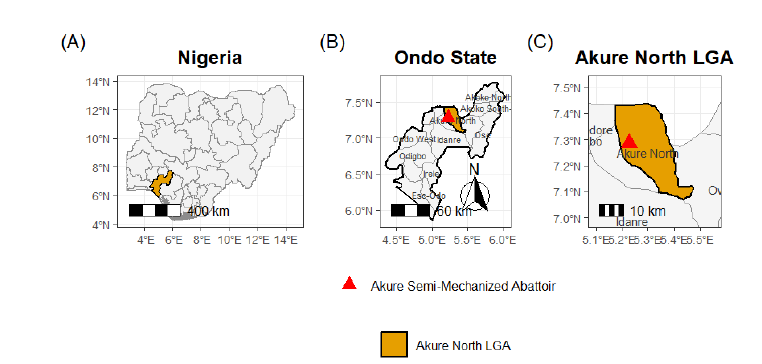
Slaughter of pregnant cows results in foetal wastage, with implications for animal welfare and the economic productivity of cattle production. This study assessed the prevalence, pattern and potential economic impact of foetal wastage at the Akure Semi-Mechanised Abattoir, Ondo State, Nigeria, over a six-year period (2020–2025), using abattoir meat inspection records. Of the 44,733 cows slaughtered during the study period, 3,568 foetal wastage cases were recorded, giving an overall prevalence of 7.98%, equivalent to approximately one foetal wastage case for every 13 cows slaughtered. Foetal wastage prevalence varied over the study period, compared with 2020, the odds of foetal wastage were higher in 2024 (OR 1.33, 95% CI 1.18–1.50) and 2025 (OR 1.31, 95% CI 1.17–1.47) (P<0.001). Prevalence varied significantly by month (P<0.001), lowest from February to April (3.83-5.77%) and highest from May to November (9.05-11.06%), peaking in June (11.06%), when grouped by season it was higher in the wet (8.72%) than the dry season (6.54%) (P<0.001). The 3,568 foetuses represented a crude estimated economic loss of ₦713.6 million (approximately US$538,000). The findings demonstrate that foetal wastage is a persistent problem at the Akure abattoir. Strengthening antemortem pregnancy screening, improving coordination among veterinary personnel, cattle owners and livestock traders may help reduce the occurrence of foetal wastage
References
Adebayo, V. A., Titus Adeniyi, O., Morayo Busayo, A., & Halimat Adeola, A. (2024). Prevalence of Gastrointestinal Parasite in Four Goat Breeds Slaughtered in Two Major Abattoirs in Akure, Ondo State, Nigeria. Asian Journal of Research in Animal and Veterinary Sciences, 7(1), 9–16. https://doi.org/10.9734/ajravs/2024/v7i1280
Adebowale, O. O., Ekundayo, O., & Awoseyi, A. A. (2020). Female cattle slaughter and foetal wastage: A case study of the Lafenwa abattoir, Ogun state, Nigeria. Cogent Food & Agriculture, 6(1), 1809308. https://doi.org/10.1080/23311932.2020.1809308
Adelakun, O. D., Akinseye, V. O., Adesokan, H. K., & Cadmus, S. I. B. (2019). Prevalence and Economic Losses Due to Bovine Tuberculosis in Cattle Slaughtered at Bodija Municipal Abattoir, Ibadan, Nigeria. Folia Veterinaria, 63(1), 41–47. https://doi.org/10.2478/fv-2019-0006
Adenuga, B. M., & Montowska, M. (2023). The Nigerian meat industry: An overview of products’ market, fraud situations, and potential ways out [pdf]. Acta Scientiarum Polonorum Technologia Alimentaria, 22(3), 305–329. https://doi.org/10.17306/J.AFS.2023.1157
Ahmad, M. Y., Hanga, H. R., & Abdulwahab, K. S. (2023). FOETAL WASTAGE IN KANO CENTRAL ABATTOIR AND ITS IMPACT ON THE NIGERIAN ECONOMY. FUDMA Journal of Agriculture and Agricultural Technology, 8(2), 175–179. https://doi.org/10.33003/jaat.2022.0802.23
Atawalna, J., Emikpe, B., Shaibu, E., Mensah, A., Eyarefe, O. D., & Folitse, R. D. (2013). Incidence of fetal wastage in cattle slaughtered at the Kumasi Abattoir, Kumasi, Ghana. © IDOSI Publications, 2013, 11 (4).
Bakari, A. H., Habibu, S. M., Saulawa, M. A., Yusuf, M. S., Da’u, F., & Nagoma, A. U. (2025). Assessment of Fetal Wastage and its Economic Implication among Ruminant Animals Slaughtered at Kano Main Abattoir, North-Western Nigeria. 13 No. 3.
Consalez, F., Ahern, M., Andersen, P., & Kjellevold, M. (2022). The Effect of the Meat Factor in Animal-Source Foods on Micronutrient Absorption: A Scoping Review. Advances in Nutrition, 13(6), 2305–2315. https://doi.org/10.1093/advances/nmac089
Danladi, J., Kwaghe, A. V., Olasoju, T., Ibrahim, H. I., Buba, M. I., Dakogi, A. Y., & Vakuru, C. T. (2024). Prevalence, trends, and magnitude of bovine tuberculosis in slaughtered cattle across States in Nigeria, 2020-2022: A retrospective study. PAMJ-One Health, 15. https://doi.org/10.11604/pamj-oh.2024.15.20.45323
Dauda, I. D., Binhambali, A., Jibril, A. H., Idris, Z. O., & Akorede, F. R. (2025). Economic impact of fetal wastage and common diseases, along with their incidence rates and seasonal variations, at an abattoir in FCT, Nigeria. PLOS ONE, 20(2), e0310806. https://doi.org/10.1371/journal.pone.0310806
Dunka, H. I., Buba, D. M., Gurumyen, Y., Oragwa, O. A., D, O., Department of Veterinary Theriogenology and Production, Faculty of Veterinary Medicine, University of Jos, Plateau State, Nigeria., N, P., & Department of Veterinary Parasitology and Entomology, Faculty of Veterinary Medicine, University of Jos, Plateau State, Nigeria. (2017). ECONOMIC LOSSES ASSOCIATED WITH THE SLAUGHTER OF PREGNANT ANIMALS IN JOS ABATTOIR. International Journal of Advanced Research, 5(7), 1047–1052. https://doi.org/10.21474/IJAR01/4813
Food and Agriculture Organization of the United Nations. (2025). [Food balance sheets 2010–2023.]. https://openknowledge.fao.org/handle/20.500.14283/cd7162en
Jajere, S. M., Mohammed, S., Jidda, D., & Emmanuel, E. T. (2023). Fetal Wastages Among Food-producing Animals Slaughtered at Maiduguri Abattoir: Prevalence, Causes and Economic Implications. Sahel Journal of Veterinary Sciences, 20(3), 46–52. https://doi.org/10.54058/saheljvs.v20i3.403
More, S., Bicout, D., Botner, A., Butterworth, A., Calistri, P., Depner, K., Edwards, S., Garin‐Bastuji, B., Good, M., Gortazar Schmidt, C., Michel, V., Miranda, M. A., Saxmose Nielsen, S., Velarde, A., Thulke, H., Sihvonen, L., Spoolder, H., Stegeman, J. A., Raj, M., … Winckler, C. (2017). Animal welfare aspects in respect of the slaughter or killing of pregnant livestock animals (cattle, pigs, sheep, goats, horses). EFSA Journal, 15(5). https://doi.org/10.2903/j.efsa.2017.4782
Mshelia, G., Maina, V., & Aminu, M. (2015). Foetometrics and Economic Impact Analysis of Reproductive Wastages in Ruminant Species Slaughtered in North-Eastern Nigeria. Journal of Animal Production Advances, 5(4), 645. https://doi.org/10.5455/japa.20150216024050
Mutwedu, V. B., Buuma, B. K., Mushagalusa, A. C., Bisimwa, N. P., Cirezi, N. C., Mugumaarhahama, Y., & Ayagirwe, R. B. B. (2019). Prevalence and economic losses of calf fetal wastage in ELAKAT public slaughterhouse of Bukavu, Democratic Republic of Congo. Veterinary World, 12(10), 1644–1649. https://doi.org/10.14202/vetworld.2019.1644-1649
Nabasirye, S., Baluka, S. A., & Sengooba, A. (2024). Prevalence and economic losses associated with foetal wastage in abattoir. Veterinary Medicine and Science, 10(1), e1343. https://doi.org/10.1002/vms3.1343
Njoga, U. J., Njoga, E. O., Nwobi, O. C., Abonyi, F. O., Edeh, H. O., Ajibo, F. E., Azor, N., Bello, A., Upadhyay, A. K., Okpala, C. O. R., Korzeniowska, M., & Guiné, R. P. F. (2021). Slaughter Conditions and Slaughtering of Pregnant Cows in Southeast Nigeria: Implications to Meat Quality, Food Safety and Security. Foods, 10(6), 1298. https://doi.org/10.3390/foods10061298
Njoga, U. J., Njoga, E. O., & Oguttu, J. W. (2026). Maternal slaughter and foetal wastage in Nigerian municipal abattoirs: Prevalence, drivers, economic losses and One Health implications. One Health, 23, 101508. https://doi.org/10.1016/j.onehlt.2026.101508
Odetoyin, B., Adeola, B., & Olaniran, O. (2020). Frequency and Antimicrobial Resistance Patterns of Bacterial Species Isolated from the Body Surface of the Housefly (Musca domestica) in Akure, Ondo State, Nigeria. Journal of Arthropod-Borne Diseases. https://doi.org/10.18502/jad.v14i1.2715
Okorie-Kanu, O. J., Ezenduka, E. V., Okorie-Kanu, C. O., Anyaoha, C. O., Attah, C. A., Ejiofor, T. E., & Onwumere-Idolor, S. O. (2018). Slaughter of pregnant goats for meat at Nsukka slaughterhouse and its economic implications: A public health concern. Veterinary World, 11(8), 1139–1144. https://doi.org/10.14202/vetworld.2018.1139-1144
Oloruntade, A. J., Oguntunde, P. G., & Alao, F. (2024). Effects of Length of Monsoon Drought on the Annual Yield of Cocoa in Akure, Southwestern Nigeria. FUOYE Journal of Engineering and Technology, 9(3), 525–529. https://doi.org/10.4314/fuoyejet.v9i3.24
Raimi, C. . O., Oduguwa, B. . O., & Bamgboye, F. . O. (2017). SLAUGHTERED CATTLE AND REASONS FOR SLAUGHTERING COWS IN EMBER MONTHS AT LAFENWA ABATTOIR IN ABEOKUTA, NIGERIA. European Journal of Agriculture and Forestry Research, 5(1).
Rueda García, A. M., Fracassi, P., Scherf, B. D., Hamon, M., & Iannotti, L. (2024). Unveiling the Nutritional Quality of Terrestrial Animal Source Foods by Species and Characteristics of Livestock Systems. Nutrients, 16(19), 3346. https://doi.org/10.3390/nu16193346
Uduak, A., & Samuel, A. B. (2014). Incidence of foetal wastage and its economic implications in cattle slaughtered at Abak slaughter house Abak, Akwa-Ibom State (Pt 65-68).
Uko, I. B., Obialigwe, T. F., Nyifi, S. A., Ekechukwu, K. C., & Tanimu, E. (2024). Prevalence of Foetal Wastage in Jalingo Abattoir: A Retrospective Study. Sahel Journal of Veterinary Sciences, 21(1), 39–43. https://doi.org/10.54058/saheljvs.v21i1.439
Wakayo, B. U., & Abrham, Y. (2021). Prevalence and associated economic loss of fetal wastage in small ruminants slaughtered at Addis Ababa municipality abattoir, Ethiopia. Ethiopian Veterinary Journal, 25(1), 110–127. https://doi.org/10.4314/evj.v25i1.7
Zitterer, I., & Paulsen, P. (2021). Slaughter of Pregnant Cattle at an Austrian Abattoir: Prevalence and Gestational Age. Animals, 11(8), 2474. https://doi.org/10.3390/ani11082474
Zubairu, A. H., Haruna, U., Iliyasu, D., Mustapha, A. R., Lawan, F., Mustapha, M., Adamu, L., & Muhammad, S. T. (2022). Retrospective Study of Cattle Fetal Wastage at Hadeja Abattoir, Jigawa State: Economic Implication and Seasonal Variation. Sahel Journal of Veterinary Sciences, 19(1), 31–34. https://doi.org/10.54058/saheljvs.v19i1.303
Downloads
Published
Issue
Section
Categories
License
Copyright (c) 2026 Maryam Nasir, Hikmot B. Abdulkareem, Nahimah O. Idris, Omosubomi O. Olutekunbi, Karimot A. Babalola, Titilayo A. Ayodele, Abubakar Aliyu, Taiwo O. Okafor, Oloruntoba A. Olodun, Nathaniel A. Omoba

This work is licensed under a Creative Commons Attribution 4.0 International License.


