
Bacteriological and Physicochemical Assessment of Well Water Quality in Wukari Metropolis, Taraba State, Nigeria
DOI:
https://doi.org/10.33003/fjs-2026-1022-6246Keywords:
Well Water, Groundwater Quality, Bacteriological Analysis, Physicochemical Properties, Escherichia Coli, Wukari, NigeriaAbstract
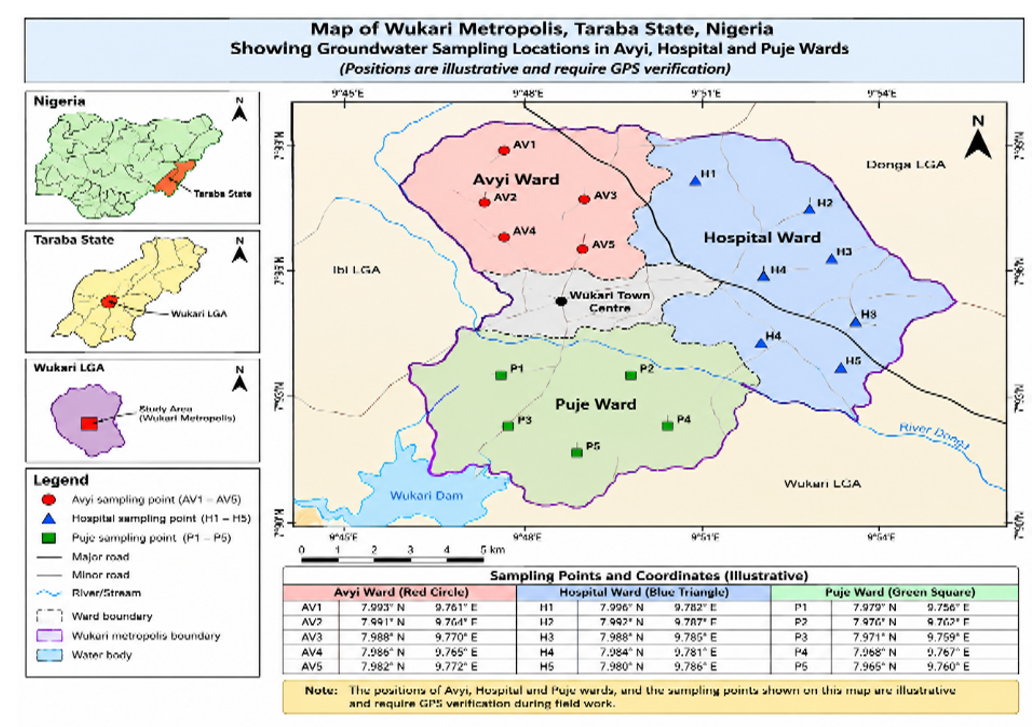
Groundwater is an important source of domestic water in Wukari Metropolis, Taraba State, Nigeria, but inadequate well protection and human activities may compromise its quality. This study assessed the bacteriological and physicochemical characteristics of well water collected from three wards in Wukari Metropolis. Nine water samples were obtained from selected wells in Avyi, Hospital, and Puje wards and analysed using conventional microbiological and physicochemical methods. Bacterial isolates were identified presumptively from colony morphology, Gram staining, and biochemical tests. Four bacterial groups were reported: Escherichia coli, Staphylococcus aureus, Pseudomonas aeruginosa, and Klebsiella spp. Total viable bacterial counts ranged from 1.0 × 10⁶ to 1.6 × 10⁶ CFU/mL. Of the 18 isolates recovered, S. aureus accounted for 38.9%, followed by E. coli (27.8%), P. aeruginosa (22.2%), and Klebsiella spp. (11.1%). The pH ranged from 6.8 to 8.3, electrical conductivity from 96.1 to 120.3 µS/cm, and total dissolved solids from 109.3 to 128.8 mg/L. Turbidity (25.8 to 29.4 NTU) exceeded the 5 NTU benchmark used in the study. The findings indicate substantial bacterial contamination and suggest that the sampled well water requires appropriate treatment before consumption. Improved well protection, sanitation, and routine water quality monitoring are recommended.
References
American Public Health Association. (2012). Standard methods for the examination of water and wastewater (22nd Ed.). American Public Health Association.
Aremu, M. O., Oko, O. J., & Andrew, C. (2017). Ground water and river quality assessment for some heavy metals and physicochemical parameters in Wukari town, Taraba State, Nigeria. International Journal of Sciences, 6(5), 73–80. https://doi.org/10.18483/ijSci.1298
Ashbolt, N. J. (2004). Microbial contamination of drinking water and disease outcomes in developing regions. Toxicology, 198(1–3), 229–238. https://doi.org/10.1016/j.tox.2004.01.030
Cappuccino, J. G., & Welsh, C. T. (2017). Microbiology: A laboratory manual (11th Ed.). Pearson.
Chapman, D. (Ed.). (1996). Water quality assessments: A guide to the use of biota, sediments and water in environmental monitoring (2nd Ed.). E & FN Spon.
Cheesbrough, M. (2006). District laboratory practice in tropical countries: Part 2 (2nd Ed.). Cambridge University Press.
Doria, M. de F. (2010). Factors influencing public perception of drinking water quality. Water Policy, 12(1), 1–19.
Isa, M. A., Allamin, I. A., Ismail, H. Y., & Shettima, A. (2013). Physicochemical and bacteriological analyses of drinking water from wash boreholes in Maiduguri Metropolis, Nigeria. African Journal of Food Science, 7(1), 9–13.
Onyango, A. E., Okoth, M. W., Kunyanga, C. N., & Aliwa, B. O. (2018). Microbiological quality and contamination level of water sources in Isiolo County in Kenya. Journal of Environmental and Public Health, 2018, Article 2139867. https://doi.org/10.1155/2018/2139867
Pritchard, M., Mkandawire, T., & O’Neill, J. G. (2008). Assessment of groundwater quality in shallow wells within the southern districts of Malawi. Physics and Chemistry of the Earth, Parts A/B/C, 33(8–13), 812–823.
Standards Organisation of Nigeria. (2007). Nigerian standard for drinking water quality (NIS 554:2007). Standards Organisation of Nigeria.
World Health Organization. (2022). Guidelines for drinking-water quality: Fourth edition incorporating the first and second addenda. World Health Organization.
Downloads
Published
Issue
Section
Categories
License
Copyright (c) 2026 Muslim Mohammed Tanko, Daniel Na’Allah, Musa Zira, Hajara Saleh, Ugwu Immaculata Chidiebere, Ahmad Musa, Maryam Bako

This work is licensed under a Creative Commons Attribution 4.0 International License.


