
Comparative Assessment of Well Water Quality of three different locations in Gindin Dorowa, Wukari Local Government Area, Taraba State, Nigeria
DOI:
https://doi.org/10.33003/fjs-2026-1021-4347Keywords:
Physicochemical Analysis, Bacteriological analysis, Well pathogen, Gindin DorowaAbstract
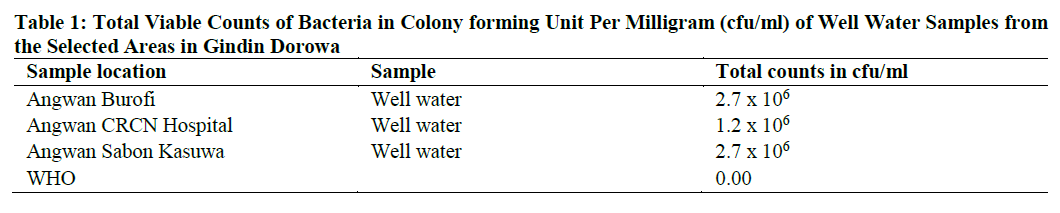
Water plays many different roles in daily life and is a vital component of human nutrition, either directly as drinking water or indirectly as a component of food. Water contamination poses a serious threat to the wellbeing of people globally. In Nigeria, there have been increasing cases of waterborne diseases owing to water contamination, thus becoming public health concerns. This study was carried out to investigate the physicochemical and bacteriological quality of well water samples in Gindin Dorowa community, Wukari local Government Area of Taraba State. Nine Well water samples were collected from three different locations (three samples from each location) and subjected to standard bacteriological and physicochemical analysis. The result for coliform count of the bacterial isolate revealed high levels of bacterial contamination across all samples. Well water samples showed higher contamination levels in two locations, with Angwan Burofi and Angwan Sabon Kasuwa both recording 2.7x10⁶ cfu/ml, while Angwan CRCN Hospital recorded 1.2x10⁶ cfu/ml. A total of 36 bacterial isolates were identified and Pseudomonas auroginosa had the highest occurrence of 12 while Shigella showed the least occurrence with 2 isolates. Among the locations, Angwan Burofi recorded the highest total bacterial occurrence, accounting for 15 out of 36 isolates (41.7%) followed by Angwan Sabon Kasuwa with 13 isolates (36.1%), while Angwan CRCN Hospital had the lowest occurrence with 8 isolates (22.2%).
References
Abubakar, B. S., Abdullah, A., Jones, A. N., & Hussaini, M. (2018). Assessment of public boreholes water quality in Maiduguri Metropolis. Arid Zone Journal of Engineering, Technology and Environment, 14(4), 639-637.
Akani, N. P., Amadi, L. O. and Amafina, I. M. (2021). Assessment of physicochemical and bacteriological quality of well water samples in Ido community, Nigeria. Microbiology Research Journal International, 31(1), 1-10. DOI: https://doi.org/10.9734/MRJI/2021/v31i130284
Al-Khatib, I. A., Al-Jabari, M., & Al-Oqaili, M. (2023). Assessment of bacteriological quality and physiochemical parameters of domestic water sources in Jenin governorate: a case study. Journal of Environmental and Public Health, 2023(1), 8000728. https://doi.org/10.1155/2023/8000728.
Caramujo, S., Abreu, R., Pereira, G., Cunha, E., Tavares, L., McFarlane, E. and Oliveira, M. (2026). Antimicrobial Resistance in Escherichia coli from Captive Wild Felids: Associations with Host and Management Factors. Veterinary Sciences, 13(2), 124. https://doi.org/10.3390/vetsci13020124
Cheesbrough, M. (2006). District laboratory practice in tropical countries (2nd ed., Chapter 7, pp. 62–70). New York, USA.
Cheesbrough, M. (2009). District laboratory practice in tropical countries (2nd ed., Chapter 7, pp. 132–304). New York, USA.
Collee, J. G., Barrie, P. M., Andrew, G. F. and Anthony, S. (2016). Mackie McCartney practical medical microbiology (4th ed., pp. 254–413). Singapore.
Dietrich, A. M. and Devesa, R. (2019). Characterization and removal of minerals that cause taste. Taste and odour in source and drinking water: causes, controls, and consequences, 113-142. https://doi.org/10.2166/9781780406664_0245
Elemile, O. O., Raphael, D. O., Omole, D. O., Oloruntoba, E. O., Ajayi, E. O., & Ohwavborua, N. A. (2019). Assessment of the impact of abattoir effluent on the quality of groundwater in a residential area of Omu-Aran, Nigeria. Environmental Sciences Europe, 31(1), 16. https://doi.org/10.1186/s12302-019-0201-5 13.
Ewusi A., Ahenkorah I., and Aikins D. (2021). Modelling of total dissolved solids in water supply systems using regression and supervised machine learning approaches. Applied Water Science, 11(2), 334–625. https://doi.org/10.1007/s13201-020-01352-7
França, A., Gaio, V., Lopes, N. and Melo, L. D. (2021). Virulence factors in coagulase-negative staphylococci. Pathogens, 10(2), 170. https://doi.org/10.3390/pathogens10020170
Garba, Y. I., Gano, U. T., Yusuuf, M. S. and Musa, D. M. (2018). Assessment of physicochemical and microbiological quality of borehole water in Dutse Metropolitan Jigawa State, Nigeria. Science World Journal, 13(3), 1-5.
Gonzalez, S., Lopez-Roldan, R. and Cortina, J. L. (2013). Presence of metals in drinking water distribution networks due to pipe material leaching: a review. Toxicological & Environmental Chemistry, 95(6), 870-889. https://doi.org/10.1080/02772248.2013.840372
Igwe, O., Ngwoke, M., Ukah, B. U., &Ubido, O. E. (2021). Assessment of the physicochemical qualities of groundwater and soils around oil- producing communities in Afam, area of Porthacourt, Niger Delta Nigeria. Applied Water Science, 11(4), 1-13. https://doi.org/10.1007/s13201-021-01393-6
Imam, N., Abdurrahman, N., Isah, L.A. and Lawal, O.S. (2023) Progress on Drinking Water Quality Monitoring in the Northern Part of Nigeria: A Catalyst to Achieving Sustainable Development Goals. FUDMA Journal of Sciences, 7(2): 152 - 158 https://doi.org/10.33003/fjs-2023-0702-1472
Kebede N. M., Mathapelo P. S., Ntebogeng S. M., Robert M. C., & Amjad A. S. (2018). Assessment of microbiology, physicochemical, water-soluble anions and elemental contents of water sediments of Bon Accord Dam, South Africa. Cogent Chemistry, 4(1). 2. https://doi.org/10.1080/23312009.2018.1560858
Khan, F. M. and Gupta, R. (2020). Escherichia coli (E. coli) as an Indicator of Fecal Contamination in Groundwater: A Review. In International Conference on Sustainable Development of Water and Environment (pp. 225-235). Cham: Springer International Publishing.
Kolawole OM, Afolayan O. Assessment of Groundwater quality in Ilorin, North Central Nigeria. Arid Zone J Eng, Technol Environ. 2017;13(1):111-126. 12.
Kubicz, J., Pawełczyk, A. and Lochyński, P. (2018). Environmental health risk posed by contamination of the individual water wells. Chemosphere, 208, 247-256. 10.1016/j.chemosphere.2018.05.182
Kwikima, M. M. (2025). Analyzing the presence of microbial contaminants in water sourced from shallow wells within Dodoma city, Tanzania. International Journal of Energy and Water Resources, 9(1), 1-12. https://doi.org/10.1007/s42108-024-00278-z
Malecki K. M., Schultz A. A., Severtson D. J., Anderson H. A., and VanDerslice J. A. (2017). Private-well stewardship among a general population-based sample of private well owners. Science of the Total Environment. 601, 1533–1543. 10.1016/j.scitotenv.2017.05.284
Mosuro, G. O., Omosanya, K. O., Bayewu, O. O., Oloruntola, M. O., Laniyan, T. A., Atobi, O. and Adekoya, F. (2017). Assessment of groundwater vulnerability to leachate infiltration using electrical resistivity method. Applied Water Science, 7(5), 2195-2207. https://doi.org/10.1007/s13201-016-0393-4
Nduka, J. K. C., Orisakwe, O. E., Ezenweke, L. O., Ezenwa, T. E., Chendo, M. N., & Ezeabasili, N. G. (2008). Acid rain phenomenon in Niger delta region of Nigeria: economic, biodiversity, and public health concern. The Scientific World Journal, 8(1), 811-818. https://doi.org/10.1100/tsw.2008.47
Nigam, V., Behl, N., and Kanchan, M. C. (2013). Physicochemical parameters for testing of water-a review. Int J Pharmacy Biological Sci, 3(3), 523-527.
Nwandkor, U. U. and Ifeanyi, O. E. (2015). Bacteriological assessment of different borehole drinking water sources in Umuahia Metropolis. International Journal of Current Microbiology and Applied Sciences, 4(5), 1139-1150.
Obuekwe, I. S., Oshoma, C. E. and Omorogbe, J. N. (2021). Evaluation of Physicochemical and Bacteriological Properties of Borehole Water in Selected Areas of Benin City, Edo State. Nigerian Journal of Life Sciences 11(1 & 2), 10-17. https://doi.org/10.52417/njls.v11i1%20&%202.59
Ocheli, A., Otuya, O. B., and Umayah, S. O. (2020). Appraising the risk level of physicochemical and bacteriological twin contaminants of water resources in part of the western Niger Delta region. Environmental Monitoring and Assessment, 192(5), 1-16. https://doi.org/10.1007/s10661-020-08302-5
Tula, M. Y., Enabulele, O. I., Ophori, E. A., and Aziegbemhin, A. S. (2022). A comprehensive study on the physicochemical characteristics of two water sources from the Adamawa North senatorial zone, Nigeria. Public Health Toxicology, 2(4), 1-13.
DOI: https://doi.org/10.18332/pht/158012
Tsor, J. O., Biam, J. T., Terver, D., Shimlumun, A.P. and Jombo, G.T.A. (2022). Assessment of Physico-chemical Parameters and Heavy Metal Concentrations in Well Water of Logo-2 Area of Makurdi, Nigeria. Nigerian Annals of Pure and Applied Sciences, 5(1):137-148 https://doi.org/10.5281/zenodo.6905019
Serwecińska, L. (2020). Antimicrobials and antibiotic-resistant bacteria: a risk to the environment and to public health. Water, 12(12), 3313. https://doi.org/10.3390/w12123313
Shar, A.T., Onekutu, A.A., Ebah, E.E., and Olasan, J.O. (2021) Assessment of Seasonal Variation in Relation to Physicochemical Properties of Water from Hand Dug Wells near Soakaway Pits in Vandeikya, Benue State, Nigeria. International Journal of Research Publication and Reviews 2(7):1960-1965
Singh, G., Singh, A., Singh, P., Shukla, R., Tripathi, S. and Mishra, V. K. (2021). The fate of organic pollutants and their microbial degradation in water bodies. Pollutants and water management: resources, strategies and scarcity, 210-240. https://doi.org/10.1002/9781119693635.ch9
World Health Organization (WHO) (2009). Global health risk: Mortality and burden of disease attributable to selected major risks. Geneva: WHO. Available: http://www.who.int/healthinfo/global burden-disease/GlobalHealthRisks-report full.pdf
WHO (2024) Guidelines for drinking-water quality: small water supplies. Geneva: World Health Organization; icence: CC BY-NC-SA 3.0 IGO, p viii - 175
World Health Organization (2017). Guidelines for drinking-water quality. WHO Press, Geneva. Switzerland, 4th edition.
Zimoch, I. and Paciej, J. (2020). Use of water turbidity as an identifier of microbiological contamination in the risk assessment of water consumer health. Desalination and Water Treatment, 199, 499-511. 10.5004/dwt.2020.26426
Downloads
Published
Issue
Section
Categories
License
Copyright (c) 2026 Mary Obioha, Mohammed Muslim Tanko, Aji Gani Mairiga, Tundeno Barde Danfulloh, Abdulkarim Hashim, Ibrahim Danazumi Abdul, Ugwu Immaculata Chidiebere, Ugwu Immaculata Chidiebere, Inuwa Calvin Chitwas

This work is licensed under a Creative Commons Attribution 4.0 International License.


