
Bacteriological and Physicochemical Assessment of Borehole in Gindin Dorowa, Wukari Local Government Area, Taraba State, Nigeria
DOI:
https://doi.org/10.33003/fjs-2026-1021-6349Keywords:
Borehole Water, Bacteriological Quality, Physicochemical Properties, GroundwaterAbstract
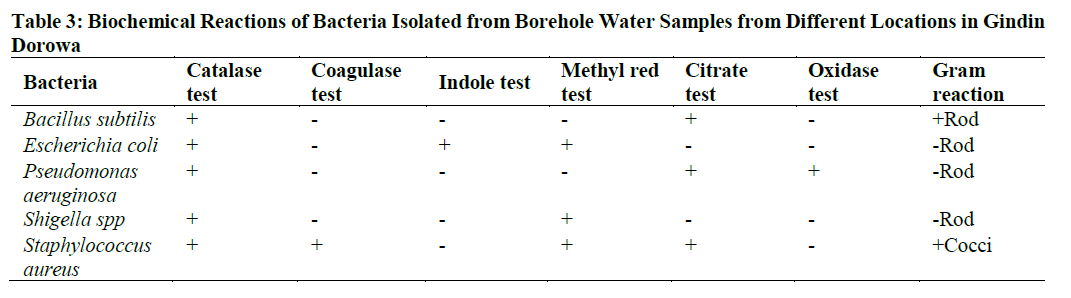
Groundwater from boreholes constitutes the primary source of domestic water in many rural communities of Nigeria. This study assessed the bacteriological and physicochemical quality of borehole water in Gindin Dorowa, Wukari Local Government Area, Taraba State, Nigeria. Water samples were collected in triplicate from three boreholes in Angwan Burofi (N07°52'15.3" E009°47'12.1"), Angwan CRCN Hospital (N07°52'21.8" E009°47'18.6") and Angwan Sabon Kasuwa (N07°52'28.4" E009°47'25.2"), Gindin Dorowa (central coordinate: 7.8704°N, 9.7785°E), using sterile sample containers. Standard microbiological procedures, including serial dilution, pour plate technique, Gram staining, colony morphology, and biochemical characterization (catalase, coagulase, indole, methyl red, citrate utilization, oxidase) were employed for bacterial isolation and identification. Physicochemical parameters comprising pH, temperature, electrical conductivity, turbidity, total dissolved solids (TDS), and dissolved oxygen (DO) were determined using standard analytical methods recommended by WHO and UNICEF, with each method described separately. Results showed total viable counts ranging from 2.0×10⁶ cfu/ml (Angwan Sabon Kasuwa) to 2.6×10⁶ cfu/ml (Angwan CRCN Hospital), far exceeding WHO/SON limit of <1×10² cfu/ml. Five bacterial species were isolated: Bacillus subtilis, Escherichia coli, Pseudomonas aeruginosa, Shigella spp., and Staphylococcus aureus, with E. coli indicating recent faecal contamination. Physicochemical analysis revealed pH values of 6.1-6.7 (below WHO 6.5-8.5), turbidity 40-56 NTU (above WHO ≤5 NTU), while electrical conductivity (19.6-30.1 µS/cm) and TDS (428.6-474.1 mg/L) were within WHO limits (1000 µS/cm and 500 mg/L respectively). The borehole water is severely contaminated and unfit for consumption without treatment
References
Abdelaziz, A. A., Kamer, A. M. A., Al-Monofy, K. B. and Al-Madboly, L. A. (2023). Pseudomonas aeruginosa greenish-blue pigment pyocyanin: its production and biological activities. Microbial Cell Factories, 22(1), 110. https://doi.org/10.1186/s12934-023-02122-1
Adamu, S. U., Saliu, O. A., Okoroiwu, G., and Ebhodaghe, F. (2024). Physio-chemical and microbial assessment of the source of drinking water and the prevailing waterborne diseases in Gwagwalada Municipal Area Council of Abuja, Nigeria. Dutse Journal of Pure and Applied Sciences, 10(3c), 113-127. https://doi.org/10.4314/dujopas.v10i3c.10
Akib Jabed, M., Paul, A. and Nath, T. K. (2020). People’s perception of the water salinity impacts on human health: a case study in south-eastern coastal region of Bangladesh. Exposure and health, 12(1): 41-50. https://doi.org/10.1007/s12403-018-0283-0
APHA (1995). Standard method for examination of water and waste water. 19th Edition, Published by E and FN Poan, Washington D.C, 2-56.
Atuanya, E.I., Adeghe, O.M. and Iyahen, E. (2018). Effects of storage on borehole water quality stored in plastic containers for prolong periods. Journal of Applied Science and Environmental Management, 22 (12): 1925-1930. doi. https://doi.org/10.4314/jasem.v22i12.9
Bhatt, S. and Srinivasan, M. (2019). Analysis of physicochemical parameters at Koliyak coast. International Journal of Fisheries and Aquatic Studies, 7(4): 246-247.
Caramujo, S., Abreu, R., Pereira, G., Cunha, E., Tavares, L., McFarlane, E. and Oliveira, M. (2026). Antimicrobial Resistance in Escherichia coli from Captive Wild Felids: Associations with Host and Management Factors. Veterinary Sciences, 13(2), 124. https://doi.org/10.3390/vetsci13020124
Chakraborty, S. K. (2021). Water: Its properties, distribution, and significance. In Riverine Ecology Eco-functionality of the Physical Environment of Rivers. Volume 1: (pp. 23-55). https://doi.org/10.1007/978-3-030-53897-2_2
Cheesbrough, M. (2009). District laboratory practice in tropical countries (2nd ed., Chapter 7, pp. 132–304). New York, USA.
Clayton, G. E., Thorn, R. M. and Reynolds, D. M. (2021). The efficacy of chlorine-based disinfectants against planktonic and biofilm bacteria for decentralised point-of-use drinking water. Nature Partner Journal Clean Water, 4(1), 48. https://doi.org/10.1038/s41545-021-00139-w
Collee, J. G., Barrie, P. M., Andrew, G. F. and Anthony, S. (2016). Mackie McCartney practical medical microbiology (4th ed., pp. 254–413). Singapore.
Dhaouadi, L., Besser, H., Karbout, N., Wassar, F. and Alomrane, A. R. (2021). Assessment of natural resources in tunisian Oases: degradation of irrigation water quality and continued overexploitation of groundwater. Euro-Mediterranean Journal for Environmental Integration, 6(1): 36. https://doi.org/10.1007/s41207-020-00234-3
Dietrich, A. M. and Devesa, R. (2019). Characterization and removal of minerals that cause taste. Taste and odour in source and drinking water: causes, controls, and consequences, 113-142. https://doi.org/10.2166/9781780406664_0245
Eneje, F.I. and Ogoko, E. C. (2025). Physicochemical Properties of Borehole Water Within the Vicinity of Karu Municipal, Nasarawa State. Journal of Chem. Soc. Nigeria, Vol. 50, No. 5, pp 929 – 938. https://dx.doi.org/10.4314/jcsn.v50i5.2
França, A., Gaio, V., Lopes, N. and Melo, L. D. (2021). Virulence factors in coagulase-negative staphylococci. Pathogens, 10(2), 170. https://doi.org/10.3390/pathogens10020170
Garba, Y. I., Gano, U. T., Yusuuf, M. S. and Musa, D. M. (2018). Assessment of physicochemical and microbiological quality of borehole water in Dutse Metropolitan Jigawa State, Nigeria. Science World Journal, 13(3), 1-5.
Hamid, A., Bhat, S. U. and Jehangir, A. (2020). Local determinants influencing stream water quality. Applied Water Science, 10(1): 1-16 https://doi.org/10.1007/s13201-019-1043-4
Ibearugbulam, H. O., Ugwu, E. I., Ekeleme, A. C., Njoku, C. E., Amanamba, E. C., Ezebuiro, V. and Igwegbe, E. W. (2021). A study on physicochemical parameters of fish pond effluents: A case study of Umudibia fish farm. IOP Conference Series: Materials Science and Engineering, 1036(1): 012005. DOI https://doi.org/10.1088/1757-899X/1036/1/012005
Khan, F. M. and Gupta, R. (2020). Escherichia coli as an Indicator of Fecal Contamination in Groundwater: A Review. In International Conference on Sustainable Development of Water and Environment (pp. 225-235). https://doi.org/10.1007/978-3-030-45263-6_21
Kristanti, R. A., Hadibarata, T., Syafrudin, M., Yılmaz, M. and Abdullah, S. (2022). Microbiological contaminants in drinking water: Current status and challenges. Water, Air and Soil Pollution, 233(8): 299. https://doi.org/10.1007/s11270-022-05698-3
Kumar, S., Prasad, S., Yadav, K. K., Shrivastava, M., Gupta, N., Nagar, S. and Malav, L. C. (2019). Hazardous heavy metals contamination of vegetables and food chain: Role of sustainable remediation approaches-A review. Environmental Research, 179: 108792. 10.1016/j.envres.2019.108792
Nicholas, C.E., Christabel, A. O., Macanthony, N. E and Jennifer, U.E. (2022). Bacteriological assessment of borehole water in some communities in Owerri West, Southeastern Nigeria. GSC Biological and Pharmaceutical Sciences, 18(03), 177–181. DOI: https://doi.org/10.30574/gscbps.2022.18.3.0115
Obuekwe, I. S., Oshoma, C. E. and Omorogbe, J. N. (2021). Evaluation of Physicochemical and Bacteriological Properties of Borehole Water in Selected Areas of Benin City, Edo State. Nigerian Journal of Life Sciences 11(1 & 2), 10-17. https://doi.org/10.52417/njls.v11i1%20&%202.59
Obunadike, C. and Akerele, D. D. (2023). Assessment of physicochemical and bacteriological parameters of borehole water: a case study from Lekki, Lagos, Nigeria. Journal of Sensor Networks and Data Communications. DOI: https://doi.org/10.21203/rs.3.rs-3091423/v1
Pathan, M. A., Lashari, R. A. and Maira, M. (2018). Physical and chemical contamination studies of drinking water in the vicinity of Jamshoro area (Jetharo Village) Sindh, Pakistan. International Journal of Engineering Science, 17985. http://ijesc.org/
Pereira, M. A., Palmeira, J. D. and Ferreira, H. (2023). Contamination of a water stream and water drainage reaching Matosinhos Beach by antibiotic-resistant Bacteria. Microorganisms, 11(12), 2833. https://doi.org/10.3390/microorganisms11122833
Saad, S. M. (2025). Isolation and Diagnoses Escherichia coli from Patients at Hospital in Baghdad. Iraqi Journal of Scientific and Industrial Research, 4(2), 37-40.
Sachdev, J. (2015). Isolation and Characterisation of Shigella from Diarrheal Stool Samples Received in a Tertiary Care Hospital, and Determination of Antimicrobial Susceptibility (Doctoral dissertation, Rajiv Gandhi University of Health Sciences (India)).
Serwecińska, L. (2020). Antimicrobials and antibiotic-resistant bacteria: a risk to the environment and to public health. Water, 12(12), 3313. https://doi.org/10.3390/w12123313
Singh, G., Singh, A., Singh, P., Shukla, R., Tripathi, S. and Mishra, V. K. (2021). The fate of organic pollutants and their microbial degradation in water bodies. Pollutants and water management: resources, strategies and scarcity, 210-240. https://doi.org/10.1002/9781119693635.ch9
Singh, S. K., Kanth, M. K., Kumar, D., Raj, R., Kashyap, A., Jha, P. K. and Kumar, S. (2017). Physicochemical and bacteriological analysis of drinking water samples from urban area of Patna District, Bihar, India. International Journal of Life Sciences Scientific Research (IJLSSR) 3(5): 1355-1359. DOI: https://doi.org/10.21276/ijlssr.2017.3.5.15
Tenebe, I. T., Babatunde, E. O., Ogarekpe, N. M., Emakhu, J., Etu, E. E., Edo, O. C. and Benson, N. U. (2024). Detection and measurement of bacterial contaminants in stored river water consumed in Ekpoma. Water, 16(18), 2696. https://doi.org/10.3390/w16182696
Ukaogo, P. O., Ewuzie, U. and Onwuka, C. V. (2020). Environmental pollution: causes, effects, and the remedies. In Microorganisms for sustainable environment and health. Elsevier. (pp. 419-429). 10.1016/B978-0-12-819001-2.00021-8
Viban, T. B., Herman, O. N. N., Layu, T. C., Madi, O. P., Nfor, E. N., Kingsly, M. T. and Albert, N. (2021). Risk factors contributing to microbiological contamination of boreholes and hand dug wells water in the Vina Division, Adamawa, Cameroon. Advances in Microbiology, 11(2), 90-108. DOI: 10.4236/aim.2021.112007
World Health Organization (WHO) (2011). Guidelines for drinking water quality, (4th ed.). Geneva: WHO Press.
World Health Organization (2017). Guidelines for drinking-water quality. WHO Press, Geneva. Switzerland, 4th edition.
World Health Organization (2018). WHO Housing and Health Guidelines. Geneva: Table 8.3, WHO guideline values for drinking-water quality: bacteria. Available from: https://www.ncbi.nlm.nih.gov/books/NBK535301/table/ch8.tab3/Accessed on 30/5/2024.
Wu, Y., Wang, S., Ni, Z., Li, H., May, L. and Pu, J. (2021). Emerging water pollution in the world’s least disturbed lakes on Qinghai-Tibetan Plateau. Environmental Pollution, 272, 116032. 10.1016/j.envpol.2020.116032
Zimoch, I. and Paciej, J. (2020). Use of water turbidity as an identifier of microbiological contamination in the risk assessment of water consumer health. Desalination and Water Treatment, 199, 499-511. 10.5004/dwt.2020.26426
Downloads
Published
Issue
Section
Categories
License
Copyright (c) 2026 Mary Obioha, Muslim M. Tanko, Abdulkarim Hashim, Abdul D Ibrahim, Audu Kingsley, Iliya Andesiye, Ugwu I. Chidiebere, Inuwa Calvin Chitwas

This work is licensed under a Creative Commons Attribution 4.0 International License.


