
Molecular Docking and Admet Profiling of Allium cepa Phytochemicals against Human Pancreatic α-Amylase and Lysosomal Acid α-Glucosidase in Diabetic Management
DOI:
https://doi.org/10.33003/fjs-2026-1023-6563Keywords:
Allium cepa, α-amylase, molecular docking, admet, in silico screeningAbstract
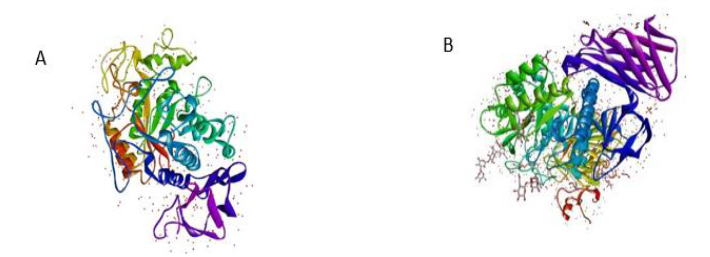
Diabetes mellitus is a major global health challenge, and inhibition of carbohydrate-digesting enzymes is one strategy for controlling postprandial hyperglycaemia in type 2 diabetes. Allium cepa (onion) contains diverse phytochemicals, but their predicted enzyme-binding and drug-related properties remain poorly characterised. This study aimed to evaluate the predicted binding affinities and pharmacokinetic properties of selected Allium cepa phytochemicals against human pancreatic α-amylase (PDB ID: 1HNY) and lysosomal acid α-glucosidase (GAA; PDB ID: 5NN4), the latter used as a structural representative of the GH31 α-glucosidase family. A total of 181 reported phytochemicals were docked using AutoDock Vina in PyRx, with acarbose and miglitol as reference compounds, after validating the protocol by redocking (RMSD 1.14 and 1.20 Å). Top-ranked compounds were further assessed for ADMET properties (ADMETlab 3.0), drug-likeness and oral bioavailability (SwissADME), and predicted activity spectra (PASS). Daucosterol (−9.7 kcal/mol), quercetin (−8.6 kcal/mol), 2,3-dihydroflavon-3-ol, taxifolin, isorhamnetin: −8.5 kcal/mol scored better than acarbose (−6.5 kcal/mol) against α-amylase, while daucosterol (−8.2 kcal/mol) and quercetin (−7.9 kcal/mol) scored better than acarbose (−6.9 kcal/mol) against GAA. Hits interacted with catalytic-site residues, including Asp197, Glu233 and Asp300 of α-amylase. Most hits satisfied Lipinski’s rule with no more than one violation and showed acceptable predicted ADMET profiles, although daucosterol is large and poorly soluble. These are computational predictions only; molecular dynamics, in vitro enzyme assays, and testing against intestinal α-glucosidases (maltase-glucoamylase and sucrase-isomaltase) are recommended
References
Abdul-Hammed, M., Adedotun, I. O., Olajide, M., Irabor, C. O., Afolabi, T. I., Gbadebo, I. O., Rhyman, L., & Ramasami, P. (2021). Virtual screening, ADMET profiling, PASS prediction, and bioactivity studies of potential inhibitory roles of alkaloids, phytosterols, and flavonoids against COVID-19 main protease (Mpro). Natural Product Research, 36(12), 3110-3116. https://doi.org/10.1080/14786419.2021.1935933
Adelusi, T. I., Oyedele, A.-Q. K., Boyenle, I. D., Ogunlana, A. T., Adeyemi, R. O., Ukachi, C. D., Idris, M. O., Olaoba, O. T., Adedotun, I. O., Kolawole, O. E., Xiaoxing, Y., & Abdul-Hammed, M. (2022). Molecular modeling in drug discovery. Informatics in Medicine Unlocked, 29, 100880. https://doi.org/10.1016/j.imu.2022.100880
ADMETlab. (n.d.). Explanation of ADMET endpoints – ADMETlab 3.0. SCBDD. Retrieved September 26, 2025, from https://admetlab3.scbdd.com/explanation/
Ahmed, M. U., Ibrahim, A., Dahiru, N. J., & Mohammed, H. S. (2020). Alpha Amylase Inhibitory Potential and Mode of Inhibition of Oils from Allium sativum (Garlic) and Allium cepa (Onion). Clinical Medicine Insights: Endocrinology and Diabetes, 13. https://doi.org/10.1177/1179551420963106
Bello I.A., Abdul-Hammed, M., John, A., Ismail, U., & Salis, M. (2025). In silico Analysis of Anti-asthmatic Potential of Phytochemicals from Moringa oleifera against S-nitrosoglutathione reductase and Interleukin-13. International Journal of Chemistry and Chemical Processes E-ISSN, 11(1), 2025. https://doi.org/10.56201/ijccp.v11.no1.2025.pg19.56
Brayer, G. D., Luo, Y., & Withers, S. G. (1995). The structure of human pancreatic α-amylase at 1.8 Å resolution and comparisons with related enzymes. Protein Science, 4(9), 1730–1742. https://doi.org/10.1002/pro.5560040908
Deshmukh, C. D., & Jain, A. (2015). Diabetes Mellitus: A Review. In Int. J. Pure App. Biosci (Vol. 3, Issue 3). www.ijpab.com
Durmaz, L., Kiziltas, H., Karagecili, H., Alwasel, S., & Gulcin, İ. (2023). Potential antioxidant, anticholinergic, antidiabetic and antiglaucoma activities and molecular docking of spiraeoside as a secondary metabolite of onion (Allium cepa). Saudi Pharmaceutical Journal, 31(10). https://doi.org/10.1016/j.jsps.2023.101760
Falade, V. A., Adelusi, T. I., Adedotun, I. O., Abdul-Hammed, M., Lawal, T. A., and Agboluaje, S. A. (2021). In silico investigation of saponins and tannins as potential inhibitors of SARS-CoV-2 main protease (Mpro). In silico Pharmacology, 9(1), 1-15.
Fu, L., Shi, S., Yi, J., Wang, N., He, Y., Wu, Z., Peng, J., Deng, Y, Wang, W., Wu, C., Lyu, A., Zeng, X., Zhao, W., Hou, T., & Cao, D. (2024). ADMETlab 3.0: An updated comprehensive online ADMET prediction platform enhanced with broader coverage, improved performance, API functionality and decision support. Nucleic Acids Research, 52(W1), W422–W431. https://doi.org/10.1093/nar/gkae236
GBD 2021 Diabetes Collaborators. (2023). Global, regional, and national burden of diabetes from 1990 to 2021, with projections of prevalence to 2050: A systematic analysis for the Global Burden of Disease Study 2021. The Lancet, 402(10397), 203–234. https://doi.org/10.1016/S0140-6736(23)01301-6
Halim, S. A., Lodhi, H. W., Waqas, M., Khalid, A., Abdalla, A. N., Khan, A., & Al-Harrasi, A. (2023). Targeting α-amylase enzyme through multi-fold structure-based virtual screening and molecular dynamic simulation. Journal of Biomolecular Structure and Dynamics, 41(15), 5617–5630. https://doi.org/10.1080/07391102.2023.2227721
Hassan, S., Channar, P. A., Larik, F. A., Saeed, A., Shah, H. S., Lecka, J., Sévigny, J., & Iqbal, J. (2018). Synthesis of novel (E)-1-(2-(2-(4(dimethylamino) benzylidene) hydrazinyl)-4methylthiazol-5-yl)ethanone derivatives as ecto-50nucleotidase inhibitors. Royal Society Open Science, 5(9). https://doi.org/10.1098/rsos.180837
Hedrington, M. S., & Davis, S. N. (2019). Considerations when using alpha-glucosidase inhibitors in the treatment of type 2 diabetes. Expert Opinion on Pharmacotherapy, 20(18), 2229–2235. https://doi.org/10.1080/14656566.2019.1672660
Hossain, M. J., Al-Mamun, M., & Islam, M. R. (2024). Diabetes mellitus, the fastest growing global public health concern: Early detection should be focused. In Health Science Reports (Vol. 7, Issue 3). John Wiley and Sons Inc. https://doi.org/10.1002/hsr2.2004
Ibironke A., Abdul-Hammed, M., Bello, M., Ismail, U., & Oladepo, M. (n.d.). Avocado Fruit Peel as a Source of Antidiabetic drugs: Evidence from Molecular Docking Studies and ADMET Profiling Article in INTERNATIONAL JOURNAL OF CHEMISTRY AND CHEMICAL PROCESSES · December 2024. https://doi.org/10.56201/ijccp.v10.no6.2024.pg17.39
Ikem, D., Buzugbe, S., Okubor, P., & Michael, O. (2026). Comparative in silico ADMET Analysis of Berberine and Piperine: A rationale for combinatorial therapy to overcome p-glycoprotein-mediated efflux. fudma journal of sciences, 10(6), 16-20.
Lipinski, C.A. (2004). Lead profiling Lead-and drug-like compounds: the rule of five revolution, Drug Discovery Today, 1(4):337-341
Manhas, D., Dhiman, S., Kour, H., Kour, D., Sharma, K., Wazir, P., Vij, B., Kumar, A., Sawant, S. D., Ahmed, Z., & Nandi, U. (2024). ADME/PK Insights of Crocetin: A Molecule Having an Unusual Chemical Structure with Druglike Features. ACS Omega, 9(19), 21494–21509. https://doi.org/10.1021/acsomega.4c02116
Maulana, A. F., Sriwidodo, S., Rukayadi, Y., & Maksum, I. P. (2022). In silico study of mangostin compounds and its derivatives as inhibitors of α-glucosidase enzymes for anti-diabetic studies. Biology, 11(12), 1837. https://doi.org/10.3390/biology11121837
Ogunyemi, B. T., Abdul-Hammed, M., Adedotun, I. O., Egunjobi, B. T., Badmos, S. T., Adegboyega, T. A., Aderogba, A. A., & Adeosun, G. G. (2025). Protein–ligand molecular dynamics simulation (PL-MDS), ADMET analyses, and bioactivity studies of phytochemicals from Aloe Vera: an In-Silico novel antidiabetics drug discovery effort. Discover Chemistry, 2(1). https://doi.org/10.1007/s44371-025-00130-1
Roig-Zamboni, V., Cobucci-Ponzano, B., Iacono, R., Ferrara, M. C., Germany, S., Bourne, Y., Parenti, G., Moracci, M., & Sulzenbacher, G. (2017). Structure of human lysosomal acid α-glucosidase: A guide for the treatment of Pompe disease. Nature Communications, 8, Article 1111. https://doi.org/10.1038/s41467-017-01263-3
Sharma, P., Joshi, T., Joshi, T., Chandra, S., & Tamta, S. (2020). In silico screening of potential antidiabetic phytochemicals from Phyllanthus emblica against therapeutic targets of type 2 diabetes. Journal of Ethnopharmacology, 248. https://doi.org/10.1016/j.jep.2019.112268
Sim, L., Quezada-Calvillo, R., Sterchi, E. E., Nichols, B. L., & Rose, D. R. (2008). Human intestinal maltase–glucoamylase: Crystal structure of the N-terminal catalytic subunit and basis of inhibition and substrate specificity. Journal of Molecular Biology, 375(3), 782–792.
Sim, L., Willemsma, C., Mohan, S., Naim, H. Y., Pinto, B. M., & Rose, D. R. (2010). Structural basis for substrate selectivity in human maltase-glucoamylase and sucrase-isomaltase N-terminal domains. Journal of Biological Chemistry, 285(23), 17763–17770. https://doi.org/10.1074/jbc.M109.078980
Shoily, M. S. A., Islam, M. E., Rasel, N. M., Parvin, S., Barmon, J., Aqib, A. H., Roy, D. N., & Parvin, M. S. (2025). Unveiling the biological activities of Heliotropium indicum L. plant extracts: Anti-inflammatory activities, GC–MS analysis, and in silico molecular docking. Scientific Reports, 15, 3285. https://doi.org/10.1038/s41598-024-79559-w
Sofian S. Mohamed, Salah M. Bensaber, Nisreen H. Meiqal, Anton Hermann, Abdul M. Gbaj, (2025), Design and In-Silico Evaluation of Pyridine-4-Carbohydrazide Derivatives for Potential Therapeutic Applications, J, Surgical Case Reports and Images, 8(3); DOI:10.31579/26901897/235
Stoica, F., Aprodu, I., Enachi, E., Stănciuc, N., Condurache, N. N., Duță, D. E., Bahrim, G. E., & Râpeanu, G. (2021). Bioactive’s characterization, biological activities, and in silico studies of red onion (Allium cepa L.) skin extracts. Plants, 10(11). https://doi.org/10.3390/plants10112330
Sunday, A. O., Abdullahi, S., Gabriel, O. K., Moses, O., & Banjo, S. (2025). In silico Investigations of Triazole-Tromethoxyphenyl Derivatives as Anti-Proliferative Agents against Adenocarcinomic Human Alveolar Basal Epithelial Cells (A549): DFT, QSAR and Molecular Docking Approaches. Kharkov University Bulletin Chemical Series, 44, 6–25. https://doi.org/10.26565/2220-637x-2025-44-01
Vivek-Ananth, R. P., Mohanraj, K., Sahoo, A. K., & Samal, A. (2023). IMPPAT 2.0: An enhanced and expanded phytochemical atlas of Indian medicinal plants. ACS Omega, 8(8), 8827–8845. https://doi.org/10.1021/acsomega.3c00156
Zainab, B., Ayaz, Z., Alwahibi, M. S., Khan, S., Rizwana, H., Soliman, D. W., Alawaad, A., & Mehmood Abbasi, A. (2020). In-silico elucidation of Moringa oleifera phytochemicals against diabetes mellitus. Saudi Journal of Biological Sciences, 27(9), 2299–2307. https://doi.org/10.1016/j.sjbs.2020.04.002
Downloads
Published
Issue
Section
Categories
License
Copyright (c) 2026 Ubeydat Temitope Ismail, Ubeydat Temitope Ismail, Al-amin Adeshina Biliaminu, Muhammad Adesina Sharafuddeen, Fasasi Yusuf Olaniyi, Aishat Ayomide Alabi, Firdaus Toyin Makinde

This work is licensed under a Creative Commons Attribution 4.0 International License.


